Have you ever wondered how some businesses seem to pop up in your feed right when you need them? That's the power of social media ads.
Imagine you could drop a flyer for your plumbing business directly into the letterboxes of homes in a certain part of London, but only the ones where the owners are thinking about a big home project. That’s what social media ads do, but on a screen. They let you show paid messages on sites like Facebook and Instagram and talk right to your best customers.
What Social Media Ads Mean for Your Business
Think about old-style ads—like in a newspaper, on a billboard, or on the radio. It's like shouting your message from a rooftop and hoping the right person walks by. You pay a lot to reach everyone, but most of them do not need you.
Social media ads are the opposite. Forget shouting. This is more like being introduced to someone who is already looking for what you sell.
For local UK businesses, this is a big deal. It stops you from wasting money on ads that do not work. It lets you aim your message at the right people. It’s how you turn being online into a steady stream of real jobs.
Why They Work for UK Tradespeople
At the end of the day, the only thing that matters for a service business is getting the phone to ring. That’s what social media ads are made for. This is not about getting 'likes'; it’s about getting real leads that turn into real money.
Here’s how it helps your business grow:
- Find Customers Nearby: Show your ads only to people in the areas you serve, whether that’s a few streets in Manchester or all of North London.
- Build Local Trust: Good, helpful ads make your business look like the local expert people can trust.
- Get More Quote Requests: You can put a "Call Now" or "Get Quote" button right on the ad. This makes it very easy for people to contact you.
- Control Your Spending: You decide how much to spend each day. There are no surprises and no big bills. You are always in charge.
The real magic of social media ads for a small business is not just reaching more people. It's about reaching the right people, in the right place, at the right time.
This guide will explain it all in simple words. We'll show you how to use these tools to get more local leads, build trust in your town, and get a good return on your ad money. You do not need to be a tech expert to make this work.
Choosing The Right Place For Your Trades Business
Not all social media sites are the same, especially when you’re a UK tradesperson trying to get the phone to ring. Picking the right one is like choosing the right tool for the job. You would not use a big hammer to hang a picture, would you?
This guide gets straight to what works. We want one thing: to get you more phone calls and quote requests. It’s all about putting your time and money where it will help your business.
At the end of the day, all these sites are just a way to get your business in front of real customers who need your help.
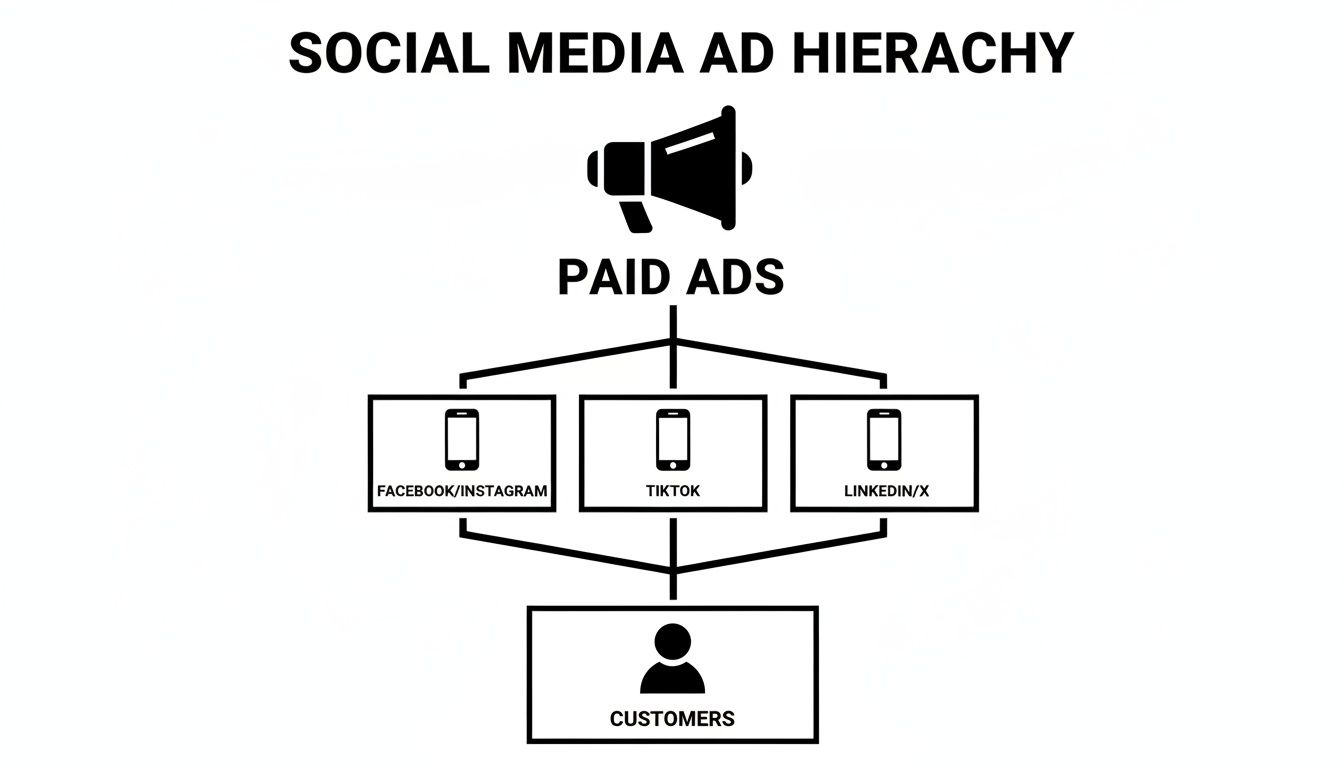
The goal of your social media ads is simple: connect your business with people who are ready to hire you.
Facebook And Instagram: The Best All-Rounders
For most local service businesses in the UK, Facebook and Instagram are your best bet. Think of them as the Swiss Army knife of social media ads. They’re perfect for reaching local homeowners because that’s where people spend their time online every day.
Let’s say you’re an electrician in Bristol. You can run ads that only show up for people living in certain postcodes like Clifton or Redland. This stops you from wasting money advertising to someone in another city. You can be very exact, which saves you money and brings in better leads. For more help, a good guide on Instagram marketing for small businesses can show you what to do.
The numbers prove it. In early 2025, the UK had 57.6 million social media users – that's a huge 84.5% of all people. With so many people scrolling, it's a goldmine for any local tradesperson. It’s no surprise that many UK businesses are already running Facebook ads to find customers right in their own area.
TikTok: Perfect For Showing Off Your Work
Is your work easy to see? If you're a landscaper, builder, painter, or tiler, TikTok can be a game-changer. It's made for short, quick videos that get attention fast.
Imagine this: a landscaper in Leeds posts a quick 15-second video. It shows a messy, overgrown garden changing into a lovely outdoor space. Seeing this is very powerful. You’re not just telling people you do great work—you’re showing them.
A great before-and-after video can get your phone ringing much faster than a flyer or a photo. These videos do not need to be fancy. A quick clip from your phone often feels more real and trustworthy to people.
LinkedIn: The Best Bet For B2B Services
What if your best customers are other businesses, not homeowners? If you run a commercial cleaning company, an IT support service, or an office design firm, then LinkedIn is where you need to be.
LinkedIn is the online place for professionals. It lets you target people based on their job title, the industry they work in, or the size of their company. A commercial painter in Birmingham, for instance, could run ads that are shown only to office managers or property developers in the city centre. It’s very precise.
To help you decide, here's a quick look at the top sites for UK service businesses.
Which Social Platform Is Best for Your UK Business
| Platform | Best For | Example Business |
|---|---|---|
| Facebook & Instagram | Reaching local homeowners and the general public (B2C). | A plumber in Glasgow aiming ads at families in certain areas. |
| TikTok | Trades that can show their results with pictures or videos. | A painter in Sheffield showing a before-and-after of a house. |
| Services for other businesses and professionals (B2B). | An office cleaning service in London reaching building managers. |
Choosing the right site is the first big step. Match the site to your ideal customer, and you give your business the best chance to connect with people ready to hire you. For more ideas on finding local customers, check out our guide on the different types of digital campaigns.
Finding Your Ideal Customers With Smart Targeting
Making a great social media ad is only half the job. The real magic happens when you get that ad in front of the right people. This is called targeting. It’s how you stop shouting to no one and start talking to your future customers.
Think of it like this. You could put a flyer on every car in the city. Or, you could hand-deliver it only to the homes you know need your help. You spend your money better and only reach people who are likely to call you.
For a local service business in the UK, this is a huge help. It means the calls you get are for the jobs you want, in the areas you are happy to drive to.
Who Are You Trying to Reach?
Before you spend a single pound, you need a clear picture of your ideal customer. Sites like Facebook and Instagram have tools that let you build a special audience based on certain details.
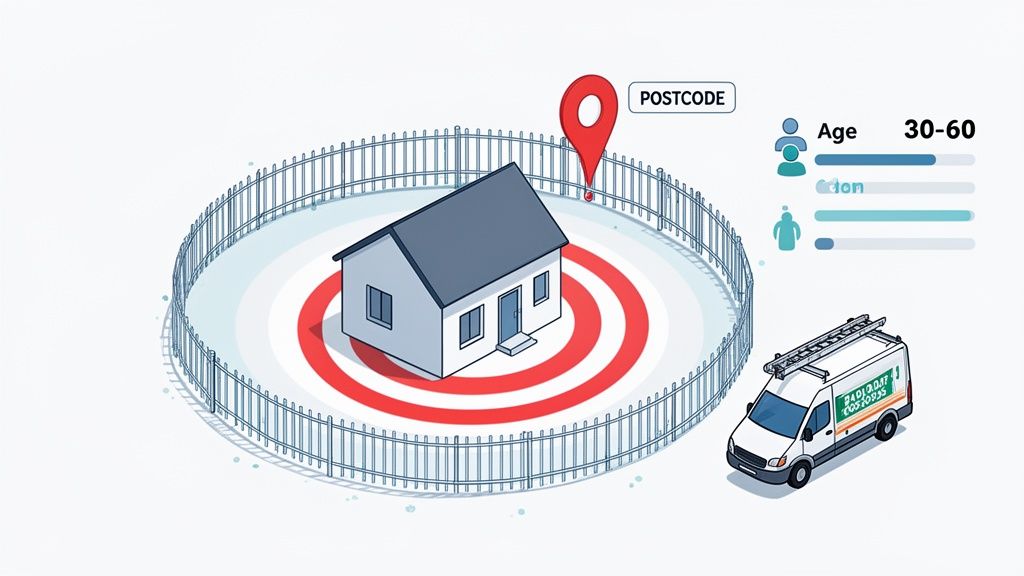
You can mix different options to find a very specific group. For example, a roofer in Liverpool could tell Facebook to show their ads only to:
- Homeowners (this leaves out renters who can't approve repairs)
- People aged 35 to 65 (the group most likely to own and look after a home)
- Those living in older areas known for needing roof work, like Aigburth or Woolton
Just like that, you’ve filtered out thousands of people who would never need you. This makes every penny of your ad money work harder.
Drawing a Digital Fence Around Your Service Area
One of the best tools for any UK tradesperson is location targeting. This lets you draw a virtual fence around the exact areas you work in. No more calls from the other side of town for a job that is not worth the travel.
You can go as big as the whole of Greater Manchester or get very specific. You can draw a tight circle around a few key areas like Didsbury, Chorlton, and Sale. This gives you full control. It makes sure you only get calls for jobs that make you money and are easy to get to.
Targeting is not just about finding customers; it's about finding the best customers. It’s the difference between a random call from far away and a call from your ideal client who lives five minutes down the road.
This kind of exact aiming is something old ads like newspapers or radio could never do. It puts you in charge.
Finding People Based on Their Interests and Habits
You can also target people based on what they like and what they do online. This is where you find people who are already thinking about what you offer.
Take a landscaper in Cardiff, for example. They could target people who have shown an interest in:
- Home improvement shows like Grand Designs or magazines like Ideal Home
- Big DIY shops like B&Q or Wickes
- Facebook pages or groups about garden design and outdoor living
This works because the sites see what pages people like and what posts they look at. By targeting these interests, you are not bothering them. You are joining a chat that is already on their mind.
To get a head start, the Facebook Audience Insights tool has a lot of data that can help you figure out who to talk to.
In the end, smart targeting is about getting the most for your money. You spend less to reach more of the right people. This means better phone calls and more money for your business.
Creating Simple Ads That Get Your Phone Ringing
A great ad is not about winning awards; it's about making people do something. For a local service business, that one key action is picking up the phone to call you. The good news? You do not need a huge budget or a marketing degree to create social media ads that work. All it takes is being real and showing how you can solve a customer's problem.
This section is all about simple, practical tips for making ads that get real results. We're skipping the fancy stuff and focusing on what connects with real people in your area who need your help right now.
Use Real Photos and Videos
People trust what they can see with their own eyes. Stock photos might look professional, but they often feel cold. UK customers can spot them a mile away. Your potential customers want to see the real people they’ll be letting into their homes.
Using real photos of you and your team on the job builds trust right away. A quick photo of your sign-written van parked in a local street, or a photo of your smiling team after a job well done feels real. It proves you're a real local business, not a big, faceless company.
Videos are even better, and your smartphone is all you need to start.
- Show a Finished Project: A quick 15-second video walking through a new bathroom or showing off a tidy garden you just finished is very powerful.
- Share a Quick Tip: Record a short clip explaining something simple, like how to fix a dripping tap. This shows you are a helpful expert.
- Introduce Your Team: A simple "hello from the team" video adds a human touch that customers like.
A real photo or a simple smartphone video shows customers you’re a real, trustworthy local expert. It builds a connection that slick, generic stock images can never match.
This makes your business feel friendly and reliable—exactly what homeowners are looking for.
Write Ad Text That Solves a Problem
The words in your ad are just as important as the pictures. Your ad text needs to be clear, direct, and focused on solving the customer's problem. Remember, people scrolling through social media have no time for long stories.
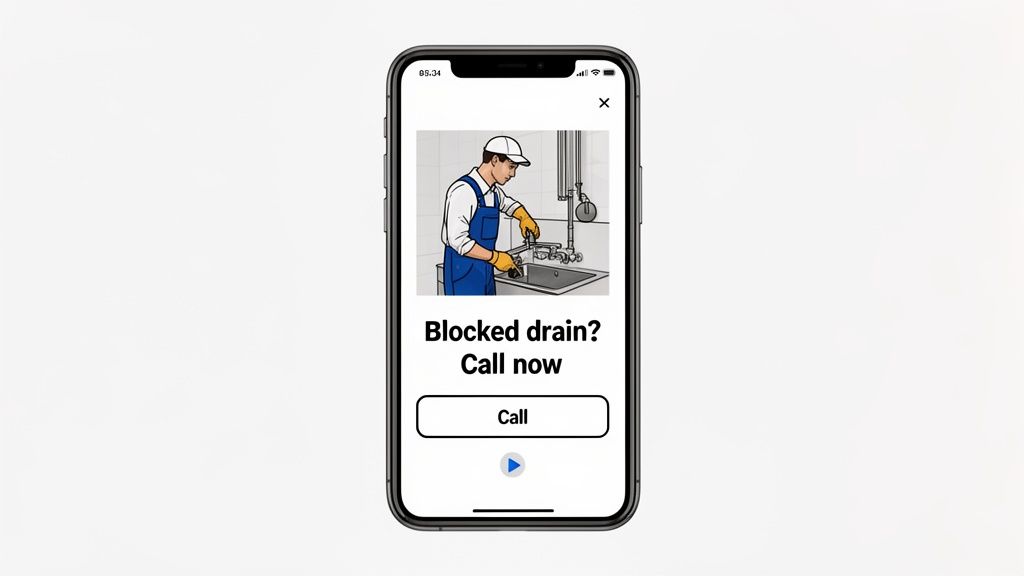
Put yourself in your customer's shoes. If you’re a plumber, they probably have a blocked drain causing a mess. Your ad needs to speak to that problem and offer a fast, simple solution.
Here are a few examples of good, problem-solving ad text:
- For a Plumber: "Blocked drain in Manchester? We can fix it today. Fast, reliable service."
- For an Electrician: "Faulty wiring in your London home? Stay safe. Call us for a free safety check."
- For a Landscaper: "Tired of your messy garden? Let's create an outdoor space you'll love. Get a free design quote."
Notice how each one names a problem, offers a solution, and says the location? This direct style cuts through the noise and gets the attention of people who need your help. For more ideas, you can learn more about the content creation process for a local business in our detailed guide.
Include a Strong Call to Action
You’ve got their attention with a great photo and good text. Now what? You have to tell them exactly what to do next. This is your call to action (CTA), and it needs to be easy to see. Do not be vague—be direct.
For service businesses, the best CTAs are almost always about getting a phone call or a quote request. That’s the whole point of these ads.
Here are some strong CTAs to use:
- "Call Now For A Free Quote": Simple, direct, and offers value with no strings attached.
- "Tap to Call Us Now": Perfect for mobile users, making it very easy to connect.
- "Send Us a Message to Book Your Job": A great choice for customers who prefer to type rather than talk.
Your call to action should be the final, clear instruction in your ad. Make it bold, make it obvious, and make it easy. When you use real photos, problem-solving text, and a strong CTA, you have a simple but powerful ad that will get your phone ringing.
Setting A Realistic Budget For Your Social Media Ads
So, how much should you actually spend on social media ads? It’s a big question, but the answer does not have to be hard or scary. You do not need a lot of money to get the phone ringing.
One of the best things about social ads is that you are in control. You can start small, test things out with as little as £10-£20 a day, and figure out what works for your business without risking a lot of money.
Understanding the Basic Costs
To set a smart budget, you need to know a couple of terms. The first is Cost Per Click (CPC). This is simply the amount you pay each time someone clicks on your ad.
Think of it like delivering flyers. You can pay to have thousands of flyers printed and delivered, but most will end up straight in the bin. With CPC, it's like you only pay a small fee when someone sees your flyer, walks up to you, and asks for your business card. You're only paying for real interest.
You might also hear the term Cost Per Mille (CPM), which is the cost per 1,000 times your ad is shown. This is great if your goal is just to get your name out there. But for a service business that needs leads, CPC is usually what matters.
What Should You Expect to Pay in the UK?
Ad costs are always changing, but it helps to have a rough idea. For UK service businesses, it is not expensive to start, especially on sites like Facebook and Instagram where local customers spend time.
Recent data for the UK shows that on Facebook, a CPC could be between £0.50 and £2.00. Instagram is often a little higher, from £0.70 to £2.50 per click. For a local business in London trying to get leads, this is very cheap. It is much cheaper than a site like LinkedIn. You can get more local information on UK ad costs from the team at Redemption Digital.
Put it this way: for less than the price of a couple of coffees, you can get your ad in front of hundreds of potential local customers.
Focusing on What Really Matters: Cost Per Lead
Things like CPC are good to know, but they do not pay the bills. The most important number for any service business is your Cost Per Lead (CPL). This is your total ad money spent divided by the number of real enquiries—phone calls, filled-in forms, quote requests—you got.
A low Cost Per Click is nice, but a low Cost Per Lead is what actually puts money in your pocket. This number tells you exactly how much it costs to make your phone ring with a potential new customer.
Let's say you spend £100 on Facebook ads and get five good phone calls from new customers looking for a quote. Your Cost Per Lead is a nice £20.
Knowing this number is a game-changer. It takes the guesswork out of your marketing. If you know that every £20 you spend brings in a lead, and each job you get is worth £500, the choice to spend more becomes very easy. Start small, track your leads well, and let the results tell you where to put your money.
How Social Media Ads And Google Work Together
Social media ads are a powerful tool on their own, but they become even stronger as part of a team. Think of your marketing like a football team. Google Ads is your striker, scoring goals by catching people who are searching for things like ‘electrician near me’. These people are ready to hire, and your ad is right there to get the job.
Social media ads, on the other hand, are your midfielders. They build awareness and warm up potential customers before they even think about searching on Google. This teamwork creates a much stronger marketing plan that helps you win more jobs in your local area.
Boosting Your Local Search Ranking
When someone sees your Facebook ad while scrolling, they might not click it right away. That's okay. They’ve seen your brand, your logo, and maybe a photo of your van. A few days later, when their boiler breaks, they’ll go on Google to find a local plumber.
As they look at the Google Map results, your business name pops up. It looks familiar. Because they already know you from social media, they’re much more likely to trust you and click on your business instead of a competitor’s. That recognition is a huge advantage.
The goal is to be everywhere your customers are. When they see you on Facebook and then again on Google, it builds a powerful sense of trust and makes your business the obvious choice.
Creating a Powerful Advertising Loop
When you run both, you create a circle that brings in more business. You use social ads to get your name out there, which leads to more people searching for your brand on Google. That increased search activity sends a strong signal to Google that your business is popular in your area. This can help your search rankings over time.
This plan works very well here in the UK. For instance, YouTube's ads can reach 98.2% of the UK adult population—a huge chance for a local builder in London to show off their best work with video ads. And even though Facebook has a large share of the social media market, a surprising number of businesses miss the chance to combine it with their Google ads. You can look at the current state of social media in NZ to get the full picture on trends.
At the end of the day, Google Ads and social media ads are not fighting; they're partners. Using them together means you have everything covered:
- Social Ads: Create interest and build that key brand recognition.
- Google Ads: Catch people who are ready to hire right now.
By making them work as a team, you make sure your business is the first one people think of, from the first small thought all the way to that final phone call. This combined method is the key to understanding the real role of PPC in lead generation and winning in your local service area.
Your Top Questions About Social Media Ads, Answered
Starting with social media ads for the first time? It’s normal to have a few questions. Most UK business owners we talk to have the same ones.
Let’s answer those final questions with some straight, simple advice so you can get started with confidence.
How Long Until I See Real Results?
You’ll likely see some action—clicks, likes, maybe a message or two—within the first couple of days. That early activity is a good sign. It means your ad is live and people are seeing it.
But turning those views into steady phone calls takes a bit longer. Give it a few weeks. Think of that first month as a test. You're learning what your local audience really likes, not just what you think they will. Be patient, make small changes based on what you see, and build from there.
Do not expect the phone to start ringing all the time overnight. This is about making small, steady improvements. Test, learn, and improve—that's how you find the winning way for your business.
Do I Actually Need a Website to Run Ads?
Good news: you do not. While having a good website is a big help in the long run, you can start getting leads right now without one.
Both Facebook and Instagram have ad types made just for this. You can run ads with a simple “Call Now” button that lets a customer phone your number straight from the ad. Or, you can use Messenger ads that open a direct chat. This makes it very easy for someone to ask for a quote without ever leaving the app.
It’s the perfect way to start and see if it works before you pay for a full website.
What's the Biggest Mistake I Can Make?
The single biggest—and most common—mistake is to "set and forget" your ads. You cannot just turn them on and hope for the best a month later. You have to check in every few days to see what’s working and what is not.
Another common mistake is aiming too wide with your targeting. It’s tempting to target all of London at once, but you’ll just waste your money. Start small. Target a few key areas where you know your ideal customers are. Once you have an ad that works in a smaller area, you can start to make your target area bigger with confidence.
Ready to stop guessing and start getting real, good-quality leads from your online marketing? Four Stripes helps UK service businesses like yours do well in their local area. Our First Page, First Call system is designed to make your phone ring. Find out how we can help at https://fourstripes.co.nz.