Here is the easiest way to think about Pay-Per-Click (PPC) advertising: imagine you have set up a stall at the busiest market in New Zealand, but you only pay rent the moment a customer stops to ask you a question. That is it. It is a very strong way for Kiwi businesses to get in front of customers at the exact moment they are searching for a solution.
Why PPC Is A Game Changer For Kiwi Service Businesses
For most service businesses in New Zealand, growth comes down to one thing: a steady flow of new enquiries. You might be a plumber in Pukekohe, an electrician in Christchurch, or a lawyer in Wellington—the goal is always to make the phone ring with good, qualified leads.
This is where PPC truly shines.
Unlike other marketing methods that take months to build up steam, PPC is all about speed and precision. It lets you jump the queue and plant your business at the very top of Google’s search results, right when a potential customer types in "emergency plumber Auckland" or "best builder Hamilton".
That immediate visibility is everything. When someone has a burst pipe, they are not going to scroll through pages of results. They are calling one of the first businesses they see. PPC makes sure that business is yours.
Connecting Directly With Customers in Need
Think about your customer’s mindset. They have a problem, and they need it fixed now. A well-built PPC campaign in New Zealand acts as a direct bridge, connecting their urgent need to your expert solution.
This is especially true for tradies and professionals who rely on responding to local demand fast. You're not just buying an ad; you're buying a front-row seat to be seen by someone who is actively looking for help.
PPC is not about hoping someone stumbles across your advert. It is about being the answer when someone asks a direct question, making sure you are visible at the most critical point of their journey.
With a focused system, you can get the phone ringing quickly and reliably. By targeting specific suburbs, services, and even times of day, you control exactly who sees your ads. This means you attract the right kind of customers without blowing your budget on tyre-kickers.
Getting Leads, Not Just Clicks
At the end of the day, advertising is about getting more business, not just more website visitors. A smart PPC campaign is built to turn clicks into paying customers. Every part of it—from the ad they read to the page they land on—is designed to get them to take one action: call you or fill out your contact form.
If you want to dig deeper into how this works, we have broken down the role of PPC in lead generation and how it drives real business results.
For service businesses all over New Zealand, PPC is an investment with a clear, measurable return. It helps you move from guessing where your next job is coming from to having a reliable system that brings customers straight to your door.
Understanding The New Zealand PPC Landscape
To get PPC right in New Zealand, you first need to get a feel for the local scene. Think of it like knowing the best fishing spots—you have to know where the fish are biting and what bait works. For Kiwi businesses, that means understanding how New Zealanders actually search online and why platforms like Google Ads are so effective here.
The great news is you do not need a massive budget to get in the game. The New Zealand market has a unique sweet spot: it is competitive enough that people are actively looking for services, but it is still surprisingly affordable. This gives local tradies and professionals a real chance to stand out without being drowned out by the big corporates. It is all about being smart, not just spending big.
Key Terms You Should Know
Before we dive deeper, let us quickly nail down a couple of terms you will hear all the time. No confusing jargon, just the basics.
-
Cost-Per-Click (CPC): This is simply the amount you pay each time someone clicks on your ad. Think of it as paying a small fee for one person to step into your "virtual shop." You only pay when someone shows genuine interest.
-
Conversion Rate: This is the percentage of people who click your ad and then actually do what you want them to do—like call your business or fill out your contact form. A high conversion rate means your ads are hitting the mark and turning clicks into real leads.
These two numbers are everything. A low CPC lets you get more potential customers for your money, and a high conversion rate means more of those people are turning into actual jobs. Nailing both is the secret to a profitable campaign.
How New Zealand Compares Globally
So, how does running ads here stack up against the rest of the world? The numbers tell a pretty compelling story for Kiwi businesses.
For service-based businesses, recent data shows the average Cost-Per-Click (CPC) across key industries is just $4.23, which is right in line with the global average of $4.66. But here is where it gets interesting: the average conversion rate for New Zealand campaigns is an impressive 8.93%, leaving the global benchmark of 6.96% in the dust. You can learn more about these local Google Ads benchmarks and what they mean for your business.
This tells us two crucial things: not only are you paying a fair price for each click, but those clicks are far more likely to turn into actual business enquiries compared to many other countries.
A higher-than-average conversion rate is a massive advantage. It means that when Kiwis click on local ads, they are serious about finding a service and ready to take the next step.
The Opportunity For Kiwi Businesses
What does all this mean for a local plumber, lawyer, or consultant? It means the opportunity is sitting right there, waiting for you. The digital marketplace in New Zealand is healthy, active, and packed with potential customers who are looking for exactly what you offer, right now.
To make it even clearer, here is how the key numbers look side-by-side.
PPC In New Zealand vs Global Averages
This table shows how key PPC metrics in New Zealand compare to global benchmarks, highlighting the strong local opportunity.
| Metric | New Zealand | Global Average |
|---|---|---|
| Average Conversion Rate | 8.93% | 6.96% |
| Average Cost-Per-Click | $4.23 | $4.66 |
As you can see, Kiwi businesses are in a strong position. Your advertising dollar can go further and work harder here. By understanding this local landscape, you can build a PPC campaign that gets your phone ringing without needing a bottomless budget to get started.
How To Set Up Your First Local PPC Campaign
Jumping into Google Ads can feel like trying to read a complicated schematic. It looks overwhelming, but setting up your first campaign is way easier than you think. The trick is to ignore all the fancy buttons and focus only on what gets local customers to call you.
Think of it like setting up a new tool in your ute. You do not need to know what every single switch does. You just need to know which ones to press to get the job done right. We will show you exactly which settings matter for getting leads in your local area, so you can get it running and bringing in work.
Choosing The Right Keywords
First things first, you need to tell Google which searches you want your ads to show up for. This is where being specific makes all the difference. Throwing money at a generic keyword like "electrician" is a great way to attract clicks from all over the country and burn through your budget.
You have to think like a local customer who has a problem they need solving now. They are not just searching for a plumber; they are searching for a "plumber in Howick" or "emergency drain unblocking Tauranga".
Here are a few examples of strong local keywords that actually work:
- For a builder: "new home builds Franklin" or "villa renovation Christchurch"
- For a lawyer: "family lawyer North Shore" or "conveyancing Wellington CBD"
- For a mechanic: "car service Henderson" or "WOF check Dunedin"
These keywords signal clear intent and a specific location. That means the person searching is a high-quality lead for your business. You're targeting people who need what you do, right where you do it.
The secret to a successful PPC New Zealand campaign is not getting thousands of clicks. It is about getting the right clicks from people in your neighbourhood who are ready to hire you.
Targeting Your Local Service Area
Next, you need to tell Google exactly where to show your ads. This is one of the most powerful tools a local business has. You can target entire cities like Auckland or Christchurch, or you can zoom right in and target just a handful of suburbs.
For example, a painter based in East Auckland might only want their ads showing up in suburbs like Pakuranga, Howick, and Botany Downs. This immediately stops you from paying for clicks from someone in West Auckland who is too far away for you to service anyway. Pinpoint targeting ensures every dollar of your ad budget is spent on potential customers you can actually help.
The data below shows how New Zealand's PPC performance, like average cost-per-click and conversion rates, stacks up against the rest of the world.
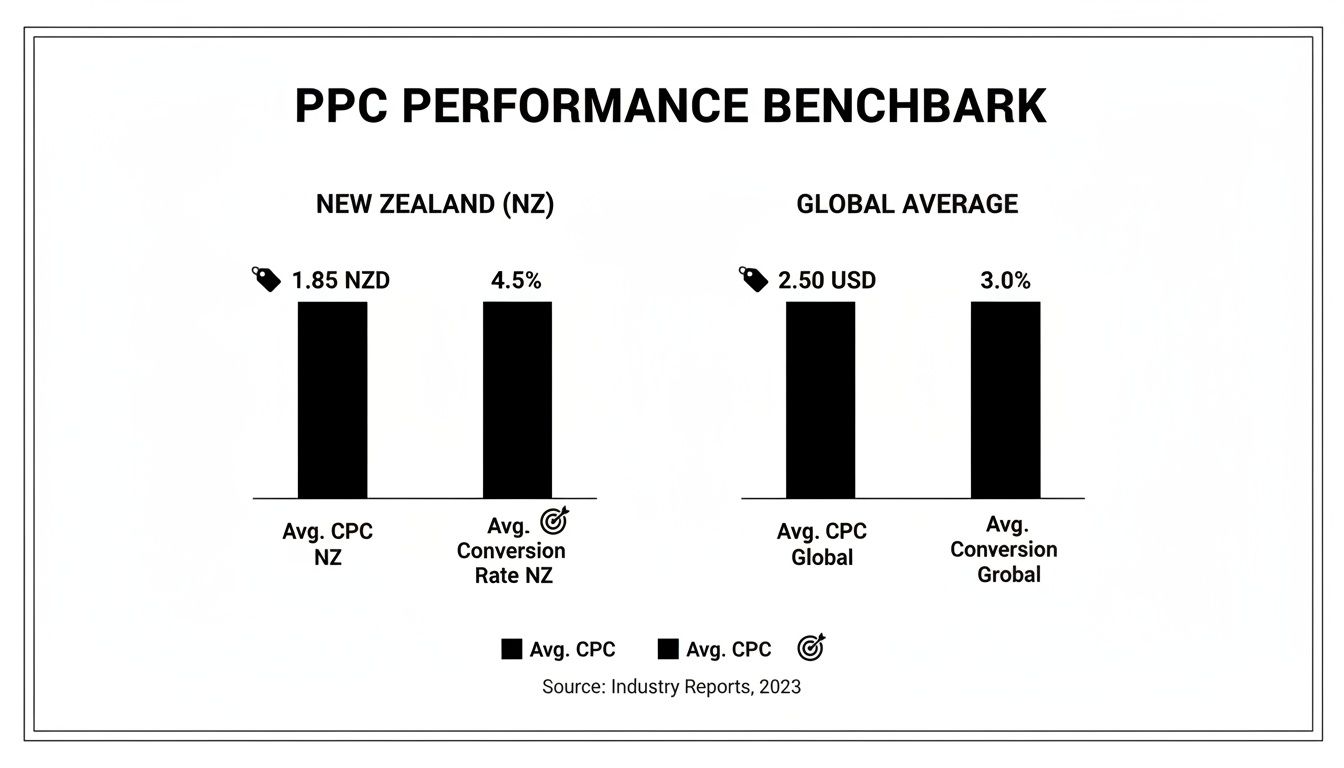
This shows that while our costs are pretty similar, Kiwis who click on ads are actually more likely to turn into a lead. That makes smart local targeting even more valuable.
Writing Ads That Get Clicks
Think of your ad as your digital storefront sign. It needs to be clear, direct, and give customers a bloody good reason to choose you. You do not need to be a clever copywriter; you just need to be genuinely helpful.
A great local ad should always include these four things:
- What you do: "Expert Gib Stopping & Plastering"
- Where you do it: "Serving the Greater Wellington Region"
- Why they should call you: "Free Quotes & Tidy Service"
- A clear instruction (call-to-action): "Call Us Today for a Free Quote"
Keep it simple and focused on solving the customer's problem. They want to know you're local, you know your stuff, and you can sort them out right now. For more ideas on writing ads that pull their weight, check out these Google Ads best practices for 2025 for what's working right now.
Setting a Sensible Budget
Here's the best part: you are in 100% control of your spending. Google Ads runs on a daily budget, which you can set as low as $10 or $20 a day just to test the waters. There is no big financial commitment needed to get started.
Think of it as the maximum amount you're willing to spend each day. Some days you might spend a bit less, but you will never spend more than your monthly limit (your daily budget multiplied by the days in a month). As you start seeing the right kind of leads come in, you can slowly dial it up.
Tracking What Matters Most
Finally, we get to the most important step of all: tracking your results. For any service business, there are only two results that actually matter: phone calls and contact form submissions. That is it.
Setting up tracking lets you see exactly which keywords and ads are making your phone ring. This information is pure gold. It shows you what is working so you can do more of it, and what is not so you can stop wasting money on it. Without tracking, you are just guessing. With tracking, you are making smart decisions that will genuinely grow your business.
Smart Ways To Lower Your Costs and Get More Leads
Once your campaign is up and running, the real work starts. The goal is not just getting clicks; it is about getting the right clicks as cheaply as possible. This constant process of tweaking and refining is called optimisation, and it is how you turn a good campaign into a great one that reliably brings in work.
Think of your campaign like a new apprentice. For the first few weeks, you're showing them the ropes and seeing what they're good at. Over time, you give them feedback to help them get quicker and more effective. Optimisation is exactly that—giving your campaign constant feedback to make it smarter and more profitable.
Tell Google What You Do Not Want
One of the fastest ways to stop wasting money is by using negative keywords. These are simply words or phrases you tell Google not to show your ads for. This is a non-negotiable for any service business running a PPC campaign in New Zealand.
Imagine you're a plumber who fixes leaky pipes in homes, but you do not sell plumbing supplies. Without negative keywords, your ad might show up when someone searches for "plumbing supplies Bunnings." That is a wasted click and money straight down the drain.
By adding words like "supplies," "jobs," and "course" to your negative keyword list, you instantly filter out tyre-kickers. This simple step stops you from paying for clicks from people who were never going to hire you anyway, freeing up your budget for genuine customers.
Understanding Your Quality Score
Google has a system to reward advertisers who give searchers a good experience. It is called Quality Score, and getting your head around it is the key to lowering your costs. Think of it like a credit rating for your ads. A higher score tells Google your ads are relevant and helpful, and in return, they give you a discount on every click.
Your Quality Score is based on three main things:
- Expected Click-Through Rate (CTR): Does your ad look appealing enough for someone to actually click it?
- Ad Relevance: Does your ad's message line up with the keywords you're bidding on?
- Landing Page Experience: Is the page they land on after clicking your ad genuinely helpful and easy to use?
A high Quality Score is a direct signal to Google that your ad is a great answer to the searcher's problem. This not only bumps up your ad's position but can seriously slash the price you pay for each lead.
Improving these three areas sends a powerful message to Google. As your score climbs, your costs fall, giving you a massive advantage over competitors who are ignoring it.
Create Ad Copy That Speaks to Kiwis
Your ad is often the very first impression a potential customer has of your business. It needs to be clear, straight to the point, and speak directly to their problem. Forget the fancy marketing jargon; focus on being helpful and trustworthy.
A strong ad for a Kiwi service business should quickly answer three questions: what you do, where you do it, and why they should call you. For example, a headline like "Urgent Roof Repairs Auckland | Free Onsite Quotes" is miles more effective than "The Best Roofing Services." It targets a specific problem, a location, and offers a clear, no-risk next step.
Build Landing Pages That Convert
The final piece of the puzzle is your landing page. This is the specific page on your website someone lands on after they click your ad. It has one job and one job only: to convince that person to call you or fill out your contact form.
A good landing page is clean and focused. It needs a big, bold headline that matches the ad they just clicked, bullet points of your services, a few customer reviews, and a very obvious phone number and contact form. Do not distract them with links to other pages on your site; guide them straight to the one action you want them to take.
For instance, optimising your landing pages can drastically improve your conversion rates, leading to more leads without increasing your ad spend. Discover more about effective conversion rate optimization strategies to maximise your campaign's impact. This laser focus on turning visitors into leads is what drives down your cost-per-lead—the most important number for any service business.
Budgeting For PPC And Measuring Your Investment
Let us cut straight to it. Every Kiwi business owner wants to know two things: "How much is this going to set me back?" and "Is it actually going to work?" Fair questions. There is a common myth that you need a massive budget to even think about PPC, but for local service businesses, that is just not true.
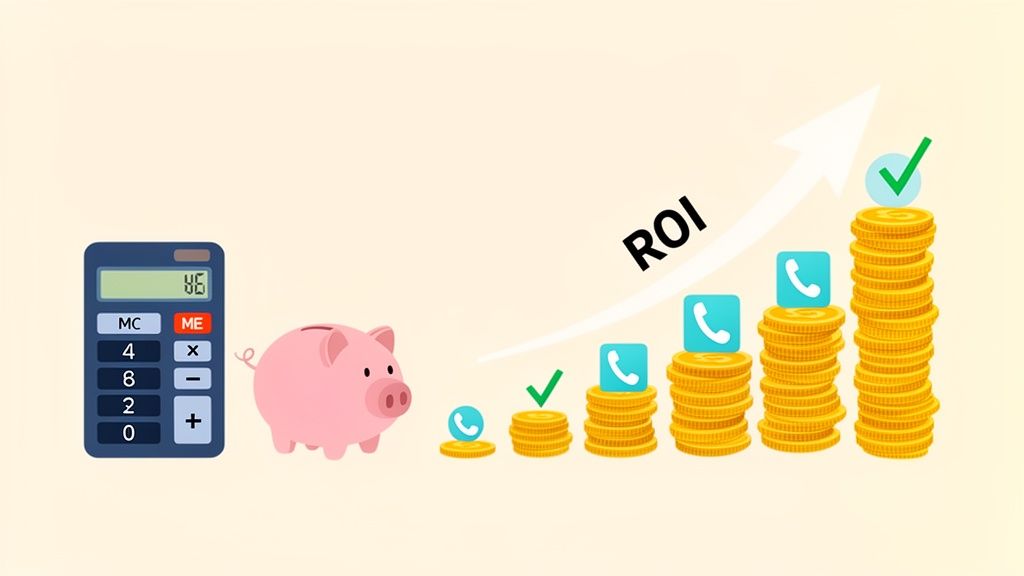
The great thing about Google Ads is that you are in the driver's seat. You can start small—even as little as $20 per day—to test the waters and see what kind of phone calls you get. Think of it as slowly turning on a tap, not opening the floodgates.
This lets you gather real-world data without a huge upfront risk. As you see which ads bring in the jobs, you can confidently turn the tap up. Understanding the cost of Google sponsored ads helps you see it for what it is: a predictable tool for growth, not just another line item on your expenses sheet.
How To Set A Sensible Starting Budget
For most small service businesses here in New Zealand, a budget between $500 and $1,000 per month is a solid starting point. This gives you enough runway to collect meaningful data on what is working and what is not, so you can make smart decisions down the track.
That sort of budget is plenty to effectively target your specific suburb or city for a handful of your core services. It is enough to get in the game and make the phone ring without having to remortgage the house.
While you might see big companies with massive ad spends, small businesses can be smarter and more nimble. The New Zealand financial sector, for example, recently hit $295.3 million in ad spend. You're not trying to compete with the big banks, but the principle is the same: spend your money efficiently on targeted ads that deliver a strong return.
Measuring Your Return On Investment
Setting the budget is only half the battle. The other, more important half, is figuring out what you are getting back for your money. We call this Return on Investment (ROI), and it is the single most important number in your marketing. It is the proof that your ad spend is actually making you money.
And do not worry, calculating it is much simpler than you think. You do not need to be an accountant.
ROI Formula: (Revenue from PPC – Cost of PPC) / Cost of PPC = Your ROI
Let us walk through a real-world example of how this plays out for a local Kiwi tradie.
A Tradie's ROI Example
Imagine you're an electrician in Tauranga. You decide to dip your toes in the water and spend $500 on a Google Ads campaign for one month.
- Your Investment (Cost): You spend $500 on your ads.
- Your Results (Leads): Those ads generate 10 phone calls from people in your area who need an electrician.
- Your New Business (Conversions): Out of those 10 genuine enquiries, you book 4 new jobs.
- Your Earnings (Revenue): Your average job value is $750. So, those 4 jobs bring in a total of $3,000 in new revenue.
Now, let us plug those numbers into our simple formula:
- ($3,000 Revenue – $500 Cost) / $500 Cost
- $2,500 / $500 = 5
To turn that into a percentage, just multiply by 100. Your ROI is 500%.
That means for every single dollar you put into your Google Ads, you got five dollars back. This is the moment you stop seeing advertising as an expense and start seeing it for what it should be: a powerful, profitable investment that grows your business.
How To Choose The Right PPC Partner In New Zealand
Deciding to hand over the reins of your ad campaigns is a massive step. Get it right, and your phone will be ringing off the hook with new jobs. Get it wrong, and you will be left with nothing but an empty bank account and a whole lot of frustration.
Think of it like hiring a new subbie for a big project. You would not just pick the first name you see. You would ask around, check their workmanship, and make sure they actually know what they're doing. The same rules apply when you're looking for someone to run your PPC in New Zealand.
Key Questions To Ask Any Potential Agency
Before you even think about signing a contract, you need to ask some hard questions. How they answer will tell you everything about their process and whether they genuinely have your back or are just looking for a quick buck. A good partner will be an open book.
Here are the non-negotiables you need to ask:
- Do you have experience with businesses like mine? An agency that gets tradies and local service businesses will understand your world far better than one that deals with big e-commerce stores selling stuff nationwide.
- How do you report on results? You want simple, clear reporting that cuts the fluff and focuses on what actually matters: phone calls and form submissions. Forget confusing metrics like "impressions" that do not pay the bills.
- Who owns the Google Ads account? It is your business, your money, your account. You should always have full ownership and admin access, even if they are managing it for you. No exceptions.
- Do you use lock-in contracts? An agency that is confident in their ability to get you results will not need to trap you in a long-term contract. They should be focused on earning your business month after month.
The right PPC partner is transparent. They should feel like an extension of your own team, completely focused on one thing: getting you a solid return on your investment. If it feels secretive or overly complicated, that is a red flag. Walk away.
What To Look For In A Great Partner
Beyond the questions, you need to get a feel for whether an agency is the real deal. A great PPC partner in New Zealand is obsessed with your business growth, not just managing your ad spend. They get that for a small business, every single dollar has to work hard.
Look for a partner who is:
- Focused on Leads, Not Clicks: They should be talking about your cost-per-lead, not just your cost-per-click. Their success is tied directly to the number of new jobs you land.
- Open and Honest: They will break down their strategy in plain English, without hiding behind a wall of jargon to confuse you. You should always know what they're doing with your money and why.
- Local Experts: They know the difference between targeting Remuera and Rotorua. A proper local expert understands the New Zealand market and knows how to zero in on specific suburbs and cities, from Auckland right down to Invercargill.
Choosing an agency is a big decision, but it does not have to be a gamble. Armed with these questions and knowing what to look for, you can find a partner who will help your business grow and make sure your marketing budget is money well spent.
Frequently Asked Questions About PPC In NZ
Diving into paid ads for the first time? It is natural to have a few questions. We've pulled together some of the most common things we get asked by Kiwi business owners, with straight-up answers to give you the confidence you need to get more leads with PPC in New Zealand.
How Quickly Will I See Results?
This is the best part. Unlike other types of marketing that can feel like you are waiting ages for something to happen, PPC gets you in front of customers almost instantly.
As soon as your ads get the green light from Google and the campaign goes live, you can show up at the top of search results that same day. For a tradie or service professional, that means your phone could be ringing with new job enquiries within 24 to 48 hours.
What Is The Difference Between PPC And SEO?
It is a bit like renting a house versus owning it.
-
PPC (Pay-Per-Click) is like renting the best billboard in town. You pay to be there, and as soon as you stop paying, your ad comes down. It is fast, gives you immediate visibility, and puts you in complete control.
-
SEO (Search Engine Optimisation) is like building and owning that billboard spot yourself. It takes time and effort to build up your authority with Google. It is a slower, long-term game, but once you rank, you do not pay for every single click.
Both are incredibly powerful. PPC is for getting the phone to ring right now, while SEO is for building a rock-solid, long-term presence. The most successful Kiwi businesses we see are using a smart mix of both.
What Makes A Good Landing Page?
A great landing page has one job and one job only: to turn someone who clicks your ad into a genuine lead. It is not your homepage—it is a purpose-built page designed purely for your ad campaign. Think simple, focused, and persuasive.
For a Kiwi service business, a winning landing page must have:
- A big, bold headline that directly matches what your ad promised.
- Your phone number, clear as day, right at the top of the page.
- A simple contact form that is dead easy to fill out.
- Bullet points that quickly explain what you do and why they should choose you.
- Trust signals, like real customer reviews or photos of your work.
And it absolutely has to load fast and work perfectly on a mobile phone. By keeping it laser-focused, you make it incredibly easy for a potential customer to get in touch for a quote.
Ready to stop guessing and start getting a predictable stream of local leads? The team at Four Stripes builds PPC campaigns that get the phone ringing for Kiwi service businesses. We take care of everything, from finding the right keywords to designing landing pages that convert—all with no lock-in contracts.
Find out how we can help your business own local search by visiting us at https://fourstripes.co.nz.