
When you think about New Zealand’s economy, it’s easy to picture big dairy exporters or tourism giants. But the real engine room of our country is much smaller, closer to home, and far more numerous. Small businesses are the absolute backbone of Aotearoa, making up an incredible 97% of all Kiwi enterprises.
These aren't just the local dairy and the corner cafe. They're the builders framing up new homes in your suburb, the accountants sorting out your taxes, and the independent creatives designing the future. Collectively, they keep hundreds of thousands of Kiwis employed and drive a massive slice of our national economy.
Understanding the NZ Small Business Landscape
To figure out how to help these businesses grow, you first need to get your head around their sheer scale and what makes them tick. Think of the entire NZ economy as a complex machine. The big corporates are the large, obvious gears you can see from a distance. But it’s the countless small businesses—the nuts, bolts, and hidden cogs—that hold the whole thing together and keep it running.
Without them, the machine would grind to a halt.
What’s amazing is their diversity. You’ve got the solo tradie running their operation from a ute, right through to a professional services firm with a dozen staff in a CBD office. This is their superpower; they can serve niche markets, build genuine local relationships, and adapt to change in a way that bigger, more cumbersome companies just can't.
The True Scale of Their Impact
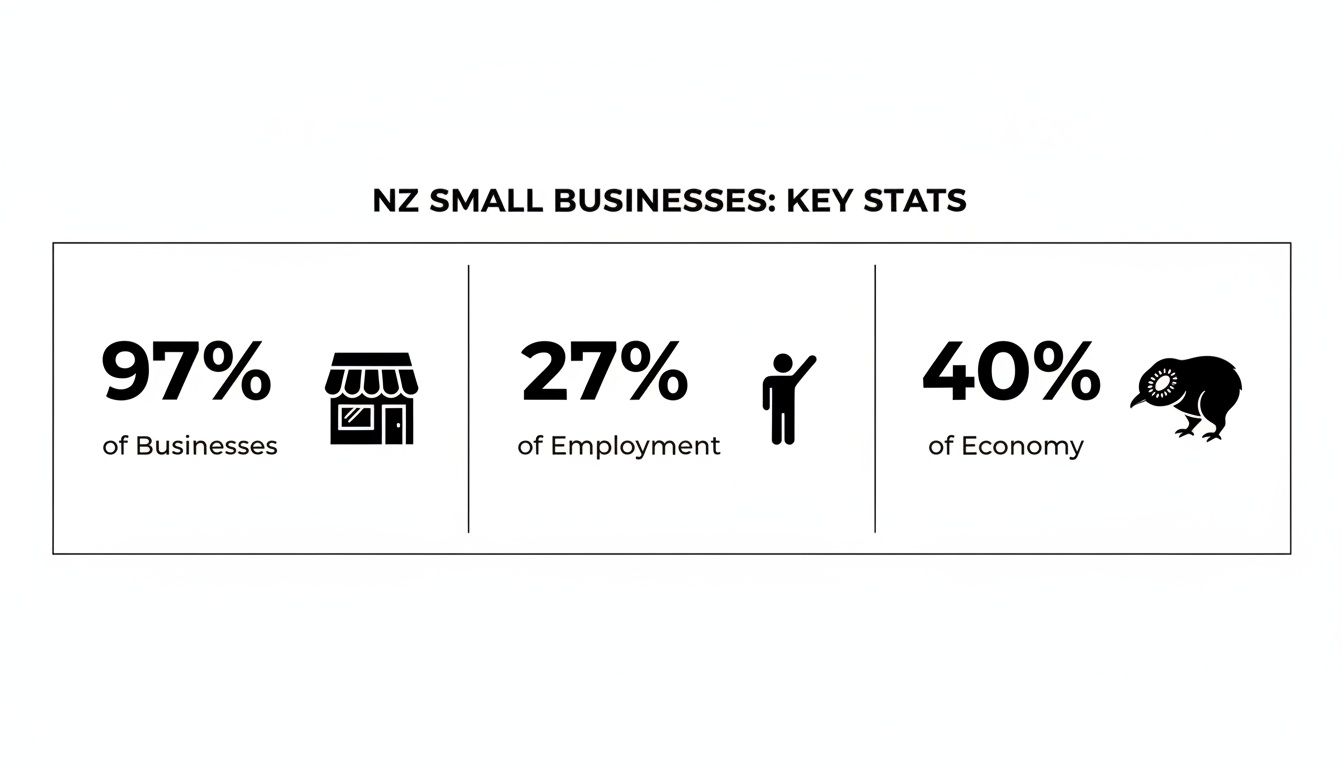
It’s one thing to say they’re important, but the numbers really drive it home. Government data shows there are around 594,000 small businesses in New Zealand, which are typically defined as having fewer than 20 employees.
Here’s a quick look at the key figures from MBIE and Stats NZ.
NZ Small Businesses at a Glance
| Metric | Figure |
|---|---|
| Percentage of All Businesses | 97% |
| Share of National Employment | 27% |
| Contribution to Economic Value | 40% |
These stats show that while each business might be small on its own, their combined economic footprint is huge. They are, without a doubt, the foundation of our local communities and the national economy.
The infographic below really puts their dominance into perspective.
This isn't just an abstract economic concept; it's about real people providing real value in every town and city across the country.
Defining Characteristics of Kiwi Businesses
So, what makes a Kiwi small business tick? There are a few common threads that run through almost all of them, shaping their daily wins and their biggest headaches.
- Lean Operations: Most run on a skeleton crew, often with fewer than five people. This means the owner is also the marketer, the salesperson, the bookkeeper, and the customer service rep. They have to wear a lot of hats.
- Deep Local Roots: A plumber in Hamilton or a lawyer in Dunedin isn't just a service provider; they're part of the local fabric. Their success is built on reputation, word-of-mouth, and being a trusted name in the community.
- Resource Constraints: Tight budgets are a fact of life. Every dollar spent on marketing, new software, or training has to count. There's no room for fluff or strategies that don't deliver a clear return.
- High Agility: This is their competitive edge. Being small means they can be nimble, pivot their services, and respond to what customers want far faster than a corporate giant ever could.
This blend of agility, community connection, and sheer hard work is what makes the sector so resilient. But it also means they need practical, no-nonsense solutions to their problems.
For many, the next big challenge is getting found online. Mastering the digital world is no longer optional—it's essential for capturing local customers and staying competitive. Building a solid foundation in online marketing in New Zealand is the key to unlocking that growth. This guide is built to give you exactly that: real-world strategies that actually work for a small business in Aotearoa.
Navigating Today's Key Challenges and Pain Points
Let's be honest: while small businesses are the backbone of the Kiwi economy, running one right now is a tough gig. It’s always been a juggling act, but the current economic climate has tossed a few more chainsaws into the mix. We're talking rising costs, customers who are holding their wallets tight, and a general feeling of uncertainty that just won't quit.
These aren't just headlines on the evening news; they’re real-world problems hitting your bottom line, messing with your growth plans, and frankly, stressing you out. From the cost of petrol for the ute to the software subscription for your firm, every single dollar is being scrutinised.
The Squeeze of Rising Operational Costs
One of the biggest headaches is the relentless climb in day-to-day running costs. Inflation has jacked up the price of everything—materials, stock, insurance, you name it. For service-based NZ small businesses, this means profit margins are getting squeezed tighter than ever.
This puts you between a rock and a hard place. Do you wear the extra costs and watch your profit shrink? Or do you raise your prices and risk scaring off customers who are also feeling the pinch? There’s no easy answer. It’s a constant balancing act.
On top of that, navigating complex regulations just adds another layer of admin and cost, pulling you away from the work that actually makes you money.
Battling a Cautious Consumer Market
When households start tightening their belts, that kitchen reno or those consulting services are often the first things put on the back burner. This "soft consumer demand" means you’re fighting harder for every job that comes through the door. The days of the phone ringing off the hook have been replaced by a market where every lead is precious.
This unpredictability makes it almost impossible to forecast your income and plan for the future. It's a huge source of anxiety when you’ve got wages, overheads, and your own bills to pay.
A recent CPA Australia survey paints a pretty grim picture, showing Kiwi small business owners are feeling deeply pessimistic. The findings reveal a sharp drop in confidence and growth, putting New Zealand at the bottom of the pile across 11 Asia-Pacific markets.
Only 36% of businesses reported growth, a huge fall from 48% the year before and well below the 64% survey average. Looking ahead, things still look shaky, with only 47% expecting to grow and a tiny 14% planning to hire. You can read the full research about these market findings to get the complete story.
The Persistent Skills Shortage
As if the financial pressures weren't enough, finding good, skilled staff is still a massive roadblock. This is especially true in the trades and specialised professional fields, where top talent is rare and in high demand.
This skills shortage has a direct, painful impact on NZ small businesses:
- You can't grow: It’s simple. You can't take on more work if you don’t have the skilled people to do it.
- Wages go up: With everyone competing for the same small pool of talent, salary expectations go through the roof, adding to your already high costs.
- You get burnt out: When you can't find staff, guess who picks up the slack? You do. That means longer hours and a fast track to burnout.
Getting through these challenges isn't just about working harder; it's about working smarter. The trick is to zero in on what you can actually control—especially how you find and win over customers right in your own backyard.
Unlocking Growth Through Digital Tools and Support
Toughing it out through economic headwinds and day-to-day operational pressures is the reality for most business owners. But it’s not a fight you have to take on alone. For many NZ small businesses, the way forward isn’t about grinding harder—it’s about working smarter. This is where getting your business online properly becomes a total game-changer, bridging the gap between today’s problems and tomorrow's growth.
This is about more than just chucking up a website or a Facebook page and hoping for the best. Real digital integration means weaving technology into the DNA of your business to crank up efficiency, find new customers, and claw back your most valuable asset: your time. This shift is what will unlock your business's true potential.
The best part? There’s a heap of support out there specifically designed to help Kiwi businesses make this jump. You don’t need to be a tech genius to get started.
Embracing Smarter Ways of Working
Think of digital tools as a new team member—one that never sleeps and happily takes on all the boring, repetitive tasks. This frees you up to focus on the stuff that actually makes you money, like strategy and looking after your customers. This could be anything from accounting software that chases invoices for you to a project management app that keeps your jobs from going off the rails.
Bringing these tools on board directly attacks the pain points we’ve already talked about. A simple Customer Relationship Management (CRM) tool can help you keep track of leads and follow up properly, which is crucial when the market is a bit soft. Inventory systems can slash waste and cut costs. It's not just about marketing, either; digital tools are essential for keeping things running smoothly and staying on the right side of compliance, with things like specialised WHS software solutions specifically for New Zealand offering critical support for small outfits.
Getting digital isn't just a nice-to-have anymore; it's fast becoming the baseline for staying in the game. Businesses that properly integrate technology are in a much better position to grow, react to market shifts, and deliver the kind of service modern customers demand.
The potential here is huge. By automating the grunt work and using real data to make smarter calls, you can genuinely reclaim hours every single week. That’s the breathing room you need to innovate, train your team, and actually plan for the future.
Navigating the Support Systems
The government and various industry groups know that this whole digital transition can feel pretty overwhelming for a busy owner. That's why they've put solid support networks in place to demystify technology and make it accessible.
Here are the key players you should know about:
- The Small Business Advisory Group: This group is the voice of small business owners in the halls of government. They give direct feedback on what’s working (and what’s not), helping shape policies so they actually make sense on the ground.
- Regional Business Partner Network: This is a nationwide network that connects you with real-world experts. They can help with everything from business planning and marketing to getting your finances sorted, often with co-funding to make the advice affordable.
- Digital Boost Programme: A government-backed initiative that’s all about building your confidence. It offers free online learning, practical tools, and support to help you build your digital skills at your own pace, with no pressure.
These aren't just names on a government website; they're practical, hands-on resources. Their entire purpose is to give you a clear path forward, breaking the process down into steps you can actually manage. Tapping into these networks is one of the smartest first moves any Kiwi business owner can make to unlock new growth.
How to Dominate Your Local Market with SEO
For many NZ small businesses, the thought of digital marketing is enough to make your head spin. But what if you could set up your digital shopfront right where local customers are already looking for your services? That’s exactly what Local Search Engine Optimisation (SEO) does.
Local SEO isn’t about going head-to-head with the big national players. It's about becoming the most visible, trusted, and obvious choice for customers in your own backyard. Think of it as having the best spot on the main street, but online—when someone nearby searches for what you do, you’re the first one they see.
This is more important than ever right now. After a tough couple of years, there are signs of life; the recent September quarter saw New Zealand small businesses post a 1.9% year-on-year sales increase—the best result in two-and-a-half years. As people start spending again, being easy to find online is how you capture that demand. You can discover more insights about these economic trends on Xero.com.
Your Digital Shopfront: The Google Business Profile
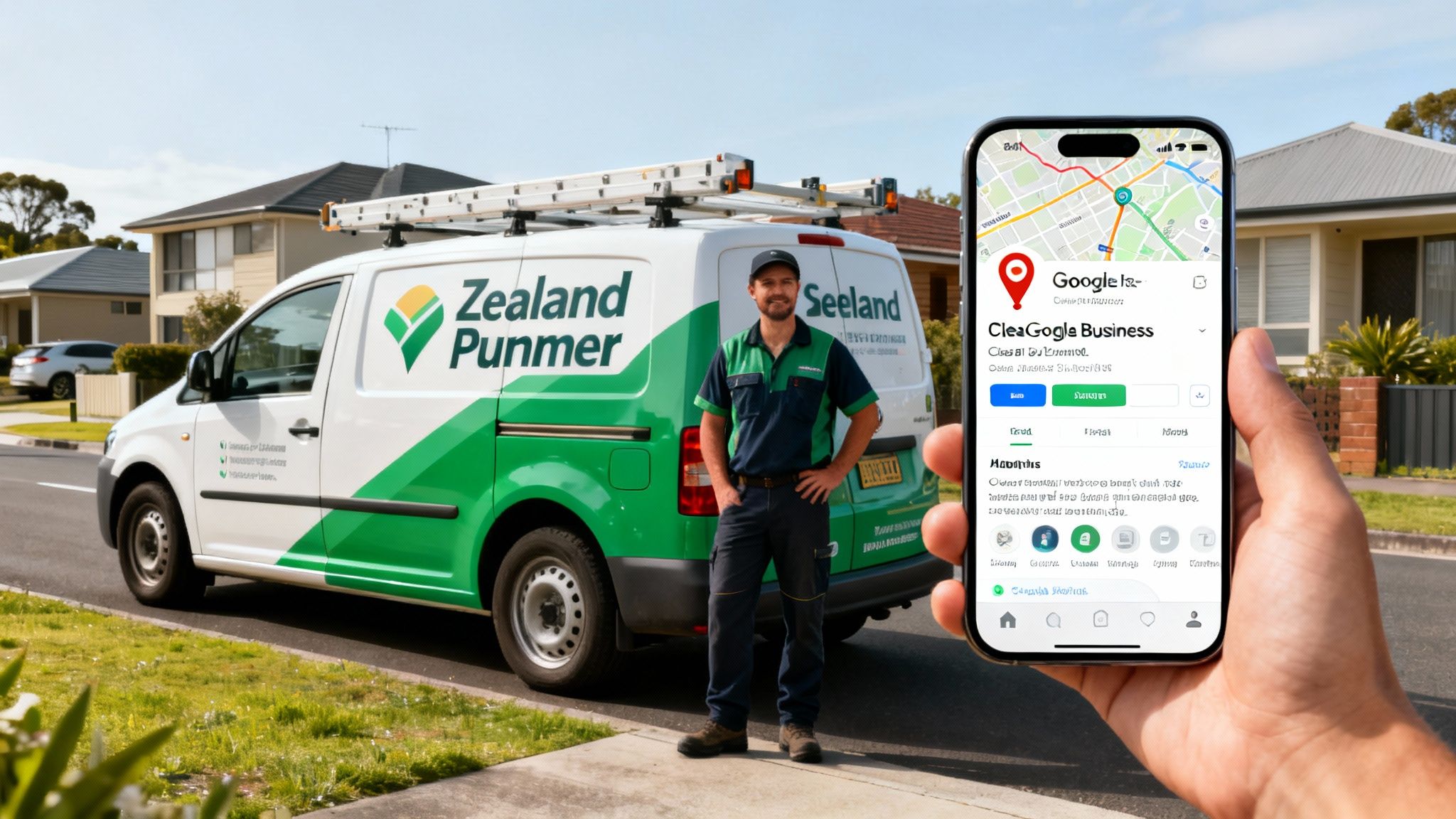
Your Google Business Profile (GBP) is your digital front door. It’s usually the first thing a potential customer sees, popping up in Google Maps and local search results. For any local business, getting this right isn't just important; it's non-negotiable.
Optimising it is simple, but the details matter. It’s not just about listing your name and address. It’s about creating a rich, informative snapshot of your business that makes searchers choose you over the competition, often before they even click through to your website.
Here’s how to put your GBP to work:
- Complete Every Single Section: Fill out everything, from your services and opening hours to accessibility details. The more complete your profile, the more Google trusts it and the higher you’ll rank.
- Use High-Quality Photos: Show off your work, your team, and your premises. If you're a builder in Auckland, this means clear photos of finished projects. If you’re a consultant in Queenstown, it might be professional headshots and a shot of your office.
- Post Regular Updates: Use the "Updates" feature to share news, special offers, or photos of a recent job. This signals to Google (and customers) that your business is active and engaged.
Building Trust with Authentic Customer Reviews
In the local market, reputation is everything. Online reviews are the new word-of-mouth, and they're a huge factor in how Google ranks you and whether a customer decides to call. A steady flow of positive, recent reviews tells everyone you're a safe bet.
The goal isn't just to chase five-star ratings. It’s about building a collection of genuine feedback that tells the story of your business. Responding to all reviews—good and bad—is crucial, as it shows you care about your customers and stand by your service.
Make it dead simple for happy clients to leave a review. After a job, send them a direct link via email or text. A plumber in Christchurch could send a quick follow-up: "Thanks for your business! If you were happy with our work, we'd appreciate a quick review."
Securing Your Spot in Kiwi Directories
Beyond Google, getting your business details listed consistently across key New Zealand directories builds your online authority. These listings, called citations, act like digital signposts all pointing back to you, confirming your location and legitimacy for search engines.
It's absolutely critical that your NAP (Name, Address, Phone number) is identical everywhere. Even a small inconsistency can confuse search engines and drag down your local rankings.
Start by making sure you're listed correctly on these essential Kiwi sites:
- Finda: One of New Zealand's oldest and most trusted online business directories.
- Yellow NZ: The online home of the iconic Yellow Pages is still a heavyweight citation source.
- NZSBD: The New Zealand Small Business Directory is another must-have for local exposure.
By methodically building out your digital footprint in these key areas, you make it impossible for local customers—and Google—to ignore you. For a deeper look at the nuts and bolts, check out our guide on 7 essential local SEO strategies for small NZ businesses.
Generating Immediate Leads with Targeted Google Ads
While Local SEO is the marathon for building a steady stream of customers, sometimes you just need a sprint. You need the phone to ring now. For NZ small businesses looking for that instant boost, Google Ads is like putting a perfectly timed ad right in front of a customer the exact moment they’re searching for your service.
It's direct, it's fast, and it lets you jump the queue straight to the top of the search results.
Unlike SEO, which takes time to build momentum, a well-managed Google Ads campaign can start bringing in qualified leads within hours. You get to control the flow, turning the tap of enquiries on when you’re quiet and easing off when you’re flat out. It’s an incredibly powerful tool for filling gaps in your schedule or pushing for growth.
Choosing Keywords That Match Kiwi Search Habits
The heart of any good Google Ads campaign is targeting the right keywords. This isn't about guessing what people might search for; it's about getting inside the heads of your local customers and using the exact language they do. For New Zealand businesses, that means thinking local.
Forget generic terms like "electrician." A much smarter move is to target phrases that scream local intent. For instance, a sparky in Auckland will get far better bang for their buck by bidding on keywords like:
- 'auckland electrician'
- 'emergency electrician north shore'
- 'rewiring specialists mt wellington'
These longer, more specific keywords are less competitive, and the person searching them is usually much closer to making a decision. Someone looking up "auckland electrician" isn't just browsing—they’ve likely got a problem they need sorted today. That makes them a red-hot lead.
Zeroing In with Geo-Targeting
One of the most valuable features in Google Ads for any local service business is geo-targeting. This lets you show your ads only to people in specific geographical areas. You can target a whole city like Christchurch, a few suburbs like Riccarton and Merivale, or even draw a tight radius of a few kilometres around your workshop.
This level of precision is gold for NZ small businesses that serve a defined local area. After all, a plumber based in Wellington has zero interest in paying for clicks from someone in Dunedin.
By tightly controlling where your ads appear, you ensure that every single dollar of your budget is spent reaching potential customers you can actually get to. This cuts out wasted ad spend and massively improves your return on investment.
Writing Ads That Speak to Local Needs
Once you've got your keywords and locations dialled in, the last piece of the puzzle is writing an ad that actually gets clicked. Your ad copy has to cut through the noise, show your value, and give someone a clear reason to choose you over the other guys on the page.
A great local ad should always:
- Include the Location: Mentioning the suburb or city (e.g., "Hamilton's Trusted Plumbers") instantly tells the searcher you’re a local and you’re relevant to them.
- Highlight a Key Benefit: What makes you the best choice? Is it your 24/7 emergency service? Your fixed-price quotes? Your years of experience? Put it front and centre.
- Have a Strong Call to Action: Don't be shy. Tell people exactly what you want them to do next. Use direct, punchy phrases like "Call Now for a Free Quote" or "Book Your Job Online."
Getting these three elements right is crucial. For a deeper dive into crafting campaigns that deliver, it pays to check out some expert advice on the latest Google Ads best practices for 2025 to make sure your strategy is current. This is how you turn Google Ads from an expense into a predictable, profitable lead machine.
Turning Your Website into a Lead Generation Machine
For too many NZ small businesses, a website is just a digital brochure. It looks nice, has some basic info, but it doesn't actually do any of the heavy lifting. This is a massive missed opportunity.
Think of it this way: your website should be your hardest-working salesperson, on the clock 24/7, turning casual browsers into paying customers. It’s not about just having an online presence; it's about building a powerful tool that actively brings in work.
The whole game changes when you stop seeing your site as a passive billboard and start treating it like an active lead generator. Every single element—from the navigation menu to the photos of your work—should have one clear purpose: guiding the visitor to take the next step.

This means your website needs to be more than just pretty. It has to be engineered from the ground up to build trust, answer questions, and make it incredibly simple for a potential customer to get in touch.
Building an Unshakeable Foundation of Trust
Before a potential customer even thinks about picking up the phone, they need to believe you're a legitimate, trustworthy business that can actually solve their problem. In the local market, trust is everything. Your website is the perfect place to build it.
Start by showing off real social proof. This is the online version of a word-of-mouth referral, and it's absolutely vital for winning over cautious Kiwi customers.
- Prominent Testimonials: Don't bury your best reviews on a forgotten page. Sprinkle short, powerful quotes from happy local clients throughout your site—especially on the homepage and your main service pages.
- Industry Certifications: Are you a Registered Master Builder or a member of a professional association? Get those logos on your site, front and centre. They act as instant trust signals.
- Case Studies: Show, don't just tell. A few before-and-after photos from a recent job can be far more convincing than paragraphs of text ever will be.
Making It Easy for Customers to Act
Once you’ve earned their trust, the next job is to make the path to becoming a customer as simple and obvious as possible. This is where so many websites fall over, hiding contact details or using confusing language that makes people give up.
Your goal is to remove every single bit of friction between a visitor's interest and their action. If someone has to hunt for your phone number or figure out how to request a quote, you've probably already lost them to a competitor whose site is easier to use.
This means putting clear, impossible-to-miss calls-to-action (CTAs) on every single page. Use strong, action-focused buttons like "Get a Free Quote" or "Call Us Now" and make sure your phone number is clickable on mobile devices. Simple.
A well-designed website for an NZ small business also needs dead-simple navigation. A visitor should be able to find exactly what they're looking for within a couple of clicks. And with a huge number of Kiwis browsing on their phones, a mobile-first design isn’t a nice-to-have; it’s an absolute must for capturing leads on the go.
Quick Wins for Trades vs Professional Services Websites
While the principles of trust and clear calls-to-action apply to everyone, the way you implement them can differ. A plumber's website has different priorities than a lawyer's. Here are some high-impact tweaks tailored to different types of NZ service businesses.
| Website Element | Quick Win for Tradies | Quick Win for Professional Services |
|---|---|---|
| Homepage Hero | A clear photo of you/your team on a job, with a "Get a Free Quote" button and a clickable phone number. | A professional headshot with a headline stating the specific problem you solve (e.g., "Simplifying Property Law for Auckland Families"). |
| Service Pages | Use bullet points to list specific tasks (e.g., blocked drains, hot water cylinder repair) and show before/after photos. | Detail the process and outcomes for each service. Use client testimonials specific to that service area. |
| About Us Page | Keep it brief. Focus on experience, qualifications (e.g., licensed, certified), and your service area. A friendly team photo works great. | Build authority. Showcase team credentials, professional memberships (e.g., NZ Law Society), and your firm's unique approach or philosophy. |
| Proof Elements | Showcase logos of brands you work with (e.g., Rheem, Bosch). Feature photo galleries of completed work. | Display logos of publications you've been featured in or awards you've won. Link to detailed case studies or white papers. |
| Contact Form | Keep it super simple: Name, Phone, Suburb, Message. That's it. Too many fields kill conversions. | Can include more fields if needed to qualify leads, such as "Type of Enquiry" or "Best Time to Call." |
These quick adjustments ensure your website speaks directly to your ideal customer, building the right kind of trust and making it easy for them to take the next step.
Your Digital Marketing Questions Answered
Diving into digital marketing can feel a bit like learning a new language. For many owners of NZ small businesses, the biggest question is simply, "Where on earth do I start?"
How Much Should I Spend on Marketing?
There’s no magic number here. How much you spend really depends on your goals, your industry, and how fast you want to grow.
Instead of pulling a figure out of thin air, a solid starting point is to set aside 5-10% of your total revenue for marketing. If you're a new business trying to get off the ground or you’re in the middle of a serious growth push, you might need to aim a bit higher.
The most important thing is to stop thinking of marketing as just another bill. It’s an investment. Start small with a focused Local SEO or Google Ads campaign, track what’s bringing in the work, and then double down on what’s actually making the phone ring.
Which Strategy Is Better: SEO or Google Ads?
This is one we hear all the time, but it’s not really about one being "better" than the other. It’s about what you need right now.
Think of it like this: SEO is like buying and building your own house. It takes time and effort to lay the bricks, but you're creating a long-term asset that builds value over time. Google Ads is like renting a massive billboard on the motorway—you get instant traffic and phone calls, but as soon as you stop paying, the billboard comes down.
For most NZ small businesses, the smartest approach is a blend of both. Use Google Ads to get the leads flowing in immediately while your SEO work builds that foundational, long-term organic traffic that keeps you busy for years to come.
Ready to stop guessing and start growing? Four Stripes builds unshakeable local authority and websites that get the phone ringing. Learn how we get you results.