
For Kiwi service businesses, nailing online marketing in New Zealand comes down to one thing: being the most visible and trusted choice in your local community. It’s a complete shift away from old-school advertising and towards meeting your customers exactly where they’re looking for you.
This guide is your roadmap to getting found online and turning those searches into actual jobs.
Winning in the New Zealand Digital Marketplace
Think of your local high street, but online. Your website is your new shopfront, Google is the main road everyone travels on, and social media is the town square where people connect. For a plumber in Ponsonby or a builder in Christchurch, showing up in this digital marketplace isn’t just a nice-to-have—it’s the engine that drives your growth.
The way Kiwis find and hire local services has completely changed. Gone are the days of flicking through the Yellow Pages or hoping a flyer in the letterbox sticks. Today, if a homeowner has a leaky tap or a business needs an accountant, their first move is to grab their phone and search.
This is a massive opportunity. Your potential customers are literally typing their needs into Google, searching for things like "emergency electrician Hamilton" or "best house painter Wellington." A smart online marketing plan puts your business right there, at that exact moment they need you.
Connecting with Kiwi Customers Where They Are
The goal here isn't about complicated global marketing fluff. It's about building a presence that feels both professional and genuinely local. You need to understand how your neighbours search online and what makes them confident enough to pick up the phone and call you.
Think of your online presence as your digital handshake. It’s the first impression you make, and it needs to instantly show you’re trustworthy, you know your stuff, and you’re a part of the local community you serve.
This digital-first approach is critical because Kiwis love to support local. Research shows that a huge 75% of online spending stays right here with New Zealand-based businesses, proving there’s a strong preference for local providers. Even when people spend a bit less per transaction, they’re buying more often and actively looking for local businesses they can trust.
What This Guide Will Cover
This guide cuts through the theory and gives you clear, actionable steps. We'll break down the essential parts of a winning strategy for any service business looking to get more work.
You'll learn how to:
- Dominate Local Search: Get your business showing up on Google Maps and at the top of local search results when customers are looking for exactly what you do.
- Build Unshakeable Trust: Use your website and online profiles to show off your work, share customer reviews, and become the go-to expert in your area.
- Generate Enquiries: Turn that online visibility into a steady stream of phone calls and quote requests from qualified local customers.
By focusing on these key areas, you'll build a powerful system that brings in new business month after month. For a head start, check out our guide on how to create a digital strategy for a local business.
Master Your Local SEO and Google Business Profile
When a Kiwi customer needs your services, Local Search Engine Optimisation (SEO) is your secret weapon to get in front of them right at that moment. Think of it like owning the best-located shop on a busy high street, but online. When someone in your suburb searches for "plumber near me" or "electrician Auckland," local SEO makes sure your business is the first one they see.
It's basically the digital version of having a solid local reputation. Instead of just relying on word-of-mouth, you’re showing Google you’re the best and most relevant choice in the area. This isn’t about ranking worldwide; it’s about winning your own neighbourhood and becoming the go-to expert for your community.
And for most Kiwi service businesses, the journey to local domination starts with one incredibly powerful free tool: your Google Business Profile (GBP).
The path to winning online is actually pretty straightforward. First, you get visible. Then you build trust. Then you turn that trust into paying customers.
This process shows that just being seen is only the first step. The real work is in turning that attention into actual jobs by proving you’re trustworthy and reliable.
Turning Your Google Business Profile Into a Customer Magnet
Your Google Business Profile is so much more than a pin on a map. It's your single most important digital storefront for local marketing. It acts as a live profile where you can show off your services, post updates, add photos of your work, and—most importantly—collect those crucial customer reviews.
An untouched profile is like a shop with no sign and dirty windows—people will just walk on by. But a fully optimised one works 24/7 to bring you leads. The data doesn't lie: businesses with complete and accurate GBPs are seen as 2.7 times more reputable by potential customers.
To get the ball rolling, nail these key areas:
- Complete Every Single Section: Fill out every field you can. Your services, opening hours, and especially your business description—pack it with the keywords real customers are searching for.
- Upload High-Quality Photos: Show off your best work, your team, and even your vehicle. Photos prove you’re a legitimate, professional outfit and can increase requests for directions by a massive 42%.
- Actively Chase Reviews: Reviews are the currency of local trust. Make it a habit to ask every happy customer for their feedback. Businesses with more positive reviews simply get more clicks.
A well-cared-for profile gives Google all the right signals to bump you up in local searches, especially in that all-important "Map Pack" at the top of the page.
The Power of Local Citations and Consistency
Beyond your Google profile, local SEO also means getting your citations in order. A citation is simply any online mention of your business's name, address, and phone number (what we call NAP). Think of online directories like Yellow.co.nz, Finda, or any industry-specific sites.
Absolute consistency here is non-negotiable. Your details must be identical everywhere. A tiny difference, like listing "St" on one directory and "Street" on another, can confuse Google and hurt your local ranking.
"Think of your business's NAP information as its digital fingerprint. If that fingerprint is smudged or inconsistent across the web, Google struggles to verify who you are and where you operate, making it less likely to recommend you in local searches."
This painful attention to detail tells Google that your business is established and legitimate. Cleaning up and building these citations is a foundational step in any decent online marketing New Zealand strategy. And to really stay ahead, it pays to keep an eye on how search is evolving, which includes things like understanding ChatGPT ranking factors.
An Action Plan for Local SEO Success
Dominating local search doesn’t happen by accident. It takes consistent, focused work.
Here’s a no-fluff plan to get you started right now:
- Claim and Fully Optimise Your GBP: This is your #1 priority. Fill out every single field with accurate info.
- Create a Review System: Set up a simple process to ask every single happy customer for a Google review. A quick text or email link works wonders.
- Run a Citation Audit: Google your business name and find all the places it’s listed. Spot any incorrect or inconsistent NAP info? Fix it immediately.
- Publish Regular GBP Posts: Use the "Posts" feature weekly to share updates, special offers, or photos from a recent job. This shows Google your profile is active and relevant.
Follow these steps, and you’ll build a rock-solid foundation for local visibility. If you want to go even deeper, our complete guide gives you advanced strategies for Google Business Profile optimisation to get more local leads.
Generate Immediate Leads With Google Ads
While local SEO is your long game for building a stellar reputation, Google Ads is your fast track. It’s like switching on a tap for customer enquiries.
When someone in your area desperately needs your service, Google Ads lets you put your business right at the very top of their search results, instantly.
Think of it this way: SEO is like earning a fantastic reputation around town through years of great work and word-of-mouth. Google Ads, on the other hand, is like placing your business’s flyer directly into the hands of a person who has just shouted, "I need a plumber right now!"
You pay for the privilege of that perfect timing, but the return can be incredibly powerful. It's what's known as Pay-Per-Click (PPC) advertising, meaning you only pay when someone is interested enough to actually click on your ad. This makes it a highly efficient way to capture the attention of Kiwis who are actively looking to hire someone with your skills.
Targeting Your Ideal Kiwi Customer
The real magic of Google Ads for a local service business is its incredible precision. There’s no point wasting your budget advertising to the whole of New Zealand. Instead, you can focus your spending with laser-like accuracy.
Imagine you're a builder based in Tauranga. You can set up your campaign to show ads only to people searching within a specific radius, ensuring you only attract enquiries from the Bay of Plenty. This geographic targeting is the cornerstone of effective online marketing in New Zealand, as it stops you from paying for clicks from customers you can't realistically serve.
But you can get even smarter with your targeting:
- Schedule Ads for Peak Hours: Are you an emergency electrician? You can schedule your ads to show up more prominently after hours and on weekends when demand is highest.
- Target Specific Devices: If most of your customers call you straight from their phones, you can tell Google to prioritise showing your ads on mobile devices.
- Use Local Lingo: Your ad copy can connect better with customers by using language they understand. An ad for a 'rubbish removal' service might also include the keyword 'junk collection' to capture how different Kiwis search.
Measuring What Really Matters: Conversions
Too many business owners get hung up on tracking 'clicks' and 'impressions'. While these metrics are part of the picture, they don't pay the bills. The only thing that truly matters is how many of those clicks turn into actual business opportunities.
The goal of a Google Ads campaign isn't just to get people to your website; it's to make your phone ring. Success means tracking real-world actions like phone calls and quote request forms, not just website traffic.
This is where conversion tracking becomes your most important tool. By setting it up correctly, you can see exactly which keywords and ads are driving genuine leads. This data allows you to double down on what’s working and cut spending on anything that isn’t, ensuring your advertising budget delivers a clear, measurable return.
For a deeper dive, check out our detailed guide on Google Ads best practices to follow.
What Does a Realistic Budget Look Like?
Setting a budget can feel like guesswork, but it helps to see what different investment levels can achieve. The key is to start with what you're comfortable with and scale up as you see a positive return on your investment.
Here are some sample monthly budgets to give you an idea of potential outcomes for a typical NZ service business.
Sample Monthly Google Ads Budget for NZ Service Businesses
| Budget Level | Monthly Spend (NZD) | Target Location | Estimated Monthly Clicks | Estimated Monthly Enquiries |
|---|---|---|---|---|
| Starter | $500 – $800 | Single Suburb/Small Town | 50 – 100 | 5 – 12 |
| Growth | $800 – $1,500 | Multiple Suburbs/City | 100 – 200 | 12 – 25 |
| Dominator | $1,500+ | Major Metro Area | 200+ | 25+ |
These numbers are estimates and will vary based on your industry's competitiveness and how well your campaigns are managed. The goal is always to refine your ads to lower the cost per lead over time.
A well-managed Google Ads campaign puts you in complete control. You set the budget, you choose who sees your ads, and you can pause or adjust your campaign at any time. It’s one of the fastest and most direct ways to generate a steady stream of qualified local enquiries and grow your business.
Build Trust with Kiwis on Social media
For Kiwi service businesses, social media isn't about going viral with some silly video. It’s about building rock-solid trust in your own backyard. Forget chasing millions of followers. The real goal is to become the go-to name that pops into a local’s head when they need your trade.
Think of platforms like Facebook and Instagram as your digital town square. It’s where you show off your expertise, prove you do quality work, and connect with potential customers on a human level. This is less about the hard sell and more about consistently showing you’re reliable and bloody good at what you do.

Showcase Your Work and Expertise
The best thing you can post on social media is simple: proof of a job well done. This is where you let your work do the talking, building a potential customer's confidence before they even think about picking up the phone.
Your feed should be a living, breathing portfolio. Get in the habit of snapping high-quality photos and videos that show off your workmanship and the fantastic results you get for your clients.
Here are a few content ideas that work a treat for service businesses in NZ:
- Before-and-After Photos: This is the gold standard, no question. Whether you're a painter, landscaper, or kitchen renovator, a dramatic transformation is powerful and easy for anyone to appreciate.
- Customer Testimonial Graphics: Turn those glowing reviews into shareable graphics. A photo of the finished job next to a quote from a happy client? That's powerful social proof right there.
- Helpful Tips and Advice: Don't be shy with your knowledge. A Christchurch builder could share quick tips on earthquake-strengthening checks. A Bay of Plenty gardener could show which native plants thrive together in the local climate.
This approach flips the script. You’re not just another contractor; you’re the local expert who genuinely wants to help out the community.
Turn Your Page into a Service Hub
Beyond just showing off your projects, your social media page needs to be a responsive customer service hub. When people ask questions in the comments or shoot you a message, a quick, helpful reply shows you’re on the ball and reliable.
Your social media presence is a direct reflection of your customer service. A page with unanswered questions and old posts suggests a business that doesn't pay attention to detail. An active, helpful page builds immense trust.
This kind of engagement is a non-negotiable part of a modern online marketing New Zealand strategy. Social media is a dominant force, with data showing 79.1% of Kiwis are active users, spending around 2 hours and 3 minutes on these platforms every single day.
A Simple Content Strategy for Building Trust
You don't need a complicated, spreadsheet-driven plan to make this work. Consistency beats complexity every time. Just aim for a healthy mix of content that teaches your audience, shows off your skills, and puts your happy customers in the spotlight.
If you want to go deeper and craft a really comprehensive approach, this small business social media strategy guide is an excellent resource.
Here’s a dead-simple weekly plan to get you started:
- Monday (Showcase): Post a crisp "before and after" from a recent job. In the caption, tell the story behind the project.
- Wednesday (Educate): Share a genuinely useful tip related to your trade. Answer a common question you get from clients all the time.
- Friday (Social Proof): Share a customer testimonial or a positive review. If they're a local business, tag them and give them a shout-out.
Follow this simple rhythm, and you'll consistently prove your value. You’ll build a loyal following of potential customers who already trust you long before they actually need to hire you.
Turn Your Website Into a Conversion Machine
It's time to stop thinking of your website as an online brochure. It should be your hardest-working employee, clocking in 24/7 to turn casual visitors into actual, paying customers. For any Kiwi service business, your website is the hub where every bit of your marketing—from a Google search to a Facebook post—ultimately leads.
Your site has one job, and one job only: convince a potential customer you're the right choice and make it dead simple for them to call you. Every single element needs to work together to guide that person from a quick look to a phone call or a quote request.
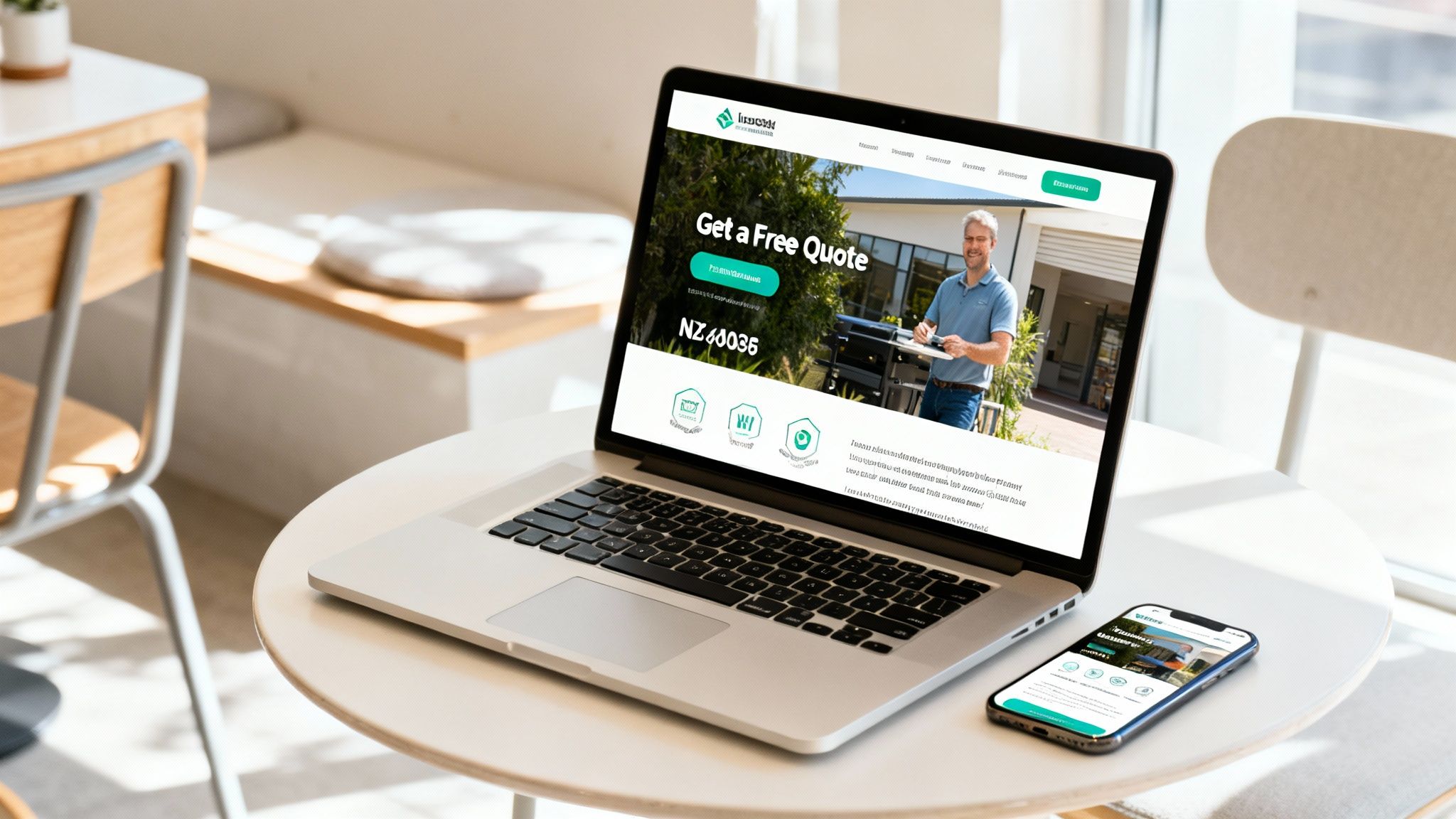
Make Contacting You Effortless
When someone lands on your site, they shouldn't have to play detective to find your phone number. Make your contact details impossible to miss.
Your phone number needs to be planted in the top right-hand corner of every single page. And on mobile, that number absolutely must be "click-to-call," letting them ring you with a single tap. It’s a tiny detail that can make a huge difference to how many enquiries you get.
Beyond that, stick a simple contact form on every service page. Don’t get greedy with the information you ask for—name, phone, email, and a quick message is all you need to get the ball rolling.
Guide Visitors with Clear Calls-to-Action
Every page on your website needs to tell the visitor exactly what to do next. We do this with a Call-to-Action (CTA). A CTA is just a button or a link with punchy, action-focused text that pushes for an immediate response.
Forget vague phrases like "learn more." You need to be direct and use CTAs that match what your customer wants to do.
- "Get a Free Quote Now"
- "Book Your Onsite Consultation"
- "Call Us for Emergency Service"
Make these buttons stand out. A bright, contrasting colour makes them the most obvious next step for anyone on the page. Your website’s job is to lead, and strong CTAs show them the way.
Build Instant Credibility with Trust Signals
Before a Kiwi customer gives you their business, they need to trust you. Your website is the perfect place to build that credibility from the second they arrive. These "trust signals" are the visual clues that prove you’re a legitimate, professional, and reliable business.
Think of trust signals as your digital handshake and a collection of references all rolled into one. They reassure visitors that they are making a safe and smart choice by choosing your business.
For a high-converting website, effective trust signals are non-negotiable. Here are the must-haves for any NZ service business:
- Local Testimonials: Show off reviews from real customers in your service area. Adding their suburb (e.g., "John from Remuera") gives you a massive dose of local proof.
- Industry Certifications: Display the logos of any qualifications or industry bodies you’re part of, like Master Builders or Registered Master Electricians.
- Galleries of Your Work: A picture really is worth a thousand words. High-quality photos of your finished projects are undeniable proof of your workmanship.
- A Flawless Mobile Experience: With so many Kiwis searching on their phones, your site has to look and work perfectly on any screen. A clunky, hard-to-use mobile site is a huge red flag for today’s customers.
Get these elements working together, and your website goes from being a passive online listing to an active conversion machine. It becomes the most valuable tool in your online marketing New Zealand toolkit.
Measure What Matters and Plan Your Budget
Good marketing isn’t about guesswork; it’s about making smart decisions with your money. To get results from online marketing in New Zealand, you have to stop worrying about vanity metrics like 'likes' or 'website visitors' and get laser-focused on what actually fills your calendar.
The only question that really matters is: are you getting more quote requests and phone calls?
The numbers that directly connect what you're spending to money in your bank account are your Key Performance Indicators (KPIs). Forget the fluffy stuff. These are the metrics that tell you if your investment is actually paying off by generating real jobs.
Tracking Your Most Important KPIs
For a Kiwi service business, the most valuable KPIs are the actions a customer takes right before they decide to hire you. It's easy to get lost in complicated reports, so just focus on tracking these core actions.
Here’s what you should be measuring:
- Phone Calls: How many people clicked the phone number on your website or Google Business Profile to ring you?
- Form Submissions: How many quote requests or contact forms did you get through your website this week?
- 'Click-to-Directions': How many people are hitting the "Directions" button on your Google Business Profile to find you?
These are the outcomes that lead directly to new work. The good news is, free tools like Google Analytics can be set up to track all of this, giving you a dead-simple picture of what’s working and what’s not.
Think of your marketing dashboard as the instrument panel in your ute. You don’t need to watch every single gauge all the time, but you absolutely need to keep an eye on the fuel level (your budget) and the engine temperature (your lead flow).
Planning a Realistic Marketing Budget
Once you know what to measure, you can start planning a budget that makes sense. There's no magic number here; the "right" amount depends on your goals, how tough your local competition is, and how fast you want to grow.
A sensible way to start is to begin with a smaller budget, measure what happens, and then reinvest in the channels that are bringing in the work. It's best to split your funds between long-term strategies like SEO and things that get the phone ringing immediately, like Google Ads. This balanced approach means you’re building a strong foundation for the future while still getting jobs in the door today.
Consider this simple split as a starting point:
- 60% on Lead Generation (e.g., Google Ads): This is your 'get jobs now' fund. It goes towards activities that capture enquiries from customers who are actively looking for your services right now.
- 40% on Brand Building (e.g., SEO, Content): Think of this as your long-term investment. It builds up your online authority, making it easier and cheaper to get leads down the track.
This approach ensures you’re not just chasing today’s job but are building a more resilient, profitable business for tomorrow. By tracking the right KPIs, you can confidently adjust where your money goes and make sure every dollar is pulling its weight.
Common Online Marketing Questions Answered
When you're running a Kiwi business, getting into online marketing can feel like a minefield. You're busy, you need answers, and you need to know what to expect. Here are the no-fluff answers to the questions we hear all the time.
How Much Should I Spend on Marketing?
There’s no magic number here, but a solid rule of thumb is to put aside 5-10% of your total revenue for marketing.
If you’re a new business or you’re really looking to ramp things up, pushing that to 12-15% gives you the fuel you need to get some serious traction.
The real trick is how you split it. We find the best approach is putting around 60% into fast-acting lead generation like Google Ads, and the other 40% into long-term assets like SEO. One gets the phone ringing now, the other builds your online presence for the future.
How Long Does It Take to See Results?
This one comes down to what tool you’re using. The results aren't one-size-fits-all.
- Google Ads: This is your fast lane. When a campaign is set up properly, you can have quality enquiries coming in within the first week of going live. It's about as instant as it gets.
- Local SEO: Think of this as planting a tree. It’s a long-term play. You might see some positive signs within a few months, but it takes 6-12 months of consistent work to lock in those strong, stable rankings for the keywords that really matter.
Do I Need a Website if I Have a Facebook Page?
Yes, one hundred per cent.
Think of it this way: your Facebook page is like a stall you rent at a market. It's great for foot traffic, but you don't own the land. The market owner (Facebook) can change the rules, move you, or even shut you down overnight. Your reach is completely at the mercy of their algorithm.
Your website, on the other hand, is your own freehold shop. It’s an asset you own and control completely. It’s the central hub for all your online marketing in New Zealand, where you build real authority, capture leads, and guide your customers without anyone else interfering.
Ready to stop guessing and start getting real, measurable results from your marketing? The team at Four Stripes specialises in building powerful local marketing systems that get the phone ringing. Get in touch for a free, no-obligation strategy session today.