

For any Kiwi service business, whether you're a plumber in Auckland or a builder in Christchurch, the local market is a battlefield. But the fight isn't just on the tools anymore. It's online.
Winning isn't just about doing a great job; it's about being seen and chosen when a customer searches on Google. Think of competitor analysis as your secret weapon—a way to turn your rivals' online moves into your next stream of paying customers.
Why Competitor Analysis Is Your Secret Weapon
For a local service business, ignoring what your competition is doing online is like working with one eye closed. You might be the best tradie in town, but if a rival is dominating Google, they're getting the calls that should be yours.
A proper competitor analysis isn't some complex, time-sucking chore. It's a straightforward way to figure out exactly what’s working in your local market without having to guess and waste money.
It really boils down to looking at what your direct competitors are doing to get customers and, just as importantly, where they’re dropping the ball. This gives you a clear roadmap to follow and improve upon. For a deeper look into the nuts and bolts, this guide to competitive analysis in SEO is an invaluable resource.
Gain a Clear Advantage
The whole point of this exercise is to find opportunities your competitors have missed. This isn't about copying them; it's about outsmarting them.
With a solid analysis, you can:
- Pinpoint gaps in the market: Find valuable services or keywords that your competitors aren’t even targeting.
- Refine your marketing message: See what customers love (and hate) about your rivals by reading their reviews, which helps you highlight your own strengths.
- Benchmark your performance: Get a real sense of how your website, Google Business Profile, and ad campaigns stack up against the top players in your area.
The reality is, the online space is fiercely contested. You're not just up against other local businesses; you're vying for attention in a massive industry. New Zealand's advertising and market research sector is valued at $2.8 billion, with a staggering 1,886 businesses fighting for a piece of the pie, according to recent analysis from IBISWorld. That’s why a sharp, focused strategy isn't just nice to have—it's non-negotiable.
How to Identify Your Real Online Rivals
Your toughest competitor isn’t always the business with the van parked next to yours at the local supplier. In the battle for online attention, your real rivals are the ones claiming the top spots on Google the moment a potential customer needs your services.
Kicking off any decent competitor analysis means figuring out exactly who you’re up against online.

The best way to do this is to think like your ideal customer. Grab your phone or open an incognito browser window—this stops your personal search history from skewing the results—and start searching for your main services.
Imagine you're a plumber in Auckland. A customer with a burst pipe isn't going to search for your company name. They’ll type in something specific and urgent, like ‘emergency plumber East Tamaki’ or ‘blocked drain specialist Howick’.
Finding Your True Competitors on Google
What you see on that first results page? That’s your digital battleground.
The businesses that appear in the coveted Google Map Pack (the three local listings with a map) and the top organic results just below it are your primary online competitors. These are the companies Google has decided are the most relevant and trustworthy for that specific search.
As you search, you'll start to notice a few different types of players showing up. It’s important to know who you’re looking at.
Identifying Competitor Types in Local Search
To make sense of the search results, it helps to categorise who you're up against. This table breaks down the common types you'll find on Google.
| Competitor Type | Description | How to Approach |
|---|---|---|
| Direct Local Competitors | Other service businesses like yours, operating in the same suburbs. Your most direct threat and your biggest opportunity for analysis. | Analyse them closely. These are the businesses you need to outperform in your local area. Their strategies are the most relevant to yours. |
| Large National Directories | Big names like Builderscrack or NoCowboys. They have huge authority and often rank for broad service terms across the country. | Don't try to beat them at their own game. Instead, focus on hyper-local keywords and building a stronger local presence they can't replicate. |
| Big-Name Franchises | Companies like Laser Plumbing or Harrisons. They have massive marketing budgets and brand recognition. | Compete on your local expertise and personal service. Highlight your community connection and gather more local reviews. |
Understanding these distinctions is key. While directories take up valuable screen space, the local tradie is the one you need to watch.
If you want a more granular look, you can explore some of the top local SEO tools available in 2025 which can help automate this discovery process and give you deeper insights.
Your goal here isn't to create a massive list of every business in your industry. Instead, aim to identify a focused group of 3-5 key local rivals who consistently show up for the search terms that matter most to your bottom line. These are the businesses whose online strategies are actually worth digging into.
By putting yourself in your customer’s shoes, you get a clear, unbiased view of the online competitive landscape. This focused list of rivals will become the foundation for the rest of your analysis, ensuring you spend your time where it counts: on the strategies that are actually winning customers in your area.
Auditing Your Competitor's Digital Shopfront
Okay, you’ve got your list of key rivals. Now for the fun part: picking apart their digital shopfronts.
We’re talking about their website and Google Business Profile. These are their most important assets, and a quick audit here often reveals some surprisingly easy weaknesses you can exploit.
Think about it. A customer’s first impression is almost always digital. If your competitor’s website is slow, confusing, or looks broken on a mobile, they're losing business. That’s your first place to look.
Analysing Their Website Experience
First, pull up each competitor's website on your phone, not your computer. This is how most of your potential customers are going to see it. Now, put yourself in their shoes.
Is it dead-obvious what they do and where they work? Can you find their phone number in three seconds flat? It’s amazing how many businesses fail this simple test, burying their contact details somewhere deep in the site.
Next, look for a clear call to action (CTA). Does the site scream "Call Now" or "Get a Free Quote"? Or does it just sit there? A weak or missing CTA is a massive missed opportunity for them, and a golden one for you.
Scrutinising Their Google Business Profile
Now, let's look at their Google Business Profile (GBP). For local service businesses, this is often more important than their website because it’s what people see first in the Map Pack. A neglected profile is a huge red flag.
Here's what a well-oiled GBP looks like—all the key info is right there in the search results, making it easy for customers to make a decision.
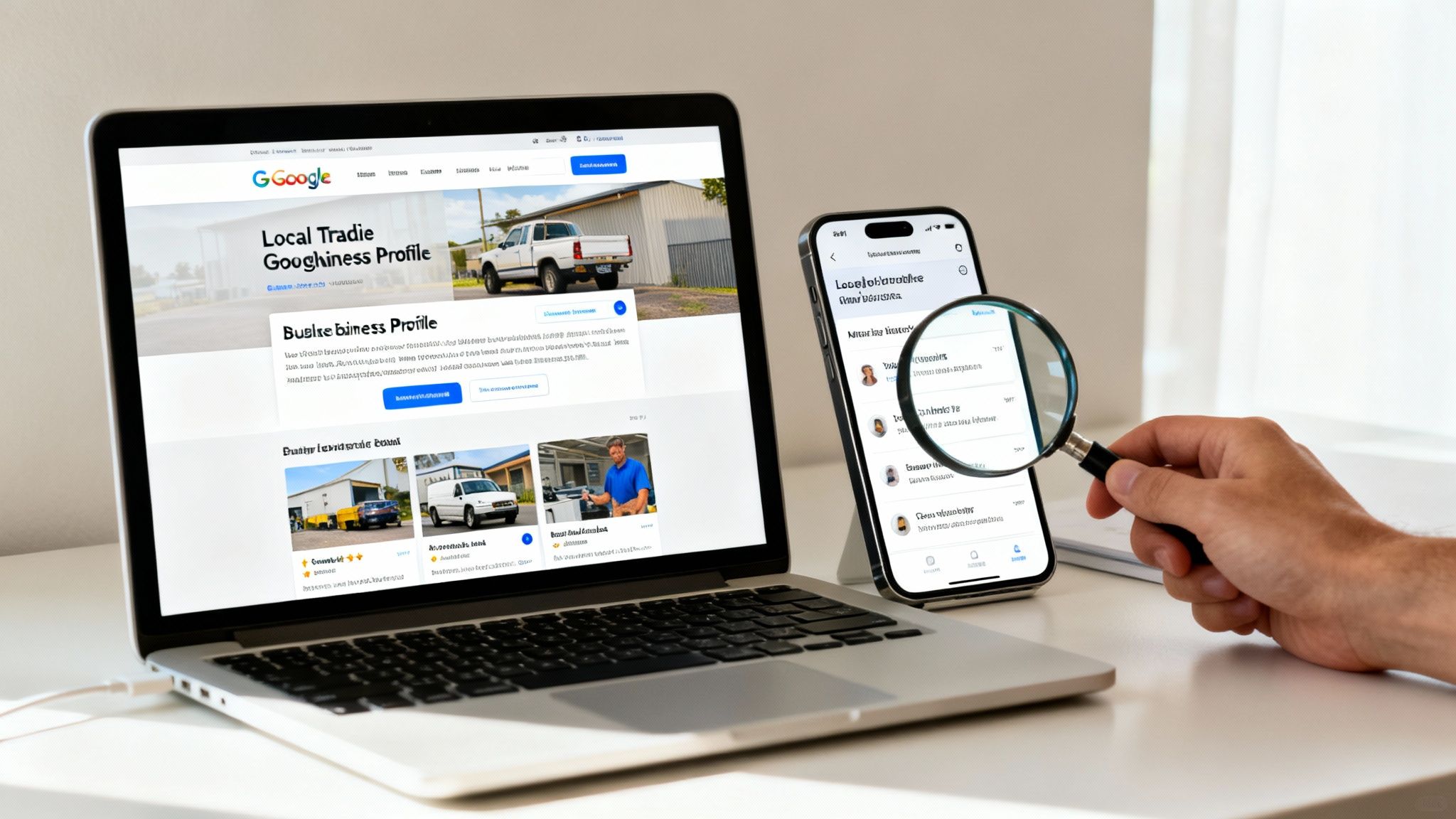
When you’re digging into your competitors' profiles, you’re looking for signs of laziness. Check these specific things:
- Photo Quality: Are their photos recent and professional, or are they blurry, ten years old, or just not there? Fresh, high-quality images of the team, their vans, and their work build a massive amount of trust.
- Service Descriptions: Have they actually listed out all their individual services with proper descriptions? So many businesses just list a couple of broad categories, completely missing the chance to rank for specific things people are searching for.
- Google Posts: Are they using Google Posts to share updates, offers, or recent jobs? Regular activity tells Google (and customers) that the business is alive and kicking.
- Customer Reviews: How many reviews do they have? What’s the average rating? And, critically, are they responding to them? Ignoring reviews, especially the bad ones, is a terrible look.
A complete, active Google Business Profile is a lead magnet. Spotting a competitor with a bare-bones profile is like finding a crack in their armour. For a deeper dive, our guide on Google Business Profile optimisation for local leads gives you the exact steps to make yours unbeatable.
By systematically pulling apart these digital shopfronts, you're not just being nosy; you’re building a list of clear, actionable gaps. A slow website, outdated photos, or a neglected GBP are all quick wins. You can immediately leverage these weaknesses to present a more professional, trustworthy, and appealing front to customers in your area.
Finding Their Keyword and Google Ads Secrets
Alright, you've audited their digital shopfronts. Now it's time to peek behind the curtain and figure out exactly what keywords they're using to bring in customers. This isn't about some complicated tech wizardry; it's just about paying close attention to the language they use on their own website.
Start by scanning their page titles, main headings (the big text at the top of each page), and the descriptions of their services. This is prime real estate for SEO, and whatever your competitors are putting here is a massive clue about the keywords they think are the most valuable.
Decoding Their SEO Strategy
Put on your detective hat for a minute. If you're an electrician and a competitor's service page heading screams "Expert Heat Pump Installation in Manukau," you can bet your bottom dollar they're targeting that exact phrase.
Go through their main service pages and start jotting down the specific phrases you see repeated. Are they zeroing in on:
- Service-specific keywords? (e.g., "gas hot water cylinder repair")
- Location-based keywords? (e.g., "plumber North Shore Auckland")
- Problem-oriented keywords? (e.g., "how to fix a leaking tap")
This simple exercise helps you build a solid list of terms that are already proven to work in your market. But the real gold is in spotting what’s missing. This is where you can get a serious leg up.
The ultimate goal here is to find the 'keyword gaps'—those valuable service or location phrases that your competitors are completely ignoring. If nobody is actively targeting "24/7 emergency electrician Papakura," that’s a golden opportunity for you to create a page for it and potentially rank number one with minimal fuss.
Analysing Their Google Ads Approach
Beyond what's on their website, you need to see how they're spending their advertising dollars. When you're running those Google searches like a customer would, pay close attention to the ads popping up at the very top.
What offers are they pushing? Is it a "No Call-Out Fee" special or "10% Off for New Customers"? The ad copy itself tells you what they believe is their strongest selling point. Look for persuasive language—are they using words like "Guaranteed," "Fast," or "Affordable"? These are direct insights into what they think makes a customer click.
This kind of analysis is crucial in a crowded market. New Zealand's digital advertising scene is getting more competitive by the day, with industry turnover hitting 3.36 billion NZD in 2023. Digital ads now account for a whopping 62.9% of the total ad spend, which just shows how fiercely businesses are fighting for online attention. You can see more details on NZ's advertising landscape over at Statista.com.
By understanding their paid strategy, you can make much smarter decisions with your own budget. You might decide to go head-to-head with a better offer, or you could target different keywords they've completely overlooked. For a deeper dive, check out our guide which covers some of the best practices for Google Ads in 2025.
Putting these SEO and PPC insights together gives you a powerful, 360-degree view of their entire customer acquisition strategy, helping you build a smarter keyword list for your own campaigns.
Turning Customer Reviews into Marketing Gold
Your competitors' reviews are more than just star ratings—they're a goldmine. When you dig into what their customers are actually saying on Google and social media, you start seeing patterns. These patterns reveal their biggest weaknesses, which just so happen to be your biggest opportunities.
This part of your analysis is all about reading between the lines. Are customers constantly complaining that a rival electrician is always late or leaves a mess behind? That’s not just a bad review for them; it’s a ready-made marketing angle for you.
You can literally build your entire brand promise around solving that exact frustration. Imagine promoting an "Always On Time, Always Tidy" guarantee. You immediately stand out and speak directly to a known pain point in the market.
Uncovering Gaps in Their Content
The same logic applies to their website. Most service businesses are great at their trade but not so great at explaining it online. This creates massive content gaps you can drive a truck through.
Look for the questions they aren't answering. If their website doesn't have a blog or a simple FAQ section, you have a clear opening. For example, if you're a plumber and no one in your area has a page answering "how much does it cost to fix a leaky tap in Auckland?", you need to be the first one to write it.
Creating this kind of helpful content does two things:
- You pull in potential customers who are searching for answers and are often ready to hire someone.
- You position your business as the helpful, transparent expert, building trust before they've even picked up the phone.
Mining your competitors' reviews and content isn't just about spotting flaws. It's about systematically finding the exact pain points and unanswered questions in your local market—then building your marketing to solve them better than anyone else.
This is especially powerful right now. Recent social media stats show that 95% of Kiwis aged 15 and over are on social media daily, but a tiny 15% of businesses are tapping into YouTube. This is a huge opportunity for service businesses to use simple video content—like answering those FAQs on camera—to build trust and attract local leads where competitors aren't even looking. You can see more about these NZ IT market trends and opportunities at teksystems.com.
Finding Your Unique Angle
Ultimately, analysing reviews and content gaps helps you find your unique selling proposition (USP). It’s the thing that makes a customer choose you over three other businesses offering the exact same service.
Is your competitor known for being cheap but slow? Your angle is speed and reliability. Do they have great technical skills but terrible communication? Your angle is outstanding customer service and keeping clients in the loop from start to finish. This deep dive into what real customers are saying gives you the raw material to craft a marketing message that genuinely connects and solves real-world problems.
Creating Your Action Plan to Win Locally
All that research is great, but it's useless without a plan. Now it's time to turn those insights into clear, manageable actions that will actually win you more business. The key is to avoid getting overwhelmed; you don't need to fix everything at once.
Instead of staring at a massive, intimidating to-do list, the smart move is to sort your findings into three distinct buckets. This gives your efforts structure and ensures you're making consistent, measurable progress from day one. It's all about building momentum and focusing on what matters most, right now.
Sorting Your Opportunities
Your plan should be broken down into immediate, short-term, and long-term goals. This framework turns a mountain of data into a simple, step-by-step roadmap.
-
Quick Wins (This Week): These are the high-impact, low-effort tasks you can knock out in just a few hours. Think about the easy fixes you spotted, like updating your service descriptions on your Google Business Profile, adding new photos from a recent job, or fixing that broken contact form on your website.
-
Medium-Term Projects (Next Month): This category is for tasks that need a bit more planning and effort. This could be writing two or three blog posts to fill the content gaps you found, or maybe launching a small Google Ads campaign targeting a keyword your main rival is completely ignoring.
-
Long-Term Strategies (Next Quarter & Beyond): These are the bigger-picture moves that build your local authority over time. We're talking about a consistent plan to gather more customer reviews, improving your website's overall SEO, or building out a comprehensive FAQ section that answers every common customer question.
The best action plans are living documents. Start with the quick wins to see immediate results—that’s what will motivate you to tackle the bigger projects. The goal is to create a cycle of consistent, informed action that keeps you one step ahead.
This simple visual shows how the insights you've gathered flow into a repeatable marketing process.
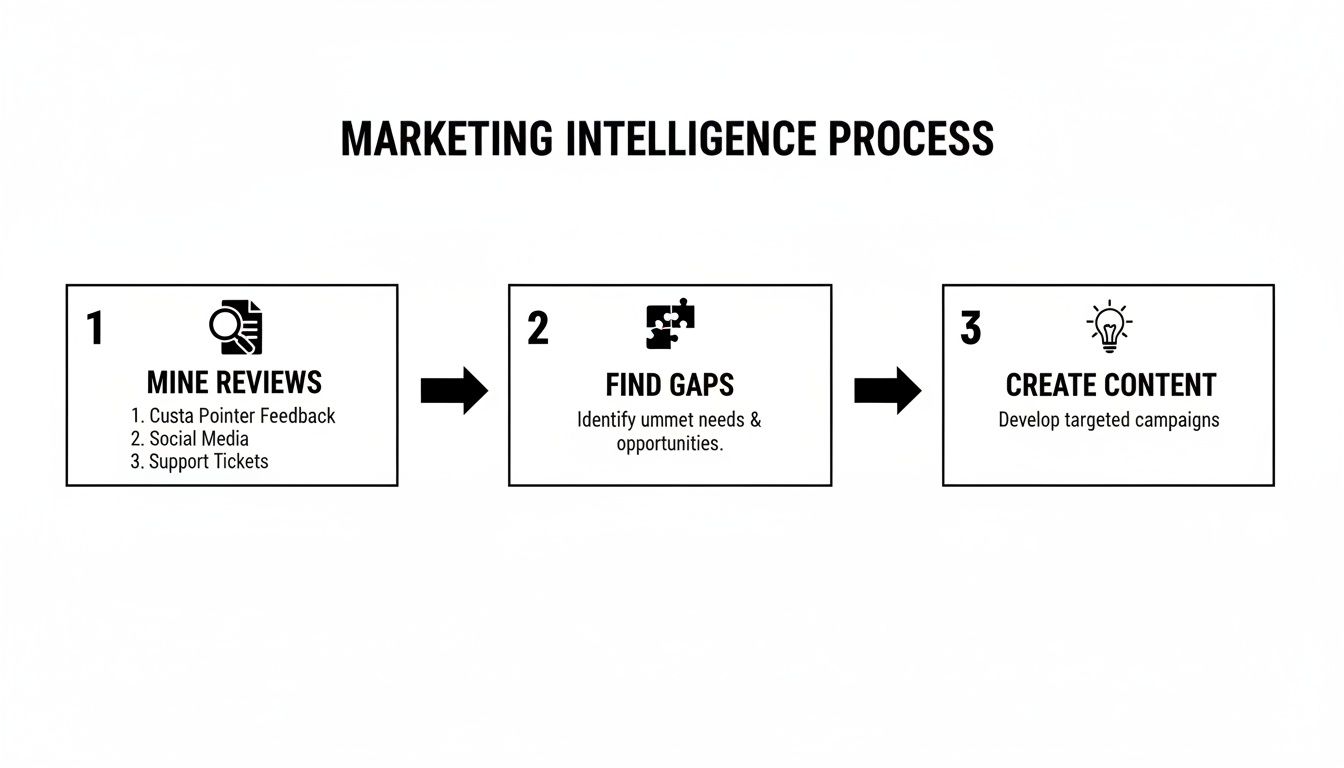
It boils down to a core loop: you mine customer reviews for pain points, find the gaps your competition has missed, and create targeted content that speaks directly to ready-to-buy customers. To build a truly comprehensive plan, you need to integrate these insights with actionable online and offline strategies to attract customers to drive real business growth. Dominating your local market starts with turning what you've learned into what you do next.
Ready to turn competitor insights into a steady stream of local leads? The team at Four Stripes combines conversion-focused web design, Local SEO, and Google Ads management to get your phone ringing. Learn more about our First Page, First Call system.