

Around 60 percent of all online searches now come from mobile devices, making mobile search engine optimisation a non-negotiable priority for any british business. With more people scrolling and searching on their phones every day, ensuring your website stands out on smaller screens can strongly influence customer decisions. Understanding mobile SEO means recognising what truly matters for mobile ranking and avoiding common misconceptions that could hold your business back. This guide unpacks practical strategies that help local companies get discovered and stay ahead.
Table of Contents
- Defining Mobile SEO And Common Misconceptions
- How Mobile Search Differs From Desktop
- Mobile SEO’s Role In Local Search Rankings
- User Behaviour And Mobile Website Experience
- Common Mobile SEO Mistakes To Avoid
Key Takeaways
| Point | Details |
|---|---|
| Importance of Mobile SEO | Mobile search engine optimisation is critical for local businesses to improve visibility and user engagement on smartphones. |
| Fundamentals of Effective Mobile SEO | A mobile-friendly site must load quickly, be responsive, and feature user-friendly navigation to succeed. |
| Differences Between Mobile and Desktop Search | Mobile users require fast, location-relevant results and have shorter attention spans compared to desktop users. |
| Common Mobile SEO Mistakes | Avoid slow loading speeds, non-responsive design, and inconsistent content to enhance mobile search performance. |
Defining Mobile SEO and Common Misconceptions
Mobile SEO represents a critical digital strategy for local businesses seeking to capture potential customers through smartphone search results. At its core, mobile search engine optimisation involves tailoring your website’s digital presence to perform exceptionally well on mobile devices, ensuring seamless user experiences and enhanced search rankings.
The fundamental objective of mobile SEO goes beyond mere visual adaptation. It involves strategically optimising websites to function smoothly across various screen sizes and device types. This means creating responsive designs that automatically adjust layout, image sizes, and navigation elements to provide an intuitive browsing experience. A website that loads quickly, displays correctly, and offers easy interaction will significantly improve user engagement and search engine performance.
Common misconceptions about mobile SEO can potentially harm a business’s online visibility. Many entrepreneurs mistakenly believe that having a mobile-friendly website is optional or that desktop and mobile versions can be managed identically. In reality, mobile users have distinct browsing behaviours and expectations. Search engines like Google prioritise mobile-first indexing, meaning the mobile version of your site becomes the primary reference point for determining search rankings. This approach underscores the importance of not just having a mobile site, but ensuring it delivers a superior, streamlined user experience.
Key characteristics of effective mobile SEO include:
- Responsive web design that adapts to different screen sizes
- Fast loading times (under 3 seconds)
- Easily tappable navigation elements
- Readable text without zooming
- Compressed images for quicker rendering
Successful mobile SEO requires continuous monitoring and refinement, recognising that user expectations and technological capabilities evolve rapidly. Local businesses must stay proactive in understanding and implementing mobile-friendly strategies to remain competitive in an increasingly mobile-driven digital landscape.
How Mobile Search Differs From Desktop
Mobile search fundamentally transforms how users interact with digital content, presenting unique challenges and opportunities for local businesses. Unlike desktop browsing, mobile search is characterised by smaller screens, touch-based interactions, and increasingly sophisticated on-the-go search behaviours that demand rapid, contextually relevant information.
Mobile web interfaces represent a dramatically different digital landscape compared to traditional desktop experiences. Touch-based navigation requires larger, more accessible interaction elements, with simplified layouts that prioritise critical information. Where desktop users might tolerate complex menus and multiple clicks, mobile users expect immediate, streamlined access to precisely what they need. This means design strategies must radically compress information hierarchy, ensuring users can find and engage with content within seconds.

The technical distinctions between mobile and desktop search extend beyond visual presentation. Mobile searches typically demonstrate higher intent and immediacy—users often seek location-specific, time-sensitive information like business hours, contact details, or instant directions. Search engines consequently prioritise mobile-friendly websites that load quickly, display cleanly, and provide frictionless user experiences. Critically, Google’s mobile-first indexing means your mobile site’s performance directly influences overall search rankings, making responsive design not just preferable, but essential.
Key differences between mobile and desktop search include:
- Smaller screen real estate requiring compact, focused design
- Touch-based navigation versus mouse-driven interactions
- Shorter user attention spans
- Location-aware search capabilities
- Preference for vertical scrolling content
Successful digital strategies must recognise these nuanced differences, crafting mobile experiences that are not merely scaled-down desktop versions, but thoughtfully optimised digital environments designed specifically for mobile user expectations and behaviours.
Mobile SEO’s Role in Local Search Rankings
Local search rankings have become increasingly dependent on mobile optimisation, transforming how small businesses compete for digital visibility. The rise of smartphone usage has fundamentally reshaped search engine algorithms, creating a landscape where mobile performance directly influences a business’s ability to attract local customers.
Local search strategies now prioritise mobile-friendly websites as a critical ranking factor. Search engines like Google have implemented mobile-first indexing, which means the mobile version of a website becomes the primary reference point for determining search rankings. This approach underscores the importance of creating responsive, fast-loading websites that provide seamless user experiences across all mobile devices.
The technical nuances of mobile SEO extend far beyond simple responsiveness. Local businesses must consider multiple factors that impact mobile search performance, including page load speed, touch-friendly navigation, localised content, and mobile-specific user experience elements. Websites that successfully integrate these components can significantly improve their visibility in local search results, effectively connecting with potential customers who are searching for services in their immediate vicinity.
Key considerations for mobile SEO in local search include:
- Rapid page loading times (under 3 seconds)
- Responsive design that adapts to different screen sizes
- Clear, easily tappable navigation elements
- Localised content with geographically relevant information
- Mobile-optimised contact and direction features
Successful local businesses recognise that mobile SEO is not a one-time implementation but an ongoing process of refinement and adaptation. By continuously improving mobile user experiences and staying attuned to evolving search engine algorithms, companies can effectively leverage digital platforms to attract and engage local customers.
User Behaviour and Mobile Website Experience
Mobile user experience represents a critical battleground for local businesses seeking to capture and retain digital attention. The modern smartphone user demonstrates dramatically different browsing behaviours compared to traditional desktop interactions, demanding instantaneous, frictionless digital experiences that deliver precisely what they need within seconds.
Mobile website performance critically hinges on understanding these nuanced user expectations. Research reveals that mobile users generate higher click-through rates but possess significantly shorter attention spans, meaning businesses have mere moments to communicate value and engage potential customers. This compressed interaction window demands ruthlessly efficient design, with navigation elements that are intuitive, content that is immediately scannable, and critical information prominently displayed.
The psychological dynamics of mobile browsing fundamentally differ from desktop exploration. Mobile users are typically task-oriented, seeking rapid solutions while potentially multitasking in complex environments. They require websites that anticipate their needs, offer clear pathways to information, and eliminate any potential friction points in their digital journey. Successful mobile experiences create seamless, almost invisible interactions that feel effortless and natural, allowing users to accomplish their objectives with minimal cognitive load.
Key principles of exceptional mobile user experience include:
- Lightning-fast load times
- Minimal required interactions
- Clear, prominent call-to-action buttons
- Simplified navigation menus
- Touch-friendly interface design
- Contextually relevant content
Local businesses must recognise that mobile user experience extends far beyond visual design—it represents a holistic approach to understanding and serving digital customers’ most immediate needs. By prioritising speed, clarity, and user-centric design, companies can transform casual mobile interactions into meaningful engagement opportunities.
Common Mobile SEO Mistakes to Avoid
Mobile search optimisation presents a complex landscape where seemingly minor technical errors can significantly undermine a local business’s digital visibility. Navigating this terrain requires understanding the most prevalent pitfalls that can inadvertently damage search engine performance and user experience.
Local business websites frequently encounter critical mobile SEO challenges that can dramatically reduce their search rankings. Improper website configurations, such as inconsistent content between mobile and desktop versions, create substantial risks for search engine indexing. Search engines prioritise websites that provide seamless, uniform experiences across all devices, meaning any discrepancies can trigger algorithmic penalties that push businesses further down search results.
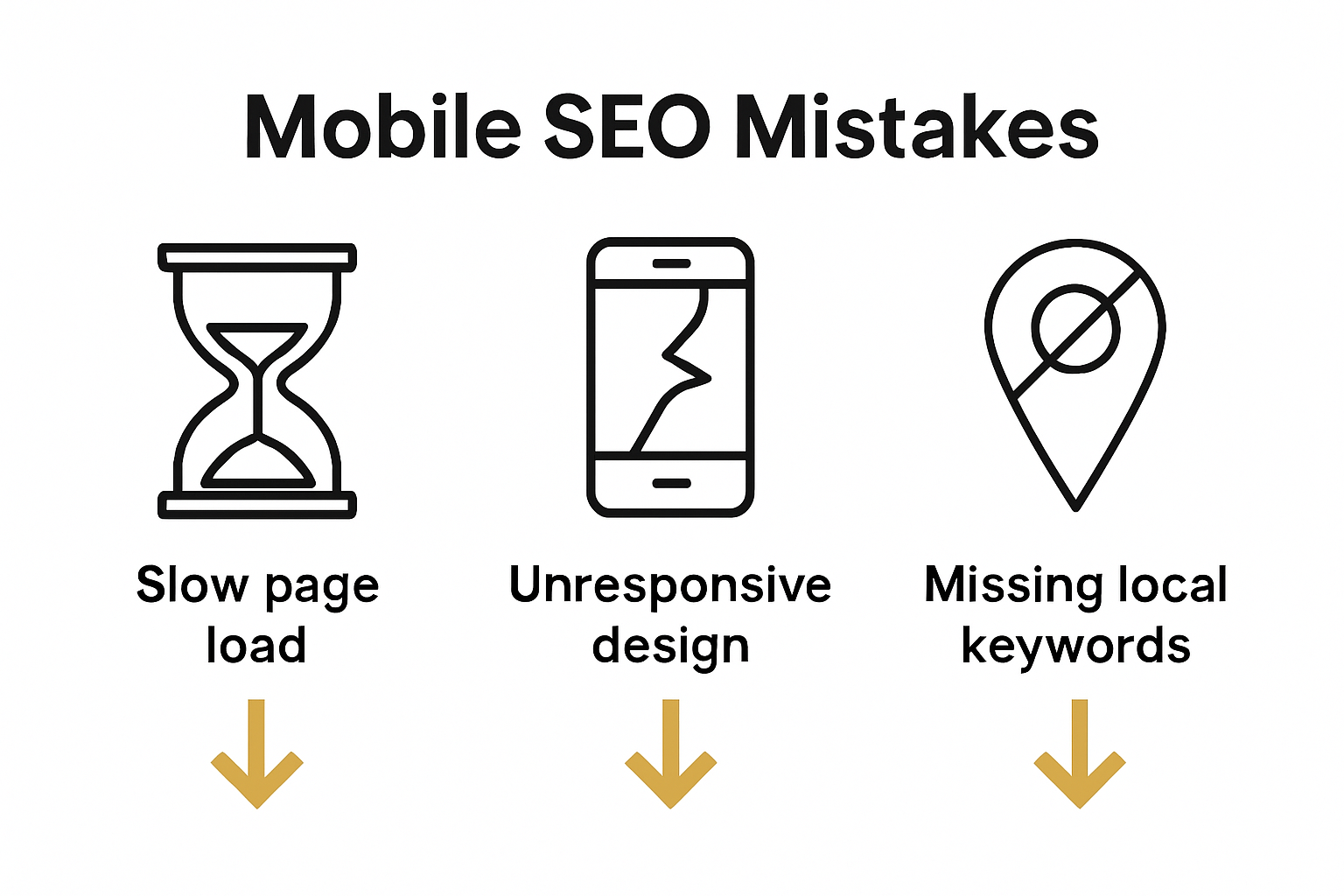
Technical implementation remains a significant battleground for mobile SEO success. Slow page loading times, non-responsive design, and complex navigation structures represent substantial barriers to effective mobile search performance. Businesses must recognise that mobile users demand instantaneous, frictionless interactions—any friction point becomes an immediate opportunity for potential customers to abandon their digital journey and seek alternatives.
Critical mobile SEO mistakes to avoid include:
- Slow website loading speeds
- Non-responsive design across devices
- Inconsistent content between mobile and desktop versions
- Unoptimised image and media files
- Complex, difficult-to-navigate menus
- Lack of mobile-specific user experience considerations
- Inadequate local schema markup
Successful local businesses understand that mobile SEO is not a static achievement but a continuous process of refinement and adaptation. By proactively identifying and addressing potential technical limitations, companies can create digital experiences that not only meet but exceed modern user expectations.
Unlock Your Local Business Potential with Expert Mobile SEO Support
Mobile SEO is essential for local businesses aiming to stand out in an increasingly mobile-driven world. Many face challenges like slow loading times and non-responsive designs that impact their Google rankings and user engagement. By focusing on fast, responsive websites that provide seamless experiences on any device you ensure you meet the expectations of mobile users and gain an edge in local search results.
Maximise your digital presence by partnering with specialists who understand the nuances of mobile SEO and how it ties into broader strategies like local SEO and Google Business Profiles. At Four Stripes, our customised approach combines proven SEO methods with strategic website design to generate consistent inbound calls and page one rankings.
Take the next step towards dominating your local market with a tailored plan that transforms your mobile user experience and online visibility. Discover how our SEO and Digital Marketing solutions work together to deliver results fast. Contact us today at Four Stripes and start your journey to becoming the first call for local customers.
Frequently Asked Questions
What is mobile SEO?
Mobile SEO refers to the process of optimising a website to perform effectively on mobile devices. This includes responsive design, fast loading times, and an intuitive user experience tailored for smaller screens.
How does mobile SEO differ from desktop SEO?
Mobile SEO focusses on elements specific to mobile user behaviour, such as touch-based navigation, smaller screen sizes, and higher intent searches. Desktop SEO, in contrast, can accommodate more complex navigational structures and content layouts.
Why is mobile SEO important for local businesses?
Mobile SEO is critical for local businesses as search engines like Google use mobile-first indexing, meaning the mobile version of a site influences rankings more than the desktop version. A well-optimised mobile site helps attract local customers searching for services on their smartphones.
What are common mistakes to avoid in mobile SEO?
Common mistakes include slow loading speeds, non-responsive design, inconsistent content across devices, complex navigation, and lack of mobile-specific user experience strategies. Addressing these issues can enhance search rankings and improve user experience.
Recommended
- The Essential Guide to SEO Strategy for NZ Businesses | Website Design & Google Ads That Generate Leads
- 7 Essential Digital Marketing Tips 2025 for Local Biz | Website Design & Google Ads That Generate Leads
- What Is Local SEO? Complete Guide for NZ Businesses | Website Design & Google Ads That Generate Leads
- How to Improve Google Rankings for Local Businesses | Website Design & Google Ads That Generate Leads
- Comprendre l’impact vidéo dans le marketing local