
When we talk about professional website design in Wellington, we’re not just talking about an online brochure. We’re talking about building your single most powerful sales tool—a digital foundation that works around the clock to find, engage, and convert local customers looking for exactly what you offer.
Your Hardest-Working Salesperson
In Wellington's competitive market, a strong online presence isn't just a nice-to-have; it's the engine of growth. Think of your website as your best salesperson. It never sleeps, never takes a sick day, and is always ready to give potential customers the information they need, right when they need it.
A properly built website establishes your credibility, shows off your expertise, and makes it incredibly easy for visitors to take the next step, whether that's calling your office or booking a job.
But here's the thing. While almost every potential customer is online, a surprising number of local Wellington businesses are nowhere to be found.
The Wellington Digital Gap
The data tells a clear story. While internet use in New Zealand has hit 96.2% of the population as of early 2025, many local businesses haven't kept up. Industry surveys reveal a shocking statistic: only 31% of Wellington firms actually have a website. The rest are effectively invisible online. You can read more about these New Zealand website trends and what they mean for businesses.
This gap between where customers are and where businesses are is your biggest opportunity. By investing in a professional website, you're putting your business directly in front of an active, motivated audience that most of your competitors are completely ignoring.
A website isn't an expense; it's a core business investment. It’s the machine that drives modern customer acquisition, builds trust, and turns Google searches into actual, real-world revenue.
This guide is your roadmap. We'll break down everything you need to know, from costs and must-have features to picking the right web design partner. Let's get started.
Understanding Wellington Website Design Costs
It's the first question every business owner asks: "So, how much is this actually going to set me back?" When it comes to getting a professional website built here in Wellington, there's no single price tag.
Think of it like building a house. A simple, one-bedroom bach in the Wairarapa has a completely different budget than a multi-level architectural home in Oriental Bay with all the custom trimmings. The final cost comes down to what you need it to do and how complex the job is.
A website's price is a direct reflection of the time, skill, and features needed to get it right. A straightforward "brochure" website with a few pages and a contact form is one thing. But if you need an e-commerce shop with secure payments, product filters, and inventory management, you're looking at a much more involved project—and a bigger investment.
This infographic really highlights the gap between how many Kiwis are online versus how few local businesses have a proper website.
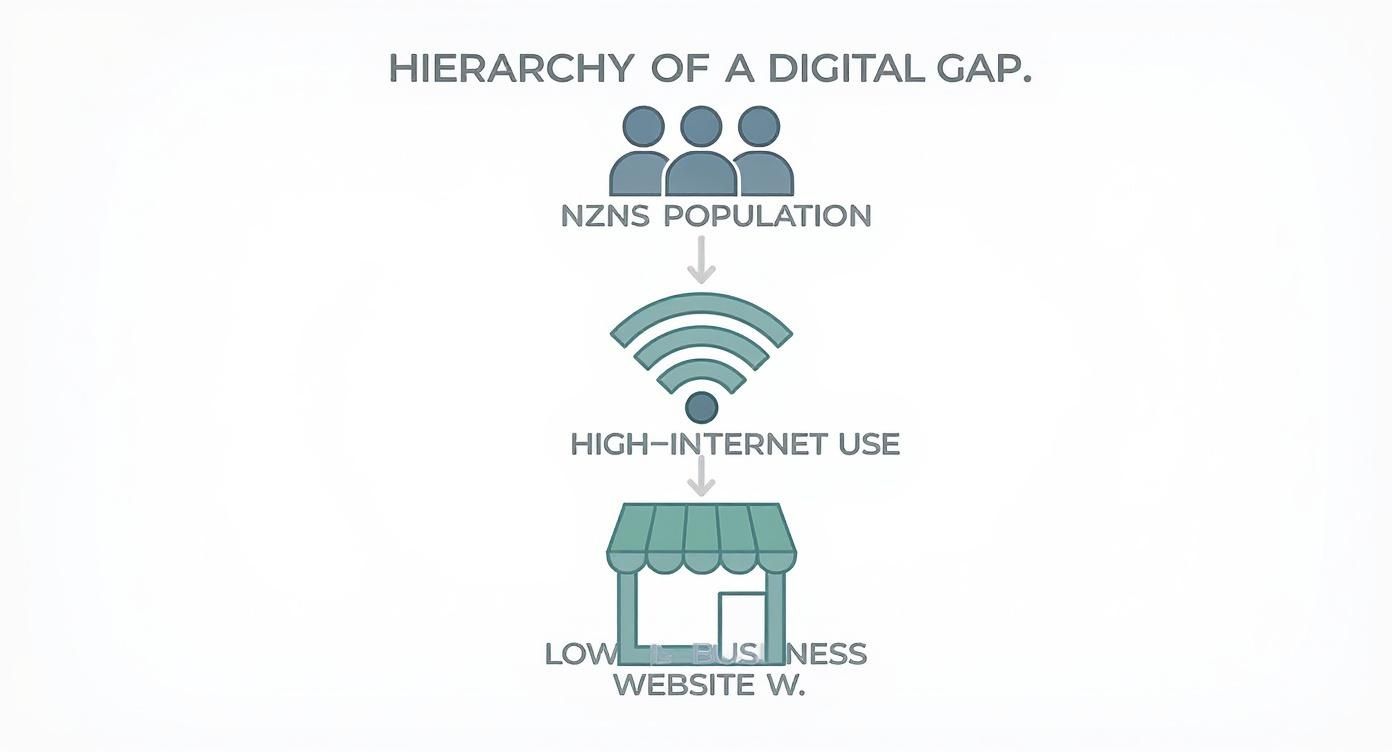
This just shows the massive opportunity for Wellington businesses to get in front of customers while their competitors are still invisible online.
Breaking Down the Investment Tiers
To give you a clearer idea of what to budget for, website projects in Wellington usually fall into a few common buckets. Each one builds on the last, adding more grunt and custom features to hit your specific business goals.
Here’s a rough guide to what you can expect to find in the Wellington market. These are ballpark figures, of course, as every project is unique, but it gives you a solid starting point for conversations with any potential web designer.
Estimated Website Design Costs in Wellington
| Website Type | Typical Features | Estimated Cost (NZD) |
|---|---|---|
| Starter "Brochure" Site | 3-5 pages (Home, About, Services, Contact), basic contact form, mobile responsive. | $2,500 – $5,000 |
| Business Growth Site | 5-10+ pages, blog/news section, SEO foundations, lead capture forms, testimonials. | $5,000 – $12,000 |
| Advanced/E-commerce Site | Online store functionality, booking systems, custom integrations, client portals. | $12,000+ |
As you can see, the investment grows with the complexity and the potential return for your business. An advanced site costs more because it's built to handle specific, revenue-generating tasks automatically.
What Else Affects the Final Price?
Beyond the basic package, a few other things will shape the final quote you receive. Knowing these upfront will save you from any nasty surprises down the track.
Key factors that add to the cost (and the value) include:
- Custom Graphic Design: Creating a unique visual identity that isn't just a generic template.
- Professional Copywriting: Writing words that sell and are optimised for Google—this is a skill in itself!
- Local SEO Setup: The technical work needed to make sure Google actually shows your site to people in Wellington.
- Ongoing Maintenance: Keeping your site secure, updated, and running smoothly after it goes live.
Each of these elements is a crucial piece of the puzzle. They ensure your website isn't just a pretty online brochure, but a hard-working asset that brings in business. For a more detailed breakdown, check out our guide to website design pricing which goes into the nitty-gritty.
Must-Have Features for a High-Performing Website

A great website is more than just a pretty online brochure; it’s your hardest-working employee, built to turn casual visitors into paying customers. While looks matter, the real muscle behind professional website design in Wellington is its functionality. These foundational features are completely non-negotiable if you want results.
Think of them as the engine, chassis, and steering of a car. A nice paint job is great, but without the core components, you’re not going anywhere. For your website, this means it absolutely must be fast, easy to use on any device, and crystal clear about what you want people to do next.
A properly built website has a direct impact on your bottom line. The data doesn't lie: a well-designed site can boost conversions by up to 200% compared to a clunky one. And when asked, 94% of visitors say easy navigation is the most important feature a website can have.
Mobile-First Is the Only Way Forward
These days, more than half of all web traffic comes from people scrolling on their phones. This isn't a trend; it's the new standard. Your website has to look and work perfectly on a small screen. A mobile-first design means we build your site for the majority of users from the very beginning, not as a clumsy afterthought.
Google has also made it clear: they prioritise mobile-friendly websites in their search rankings. If your site is a pain to use on a phone, you’re not just frustrating potential customers—you’re telling Google your site isn't worth showing to anyone. For a deeper dive, check out our guide on small business website design in NZ.
Speed Is a Feature, Not a Luxury
Be honest: how long will you wait for a slow website to load? A few seconds? If you’re like most people, not even that long. A tiny one-second delay in page load time can slash conversions by 7%. A slow site feels unprofessional and tests your visitor's patience, sending them straight to your competitor.
The main culprits behind a slow website are usually:
- Bloated Images: Huge image files are the number one cause of slow-loading pages.
- Messy Code: Clean, efficient code loads much faster than code that's been patched together.
- Cheap Hosting: You get what you pay for. Good web hosting provides the horsepower needed for speed.
Clear Calls-to-Action Guide Your Visitors
Every single page on your website needs a purpose. A Call-to-Action (CTA) is a button or link that tells the visitor exactly what to do next. "Call Us Now," "Get a Free Quote," "Book an Appointment." Without clear CTAs, visitors are left to wander aimlessly and will almost always leave without taking action.
Your CTAs are the signposts on your website. They guide visitors from just browsing to actually picking up the phone, turning curiosity into a genuine lead for your business.
And beyond the technicals, a high-performing website must be inclusive. Building an ADA compliant website design ensures everyone, regardless of ability, can access your services.
How to Win Customers with Local SEO
Having a stunning, high-performance website is a huge step, but let's be honest—it’s only half the battle. If your local customers can’t find it when they search on Google, your investment isn't going to bring in the jobs you need. This is where Local Search Engine Optimisation (SEO) becomes your most powerful tool.
Think of Local SEO like setting up shop on the busiest corner of Cuba Street instead of a back alley. It’s the strategy that gets your business seen in Google Search and on Google Maps the moment a potential customer nearby is looking for exactly what you do.
Without it, your brand-new website is like a brilliant billboard in the middle of the Rimutaka Range—it looks great, but none of the right people will ever see it.
When someone in Karori searches for "plumber near me," Google's one and only job is to show them the most relevant, trustworthy, and geographically closest result. A massive part of professional website design in Wellington is building the technical foundation to prove to Google that you are that result.
Your Website Is the Hub for Local Signals
Your website is the single source of truth for your business online. It's where Google cross-checks everything to confirm what you do, where you do it, and how people can get in touch. To win at local search, your entire online presence has to send clear, consistent signals back to this central hub.
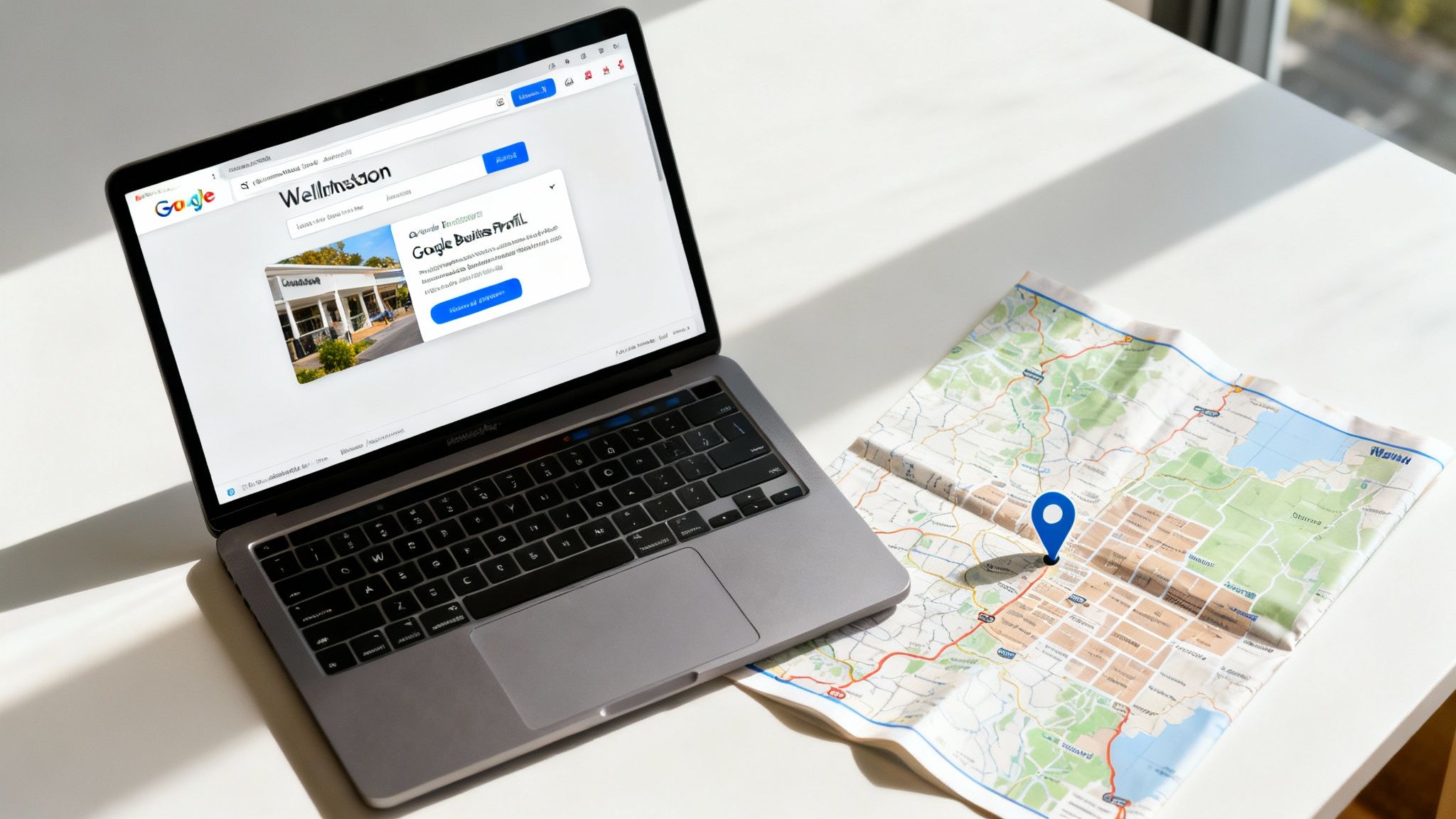
The most critical link is between your website and your Google Business Profile (GBP). That's the free listing that pops up in Google Maps and the "Map Pack" at the top of the search results. Your website must be linked to your GBP, and every piece of information between them needs to match. Perfectly.
Inconsistencies in your business name, address, or phone number across the web don't just confuse customers—they confuse Google. That confusion can seriously damage your local rankings. Your website is the anchor that keeps this all consistent.
Building Authority in Your Suburbs
To really dominate the local search results, you need to prove to Google that you're the go-to expert in specific Wellington suburbs. You do this by creating content on your website that’s laser-focused on those areas.
For example, instead of just having one generic "Services" page, a much smarter strategy is to create dedicated pages for your key services in the suburbs you serve most often.
- Service Pages by Suburb: Think pages like "Emergency Plumbing in Johnsonville" or "New Roofs in Newtown."
- Case Studies or Project Galleries: Showcase your finished work with location tags, like a "Kitchen Renovation in Khandallah."
- Local Blog Content: Write articles answering questions your Wellington customers are actually asking, such as "Best Guttering for Wellington's Windy Conditions."
This approach tells Google exactly where you operate. It makes you the obvious choice to show a customer in that specific suburb. By weaving these location-specific keywords throughout your site, you build a powerful web of local relevance. To go a bit deeper, check out these essential local SEO strategies for small NZ businesses that build on these core ideas.
How to Choose the Right Web Design Partner
Picking a web designer in Wellington isn't like hiring a supplier—it's about finding a partner who's genuinely invested in your success. You need someone who gets what you're trying to achieve and can build a website that actually brings in work, not just sit there looking pretty.
With so many freelancers, agencies, and DIY builders out there, how do you sort the good from the bad?
The demand for good web designers is booming. New Zealand's digital tech sector chipped in $7 billion to GDP in 2021 and has been growing at a massive 10.4% each year. That's great for choice, but it means you have to be extra careful who you trust with your business. You can see more on New Zealand's digital sector growth to get the full picture.
Questions to Ask Any Potential Partner
Before you even think about signing a contract, you need to grill them. The right questions will quickly show you if they know their stuff or if they're just full of hot air.
Here’s what you should be asking:
- Can I see some websites you’ve built for other local businesses like mine? This is non-negotiable. You need to see real-world examples of their work, preferably for businesses in Wellington or in a similar trade.
- Walk me through your process, from our first chat to launch day. A pro will have a clear, step-by-step process they can explain without hesitation. If it sounds messy or they can't explain it simply, run.
- How will we know if the new website is actually working? If they start talking about "brand presence" or how nice it looks, be wary. You want to hear about leads, phone calls, form submissions, and rankings.
- What happens after the site goes live? What's your plan for support and maintenance? A website is a living thing. It needs updates, security checks, and someone to call when things go wrong.
Spotting the Red Flags
Knowing what not to look for is just as important. Some warning signs are subtle, but others are massive red flags that should have you running for the hills.
If anyone promises you a "guaranteed #1 ranking on Google," walk away. Real SEO takes time and effort. Nobody can guarantee the top spot, and those who do are often using risky shortcuts that can get your site blacklisted.
Keep an eye out for these other warning signs:
- They hide behind technical jargon. A good partner makes the complex simple. If they're trying to confuse you with acronyms and buzzwords, they're either hiding something or don't know how to communicate.
- The price is vague or feels too good to be true. You should get a detailed proposal with a clear breakdown of every cost. No hidden fees, no surprises.
- They're slow or hard to get a hold of. If their communication is poor when they're trying to win your business, imagine how bad it will be once they have your money.
This is a big decision for your business, so don't rush it. Do your homework, ask the tough questions, and find a team that feels like they're on your side.
So, What’s Next? Turning Knowledge into a Lead-Generating Website
Alright, we’ve covered a lot. You’ve seen what goes into a professional website design Wellington businesses need to actually get more jobs—from the real costs and timelines to the non-negotiables like mobile performance and speed. You even know how to spot a dodgy agency from a mile away.
Now, it's time to take all that theory and put it into practice.
Don’t worry, this isn’t about making a huge, scary commitment. It all starts with a simple chat to figure out what you actually want your website to do. Are you chasing more phone calls? Do you want people filling out quote forms? Or is it about getting direct online bookings to fill up your calendar? Getting clear on that one thing is the first, most important step.
Your Simple Action Plan
Before you even think about talking to a web designer, get these three things sorted. It’ll make the whole process smoother and ensure you’re prepared for a productive conversation.
- Pinpoint Your #1 Goal: If a visitor could only do one thing on your site, what would it be? Get a quote? Call you? Book a job? Write it down. Be specific.
- Jot Down Your Must-Haves: Based on everything we've talked about, what features are essential for your business? Think about things like a gallery to show off your work, a simple online booking system, or a blog to share your expertise.
- Prep Your Questions: Get that list of questions ready. You’ll want to ask about their process, how they track results, and what happens after the site goes live.
Think of it like this: A great website is a partnership. You bring the expertise about your trade and your customers. Your web designer brings the technical skill to turn that knowledge into a tool that makes your phone ring.
Once you have this groundwork done, you're in the perfect position to start talking to the pros. The next logical step is to book a no-obligation strategy session. We can sit down, go through your goals, and map out exactly how to build a website that brings in real, measurable leads for your business.
Common Questions About Wellington Web Design
Kicking off a new website project brings up a lot of questions. We get it. As a Wellington business owner, you want to know what you’re getting into before you commit. Here are the straight-up answers to the most common queries we hear, with no fluff.
These are the practical, need-to-know details that will help you move forward with your eyes wide open.
How Long Does a Website Project Take?
It's the first thing everyone asks, and the honest answer is: it depends. But for a typical Wellington service business that needs a proper, lead-generating website, you should expect it to take between three to six weeks.
That's from our first chat to the day your site goes live. This timeframe gives us enough breathing room to do the job right, including:
- Discovery and Strategy: Nailing down your goals and who your customers are.
- Design and Build: Crafting the layout and putting all the pieces together.
- Content: Getting your text, photos, and service info loaded up.
- Review and Feedback: Giving you plenty of time to look things over before launch.
A simple one-page site might be faster, of course. Something more complex with custom booking forms or a full online shop will naturally take longer. The biggest thing that keeps a project on track? Quick feedback and having your content ready to go.
Why Do I Need Ongoing Website Maintenance?
Think of your new website like a brand-new work ute. You wouldn't drive it for years without getting it serviced, right? Your website is exactly the same. Launch day is just the beginning; ongoing maintenance is what keeps it running smoothly and earning its keep.
First off, there are security updates. The software that runs your site, like WordPress and its plugins, is constantly updated to close security gaps. If you ignore these, you’re leaving the door wide open for hackers. Second is backups. Regular maintenance means your site is saved, so if the worst happens, we can get you back online fast. Lastly, it keeps your site fast and error-free, which is huge for keeping visitors happy and staying on Google’s good side.
Website maintenance isn't some optional add-on. It's the insurance policy for your most valuable marketing asset. It protects your investment and makes sure your site stays a reliable tool for bringing in jobs.
Can I Update the Website Myself?
Yes, 100%! A good website should put you in the driver's seat, not make you feel trapped. We build our sites on a Content Management System (CMS) – usually WordPress because it's powerful yet easy to use. A CMS is basically a user-friendly dashboard that lets you manage your site's content without having to touch a single line of code.
This means you can easily log in and make changes whenever you need to, no tech skills required. You’ll be able to:
- Add new photos to your project gallery.
- Update your business hours or phone number.
- Write and publish a new blog post.
- Tweak the wording on your services pages.
We’ll even show you how it all works so you feel confident making those day-to-day updates. You get full control over your content, while we handle all the technical heavy lifting behind the scenes.
Ready to build a website that actually gets the phone ringing? The team at Four Stripes combines expert Wellington web design with powerful local SEO to turn your online presence into a lead-generating machine. Book a no-obligation strategy session with us today and let's map out a plan for your success.