
So, how much does a new website actually cost a UK business? The short answer is it can be anything from £1,500 for a simple, effective site to over £15,000 for a beast of a custom build. The final number really just comes down to what you need your website to do to win more customers.
Your Quick Guide to UK Website Design Costs
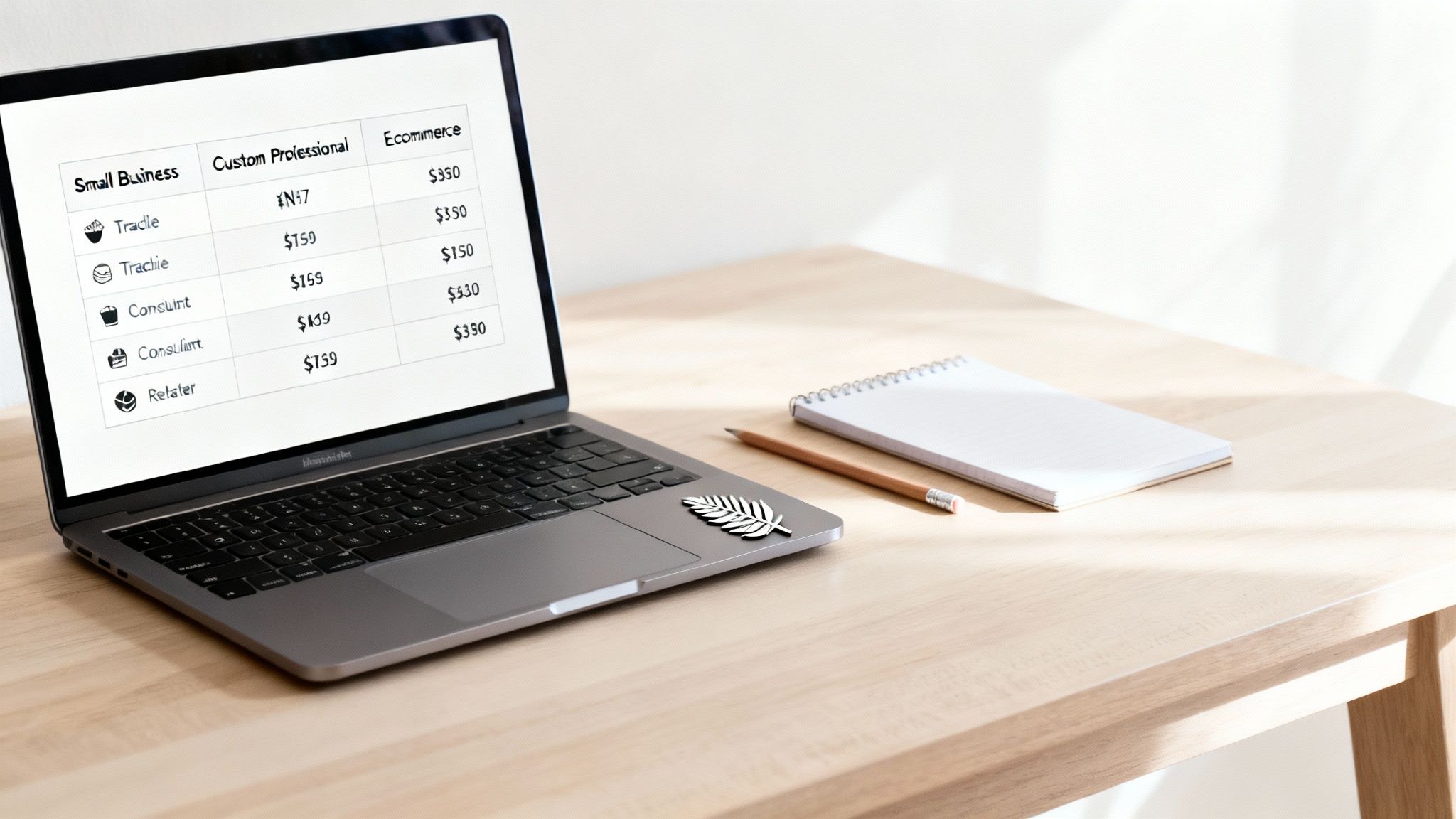
Trying to nail down a website price is a bit like quoting a building job. You wouldn't expect a garden shed to cost the same as a multi-level office block, right? It’s the exact same logic for websites. There's no single price because every single business has different goals.
Your website isn't just an online brochure; it's a hard-working asset. It’s your best tool for generating leads, building trust, and actually making sales. Because of that, the cost is a direct reflection of what you need it to achieve for your business.
A local sparky might just need a sharp-looking site that shows off their work and makes it easy for people to request a quote. On the other hand, a nationwide retailer will need a full-blown e-commerce machine with all the bells and whistles.
Understanding the Price Tiers
To give you a clearer picture, let's break down the common types of websites and what you can expect to invest. Here in the UK, the price tag shifts dramatically based on how complex the site is. For instance, a standard business website with around 8 to 16 pages typically lands somewhere between £2,000 and £7,000, plus a bit for ongoing upkeep. You can get a more detailed look in this local web design price guide.
A website's cost isn't an expense—it's an investment in your business's most powerful sales and marketing tool. The trick is to match what you spend with what you want to achieve.
To make it even simpler, here’s a quick table summarising what different types of websites might cost in the UK. It breaks down the features you get and the kind of businesses that get the most out of each level.
Estimated UK Website Design Costs at a Glance
| Website Type | Typical Features | Estimated Cost (GBP) | Best For |
|---|---|---|---|
| Basic Brochure Website | 3-5 pages, contact form, mobile-friendly design, basic on-page SEO. | £1,500 – £4,000 | Sole traders, new businesses, or anyone needing a simple online presence. |
| Small Business Website | 8-16 pages, blog, CMS (e.g., WordPress), advanced contact forms, SEO setup. | £4,000 – £7,000 | Established service businesses like tradespeople, consultants, and local professionals. |
| Custom Business Website | Custom design, advanced features (e.g., booking systems), CRM integration, in-depth SEO strategy. | £7,000 – £15,000 | Growing businesses needing a unique brand presence and specific lead generation tools. |
| E-commerce Store | Product catalogue, secure payment gateway, inventory management, customer accounts, shipping integration. | £6,000 – £20,000+ | Retailers, wholesalers, and any business selling products directly online. |
This table should give you a solid starting point for figuring out where your business fits and what sort of budget you should be thinking about.
The Key Factors That Determine Your Website Cost
Now that you’ve got a ballpark idea of the price ranges, let’s pull back the curtain on the 'why' behind the numbers. A website quote isn’t just pulled from thin air; it’s a direct reflection of the time, skill, and tech required to build a tool that actually makes your phone ring.
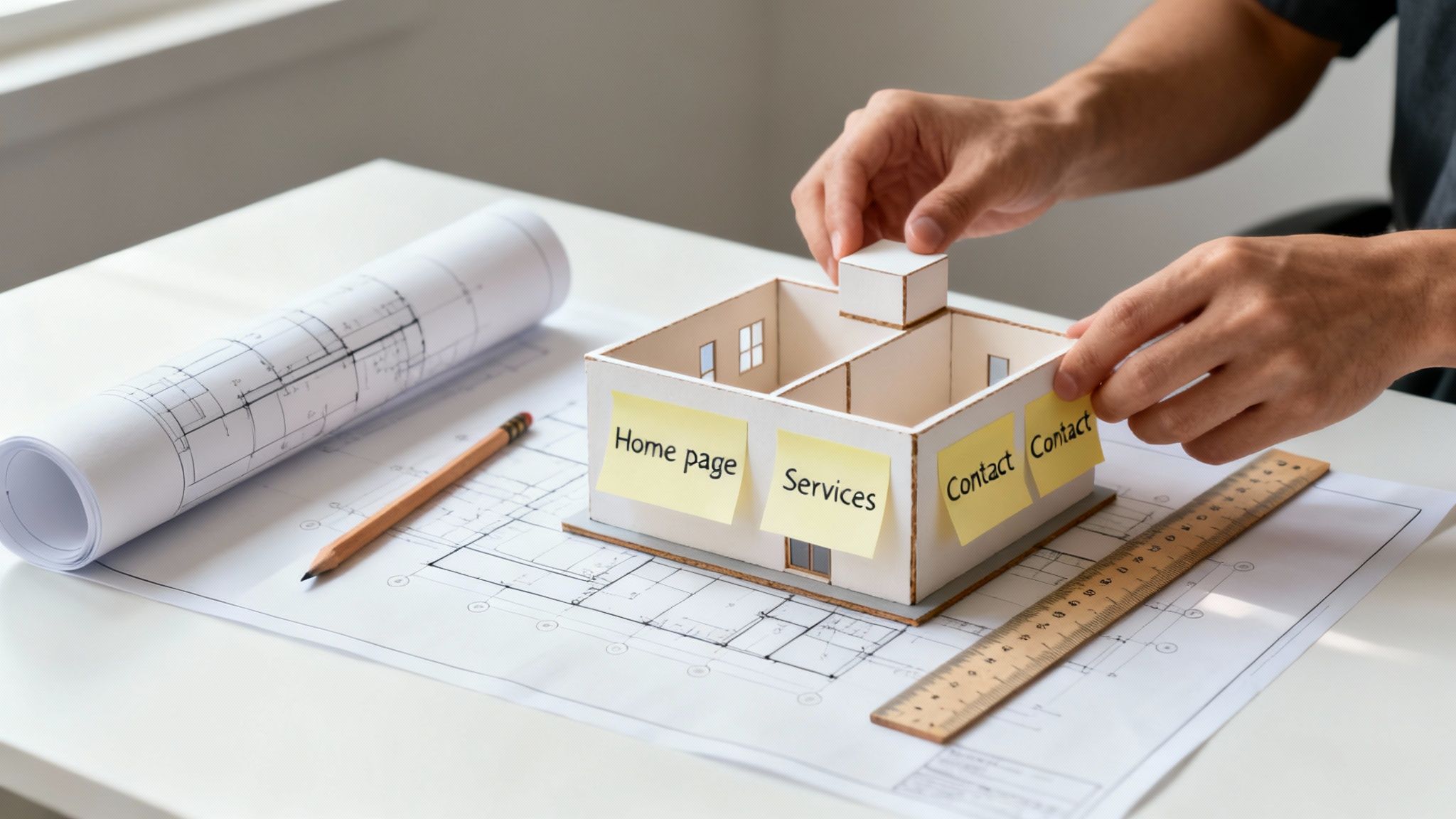
Think of it like building a house. You wouldn't expect a builder to give you a fixed price without a blueprint. The number of rooms (pages), custom architectural features (unique design), and the quality of the plumbing and wiring (functionality) all shape the final cost.
Just like no two building projects are the same, no two websites are either. A Hamilton-based plumber has completely different needs from a law firm in London, and their websites—and the price tags attached—will reflect that reality.
Website Size and Number of Pages
One of the most straightforward cost drivers is simply how big your website is, specifically the number of unique pages that need designing and building. Every single page is a distinct piece of work requiring its own layout, content, and optimisation to get found on Google.
A basic five-page website (Home, About, Services, Blog, Contact) is like a modest starter home—it covers the essentials perfectly. But if you offer multiple distinct services, you really need a dedicated page for each one if you want to rank well in search results.
Take an electrician, for example. To properly target local customers, they might need separate pages for:
- Residential Electrical Services
- Commercial Electrical Fit-outs
- EV Charger Installation
- Emergency Call-Outs
Each of these adds to the design and development time, which directly impacts your final website design cost. It’s not just about adding another link to your menu; it’s about creating a new, valuable asset that attracts a specific type of customer.
Custom Design vs Template-Based Design
This is probably the biggest fork in the road for your budget. It’s the difference between buying a suit off the rack and getting one properly tailored.
A template-based design uses a pre-built layout. It’s faster and cheaper, but you’re stuck working within a fixed structure. Sure, you can change colours and fonts, but the core design is shared by countless other websites, making it much harder for your business to stand out from the crowd.
A custom design, on the other hand, is built from the ground up just for your brand and your customers. A good agency will run discovery sessions to get inside your head, understand your goals, and figure out what makes your customers tick. The result is a one-of-a-kind website that’s built to convert visitors into leads.
While a template gets you online fast, a custom design gives you a real competitive edge. It's a strategic investment in a digital asset that is uniquely yours and engineered to hit specific business goals.
The Power Behind the Scenes: Content Management Systems
The Content Management System (or CMS) is the engine under the bonnet of your website. It’s the platform that lets you update text, add blog posts, or change images without having to call a developer. Your choice of CMS has a huge say in both the initial build cost and your long-term flexibility.
-
WordPress: The undisputed king, powering over 43% of all websites on the internet. It's incredibly flexible and can scale from a simple brochure site to a complex online store. Its massive library of plugins means you can add almost any feature imaginable, making it the perfect choice for most UK service businesses.
-
Squarespace/Wix: These are all-in-one website builders. They’re famously user-friendly and great for getting something simple online quickly, but they can feel restrictive as your business grows and your needs become more complex.
-
Shopify: If you’re selling products online, this is your platform. Shopify is built from the ground up for e-commerce, providing a robust, secure, and feature-packed solution designed purely for selling.
The time it takes to set up and customise your chosen CMS is a key part of the project cost. This also ties directly into website hosting. A powerful website needs a reliable home to keep it running fast and secure, which is why professional WordPress website hosting is a non-negotiable for serious businesses.
Functionality and Third-Party Integrations
So, what does your website actually need to do? The answer adds another layer to the cost. Every website needs the basics like a contact form and a photo gallery, but most service businesses need a bit more grunt.
This is where integrations come in. Do you need to connect an online booking system like Calendly? Want your website enquiries to feed directly into your CRM? Maybe you need an advanced quote calculator or a private login area for clients.
Each bit of custom functionality or third-party tool requires development time to set up, test, and make sure it works seamlessly. This all adds to the total investment. It’s a similar story in other professional services; you can see a parallel discussion on how much a professional headshot costs. The more specialised the requirement, the more it influences the price.
Comparing Website Pricing Models
Getting your head around how web design agencies charge is a must. It’s not just about the final figure on the quote; it’s about finding a way of working that suits your budget, how complex your project is, and frankly, how you like to handle money.
Think of it like hiring a builder. You could agree on one fixed price for the whole job, pay them for their time as they go, or keep them on call for ongoing maintenance. In the UK, the website design cost usually falls into one of three buckets: a fixed price, an hourly rate, or a monthly retainer. Each one has its place, so let's break them down.
Fixed Price Projects
A fixed price project is exactly what it says on the tin. You agree on a single, all-in price for a crystal-clear scope of work before anyone lifts a finger. This is easily the most common way small business websites are priced, especially when the job is straightforward.
It’s just like getting a quote for a new driveway. The builder sizes up the job, lists everything that’s included (prep, materials, the pour, finishing), and gives you one number. You know exactly what you’re paying from day one, which makes budgeting a breeze. No nasty surprises.
The only catch? Because the price is locked in, the scope has to be too. If you decide halfway through you want to add a new feature or an extra page, that’ll mean a new quote and potentially a delay.
- Best For: Standard business websites where you know exactly what you need (e.g., a 5-10 page site for a local plumber or electrician).
- Pros: Total cost certainty. You know the final number before you start.
- Cons: Not very flexible. The agency might also price in a small buffer for unexpected issues, so it can feel more expensive upfront.
Hourly Rate Engagements
Paying by the hourly rate is all about flexibility. You pay the agency for the actual hours their team spends designing and building your site. This works perfectly for more complex projects where you don’t quite know the full scope from the get-go.
Imagine you're renovating an old house. You never know what you'll find when you start pulling up floorboards. Paying your builder by the hour means you can tackle problems as they pop up without having to re-quote the whole job every five minutes.
This approach is ideal for big, custom jobs with tricky integrations or if you need ongoing strategy and consulting. The obvious downside is that you don't have a fixed budget. If the scope creeps or the project isn't managed tightly, the costs can really add up.
An hourly rate gives you the freedom to change direction and adapt as you go. But it relies heavily on trust and clear communication with your agency to keep the budget from blowing out.
Ongoing Retainer Agreements
A retainer isn't for building the website itself, but for everything that comes after. You pay the agency a set monthly fee, and in return, they dedicate a certain number of hours or deliver a specific set of services to keep your site working for you.
It's like having a mechanic on retainer for your fleet of work vans. You pay a monthly fee so they're always serviced, secure, and running like a dream. It’s a partnership focused on keeping your investment performing long-term.
Retainers are for businesses serious about growth. Here’s what’s usually included:
- Monthly SEO work to climb the Google rankings.
- Adding new blog posts or updating site content.
- Technical maintenance, security checks, and software updates.
- Small design tweaks or adding new features.
This model transforms your web agency from a one-off supplier into a genuine growth partner. You get predictable monthly costs, and your website keeps evolving into a better and better lead-generating machine.
Sample Website Budgets for UK Service Businesses
All this talk about pricing models and cost factors is great in theory, but let's get down to brass tacks. Seeing how a budget actually breaks down for a real-world UK business helps put everything into perspective.
The final website design cost isn’t just one big number; it’s a strategic investment, with money allocated to different areas to get a specific job done.
To show you what this looks like in practice, we’ll walk through two sample budgets for typical UK service businesses. One is for a Manchester sparky who needs their website to be a lead-generating machine. The other is for a London-based consultant who needs a sharp, professional site to build credibility.
These examples should help you picture the investment for your own industry and start thinking about a realistic budget.
Budget Example 1: The Manchester Electrician
Let's imagine an electrician in Manchester. Their main goal is simple: get the phone ringing with local jobs. They need a professional, trustworthy website that shows up on Google when people search for "electrician Manchester" or "EV charger installation Altrincham".
Their site has to clearly lay out their services, show off customer testimonials, and have an unmissable call-to-action on every single page. For a project like this, a budget of around £5,000 is a realistic starting point for a quality build that gets results.
Here’s a rough idea of where that money goes:
- Design & Development (65%): This is the biggest piece of the pie. It covers the custom design, building the site on a solid platform like WordPress, and making sure it’s lightning-fast and looks great on a phone. This is where the strategy becomes a real, working website.
- Content Creation (15%): This pays for professionally written copy for the main service pages. Good writing is what convinces visitors to actually call you, and it tells Google exactly what you do and where you do it.
- Initial SEO Setup (15%): This involves digging into keyword research, laying the technical SEO foundations, and optimising their Google Business Profile to dominate the local map results.
- Training & Handover (5%): A small but critical slice. This covers showing the sparky how to update their site, add photos of recent jobs, or publish a blog post without needing to call a developer.
An investment like this gives them a powerful asset designed to attract and convert local customers, paying for itself many times over through new business. If you're a tradesperson looking for guidance on your own project, check out our insights on small business website design in NZ.
To help you understand the different ways you can pay for a project, this infographic breaks down the most common models.
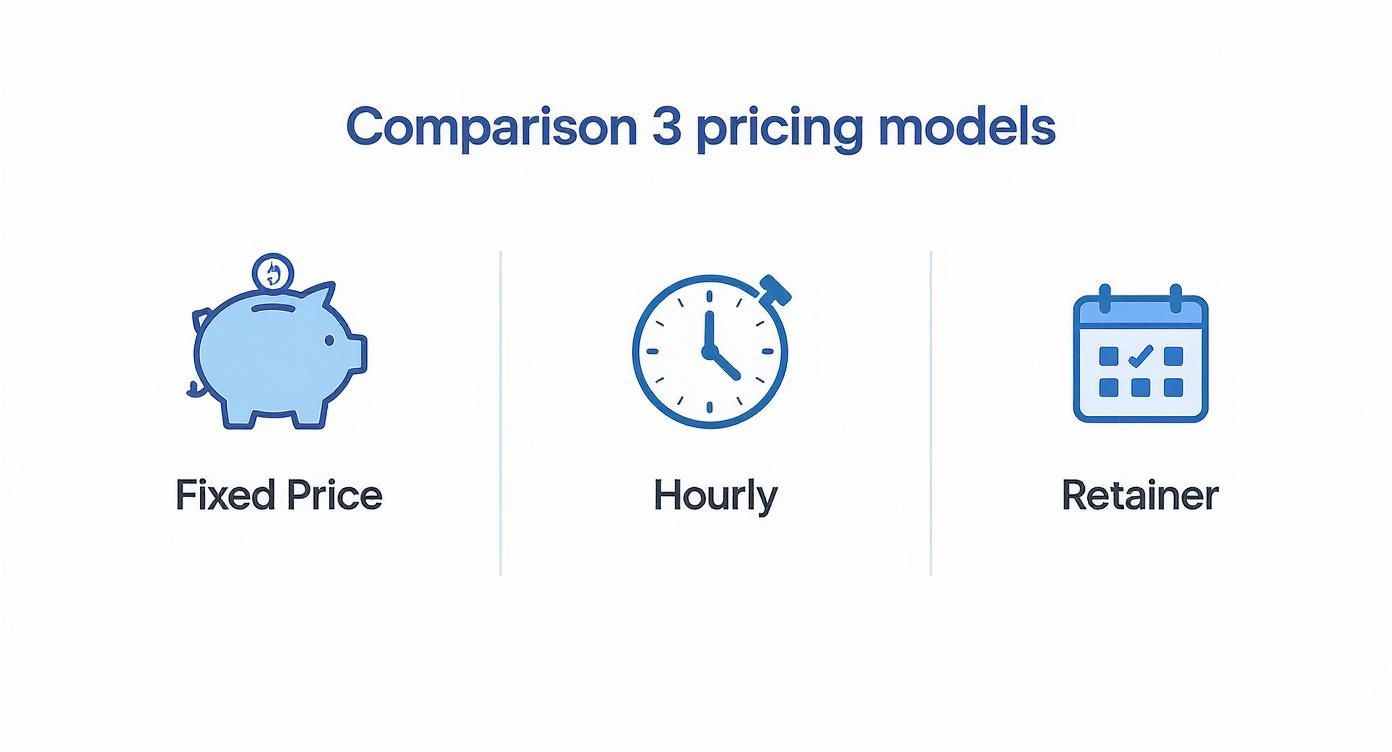
As you can see, each model gives you a different balance of cost certainty and flexibility, so you can pick the one that fits your project and comfort level best.
Budget Example 2: The London Consultant
Now, let's switch gears and look at a business consultant in London. Their goal is less about getting immediate phone calls and more about establishing authority and credibility. They need a sophisticated website that acts as their digital portfolio, showcasing case studies, client wins, and thought leadership articles.
Their audience is other business owners, so the site has to look polished, professional, and instantly communicate a high level of expertise. For a professional services website in a major centre like London, budgets typically fall between £7,000 and £12,000+. These sites often demand more custom design work and a much heavier focus on content to build that all-important trust.
Let's set a budget of £10,000 for our London consultant.
A professional service website is your digital handshake. It’s not just about what you do, but the quality, expertise, and trust you convey before you’ve even spoken to a potential client.
The budget breakdown here looks a bit different, reflecting the shift in priorities:
- Design & Development (60%): Still the biggest chunk, but with a major emphasis on a unique, high-end custom design that reflects the consultant's premium brand.
- Content & Strategy (25%): A much larger portion is dedicated to crafting compelling case studies, in-depth service descriptions, and blog content that positions them as a leader in their field.
- Initial SEO Setup (10%): The focus here is less on broad local terms and more on ranking for specific, high-value keywords related to their consulting niche.
- Training & Support (5%): Ensuring the consultant can easily manage their blog, add new case studies, and keep their portfolio fresh.
Calculating Your Website's Return on Investment
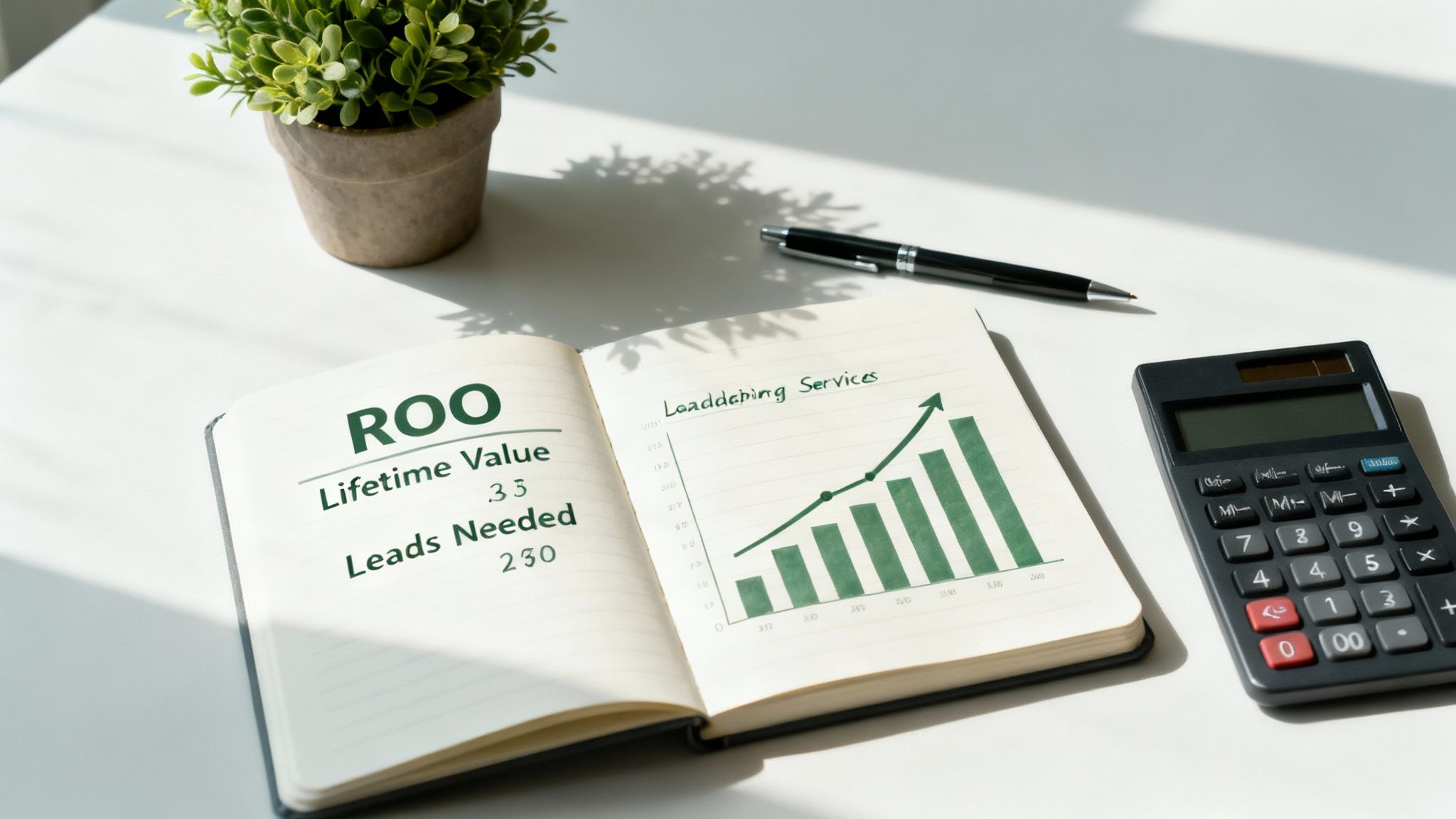
Here's one of the biggest mistakes business owners make: they see a new website as a cost. It’s not. It’s one of the most powerful investments you can make, period. The whole game changes when you stop asking, "how much will this cost me?" and start asking, "how much will this earn me?"
A great website isn't just an online brochure. It's your hardest-working salesperson—one that never sleeps, never takes a holiday, and is laser-focused on bringing in new customers 24/7. To really see its value, you have to connect the dots between what you spend and what you get back in actual jobs.
From Cost to Investment Thinking
First things first, let's get out of the "expense" mindset and into the "investment" one. Before you can even think about ROI, your website needs to be seen. If you're scratching your head wondering why your business might not be showing up on Google, you need to sort that out first. A website nobody can find has an ROI of zero. Simple as that.
Once your site is visible, the real question isn't about the price tag. It's about figuring out how many new clients it needs to land to pay for itself—and then start printing money for you.
A professional website doesn't cost your business money; it makes your business money. The initial investment is simply the fuel required to start the engine.
Let's break it down with a real-world example so you can see how the numbers actually work.
A Real-World ROI Example
Let's say you're a landscaper based in Surrey. You decide to invest £6,000 in a new, professionally built website designed to attract clients who want a full garden makeover.
To figure out your return, you need to know what a new client is actually worth to you.
- Average Job Value: A complete garden redesign project usually brings in about £8,000 in revenue.
- Profit Margin: After you've paid for plants, materials, and your team, your profit margin is a healthy 30%.
- Profit Per Job: That means you pocket £2,400 in pure profit from one average landscaping job.
Okay, now we have our numbers. Let's connect them back to that website investment.
Figuring Out Your Break-Even Point
With £2,400 profit per job, how many new clients does your website need to bring in to cover its £6,000 price tag?
The maths is pretty simple:
- Website Cost / Profit Per Job = Break-Even Point
- £6,000 / £2,400 = 2.5 Jobs
This means your website only needs to land three new customers to completely pay for itself. Three! Every single job it generates after that is pure profit, straight into your bank account.
So, what happens if that new site brings in just one new client a month? Over a year, that's 12 new jobs.
- 12 Jobs x £2,400 Profit = £28,800 Annual Profit
- £28,800 Profit – £6,000 Website Cost = £22,800 Net Return
That's a return on investment of over 380% in the first year alone. Suddenly, that website design cost doesn't look like a scary expense. It looks like one of the smartest business decisions you could ever make.
Your Checklist for Getting an Accurate Website Quote
Walking into a conversation with a web design agency can feel a bit like flying blind, especially when the final website design cost is a big unknown. But if you do a little homework first, you can take control of the conversation and get quotes that are clear, accurate, and actually comparable.
Think of it this way: asking for a website quote without a plan is like asking a builder for a price on a house without any blueprints. You’ll get a wild guess, not a fixed price. The more detail you can provide, the more precise the quotes will be.
Prepare Before You Ask for a Price
Before you fire off that first email, take a moment to get your ducks in a row. A bit of prep work now can save you thousands of pounds and a whole lot of headaches later on. Any decent agency will help you with this, but coming prepared shows you’re serious and helps them give you a much sharper price.
Here's a quick checklist of what to have ready:
- Your Target Audience: Who are you actually trying to talk to? Get specific. "Homeowners in Cheshire aged 30-50" is way more useful than "anyone who needs a plumber."
- Essential Pages: Make a list of all the pages you'll need. Think Home, About Us, pages for each of your services, a gallery or project portfolio, a blog, and a contact page.
- Key Features: What does the website need to do? This could be anything from a simple contact form to a booking system, a quote calculator, or a showcase for your testimonials.
- Inspiration Websites: Find 2-3 websites you like the look of. They don't have to be competitors. Just make a note of what you like—is it the clean layout, the colours, or how easy it is to find what you're looking for?
Having a clear vision and a defined budget before you start conversations ensures that you are comparing apples with apples when the quotes start rolling in. It puts you in control of the process.
How to Compare Quotes Effectively
Once the quotes land in your inbox, resist the urge to just scan for the lowest number. The cheapest quote is almost never the best value. Instead, you need to read the fine print and see what’s actually included.
Some quotes might look higher because they include things like copywriting or basic SEO setup, while others will sting you for those as extras later on. You can explore a range of options, including affordable website design in Auckland, to get a feel for how different packages are put together.
Look closely at the scope of work, the tech they plan to use (like WordPress vs. a custom builder), and what kind of ongoing support is offered. A good web designer will be upfront about all of this and happy to explain why they've quoted the way they have.
Frequently Asked Questions About Website Costs
Even after breaking it all down, there are always a few questions that pop up when business owners start thinking about getting a new site. Here are the no-fluff answers to the questions we hear most about the real website design cost.
Why Not Just Use a Cheap Website Builder?
Look, website builders like Squarespace or Wix have their place. They're great for getting something simple online fast, especially if the budget is tight. Think of them like a flat-pack shed—it does the job.
But they have their limits, especially when it comes to custom features, getting found on Google (SEO), and growing with your business.
A professionally built website is more like an architect-designed workshop. It's built from the ground up to fit your brand, hit specific goals (like getting the phone to ring), and can be expanded as your business grows. The upfront cost is higher, but it’s an asset built for performance.
Are There Any Hidden Costs to Be Aware Of?
Yes, absolutely. The initial build price is just the beginning. You always need to budget for a few ongoing costs to keep your site online, secure, and running smoothly.
- Domain Name Renewal: This is an annual fee, usually between £10-£20.
- Website Hosting: Think of this as the 'rent' you pay for your website's spot on the internet.
- Maintenance Plan: This is crucial. It covers security updates, software patches, and backups. Annual plans can run anywhere from £300 – £1,000+.
Always ask a potential web designer or agency to be crystal clear about what is and isn't included in their quote. Things like premium plugins, stock photos, and advanced SEO work are often extra.
"Your website isn't a set-and-forget tool; it's a living asset. Budgeting for ongoing maintenance is like servicing your work van—it’s essential for performance and protecting your investment."
How Long Does It Take to Build a Website in the UK?
For a typical small business website of around 5-10 pages, you should expect the whole process to take between four to eight weeks. That's from the initial chat right through to the day your site goes live.
The exact timeframe really depends on how complex the design is, how many changes you ask for, and—this is the big one—how quickly you can supply all your content (text and photos) to the design team. Bigger, more complex projects like e-commerce stores can easily take three months or more.
Ready to invest in a website that doesn't just look good but actually gets the phone ringing? The team at Four Stripes builds high-performance websites for UK service businesses, designed to dominate local search and deliver a steady stream of qualified leads. Get in touch today to discuss your project.