
A good services website is more than just a digital business card. It is your hardest-working employee. It brings in new customers all day and night. The secret is not about picking the best colours or letters. Great design starts with a good plan. It all begins by being very clear on who you are trying to attract and what they really need from you.
Planning Your Website for Real Results
Before any code is written or a page is designed, every good website project starts with a clear plan. Think of this planning part as laying the foundation for a house. If you get it right, you will have a site that looks professional. It will also climb up in local Google searches and get people to call you.
A strong plan makes every other step in the process smoother and better.
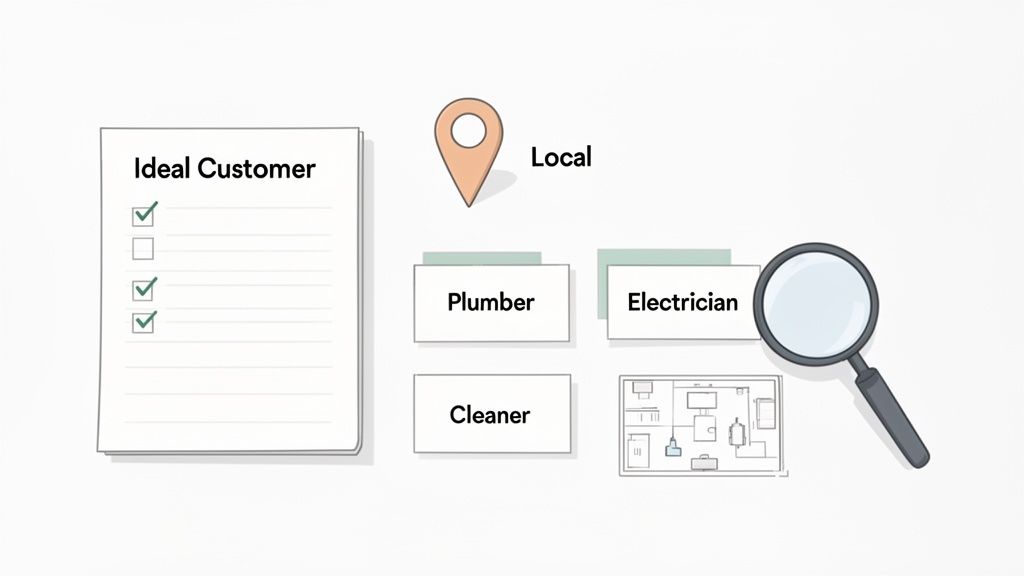
The first step? Figure out exactly who your ideal customer is. Are you a plumber aiming at homeowners in a certain part of London with a burst pipe? Or maybe you are an electrician looking for business clients who need steady, ongoing maintenance. Knowing your audience helps you choose the right words, the services you show, and the whole feel of your site.
Defining Your Audience and Services
Once you truly understand your customer's problems, you can show your services as the clear solution. You cannot be everything to everyone. So, focus on what you do best and who you do it for.
This whole planning part comes down to three key stages: knowing your audience, making your services clear, and then building a plan that connects the two.
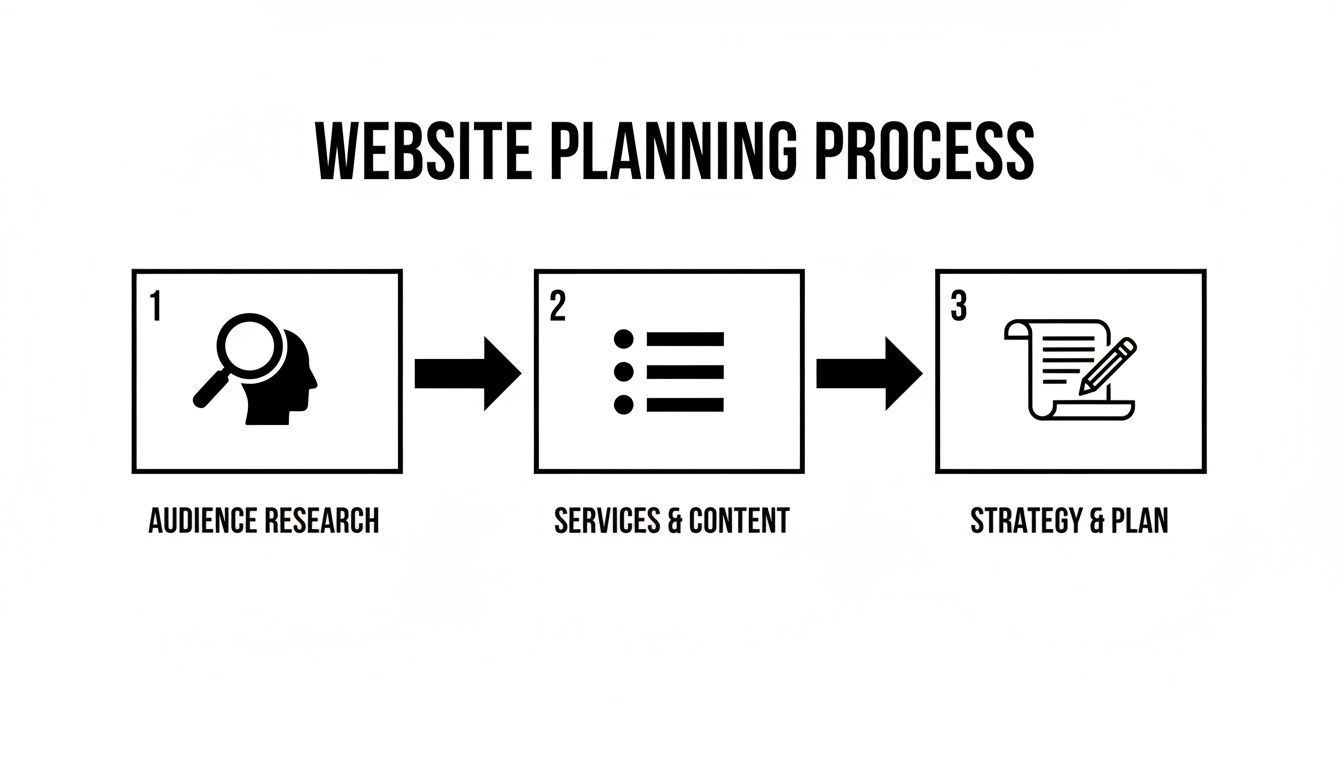
This process makes sure your website is built with a clear purpose from the start. Each step leads to the next. This creates a straight line from understanding your customer to building a site that makes them act. For a deeper look, check out our guide on small business website design in NZ.
Why a Website Is a Must-Have
For any UK business, having a proper online presence is no longer a choice. Recent numbers show that 76% of small businesses in the United Kingdom now have their own websites to stay seen and trusted. This is very true for tradespeople and local professionals. They rely on their site to get leads from people searching Google in their local areas.
A website gives you a home base online that you completely control. Unlike social media profiles, your website is your own thing. You set the rules and can track exactly how potential customers find your business.
To make your planning even better, using data-driven design principles makes sure that every choice is based on facts, not guesses. This method helps you build a website that is not just nice to look at, but is very good at turning visitors into paying customers.
Designing a Website That Builds Trust
Your website has two very important jobs. First, it needs to build trust the moment someone lands on your page. Second, it must clearly show them what to do next. If you get these two things right, your website stops being an online leaflet. It starts working for you, turning visitors into paying customers.
It all starts with a professional, clean layout. Think simple menus that make sense, text that is easy to read, and enough empty space so the page can breathe. This is not just about looking good. It is about making visitors feel calm and sure that they have found the right business.
This feeling of trust is a must-have for local service businesses. When someone is looking for a plumber, their pipe has probably burst. If they need an electrician, something has stopped working. They are stressed. Your website needs to quickly tell them that you are a reliable pro who can solve their problem, fast.
Show Off Your Real Work and Team
One of the fastest ways to build trust is with high-quality, real photos. Get rid of the generic stock photos right away. Instead, use pictures of your actual team on the job, your branded vans, and the finished projects you are truly proud of.
When a potential customer sees the real faces behind your business, it creates an instant human link. They are not just hiring a faceless company. They are inviting a real person into their home. That openness is a huge sign of trust.
Using real photos of your team and work does more than just make your site look good. It proves you are a real, local business that stands by its work. A stock photo can never show that.
Think about creating a gallery of your best work. If you are a builder, this means before-and-after shots of a recent job. For a gardener, it could be a showcase of beautiful garden makeovers. These pictures are powerful proof of your skills and are a core part of your online identity. You can get more great advice on this by checking out these digital branding tips for local service businesses.
Make It Super Easy to Take Action
A beautiful website is useless if a visitor cannot figure out what to do next. This is where strong Calls to Action (CTAs) come in. A CTA is just a message that tells the user exactly what you want them to do.
Your CTAs should be impossible to miss. Use clear, action-focused words. Place them where people will see them on every single page.
Here is what every great CTA needs:
- Clear Buttons: Use a colour that stands out from the rest of the page for buttons with text like "Get a Free Quote" or "Call Us Now".
- Clickable Phone Number: Your phone number needs to be right at the top of every page. This is very important on mobile where a customer can just tap it to call you directly.
- Simple Contact Forms: Keep your quote forms short. Really. Just ask for the key things: name, phone number, and a quick message about the job.
The goal is to remove any hassle. Make it so easy for someone to get in touch that it becomes the obvious next step. A well-designed website answers their questions, builds their confidence, and then smoothly guides them straight to your phone or inbox.
Building Your Website with WordPress
Okay, you have your plan sorted. Now it is time to actually build this thing. For almost every service business in the UK, there is really only one tool for the job: WordPress. It is the engine that powers a huge part of the internet for a reason. It is powerful, flexible, and gives you the perfect start for getting found on Google.
Building a site might sound scary, but you do not need to become a web developer overnight. It is about making a few smart choices at the start that will pay off for years. Let’s run through a quick checklist of what really matters when you are putting it all together.

Choosing the Right Theme and Page Builder
Let's use a comparison. Think of WordPress as the chassis and engine of your van. The theme is the bodywork and paint job. It sets the overall look. The page builder is the dashboard and controls. It lets you arrange everything inside exactly how you want it, without needing to be a mechanic.
This choice is very important. Why? Because it directly affects your website's speed, and speed is a huge deal for Google rankings. A slow, clunky theme will sink your SEO efforts before you even start.
That is why we stick to a proven combination:
- A Lightweight Theme: You need a theme built for speed. We are talking about options like Astra, GeneratePress, or Kadence. They are clean, fast, and will not slow your site down with junk you do not need.
- A Visual Page Builder: Pair that fast theme with a drag-and-drop builder like Elementor or Beaver Builder. These tools let you see exactly what you are building, move things around, and update text without ever looking at a line of code.
This setup gives you a professional site that is not just fast for customers, but also very simple for you to manage.
The whole point is to build a website that you can actually use. Pairing Astra with Elementor means you can jump in and change some text, upload a new photo, or add a special offer in minutes. No more calling a developer for every tiny update.
This is not just our opinion. It is the standard for top agencies across the country. In a market like London, the pros have already figured out that mobile-first, Local SEO-focused sites are built with Astra and Elementor. It is simply the winning formula. If you want a look behind the scenes, check out this guide on the top web design agencies in Auckland to see how they do it.
Essential Plugins for a Service Business Website
Plugins are just little apps that add extra features to your WordPress site. It is tempting to go crazy and install dozens of them, but that is a sure way to a slow, buggy website. Less is definitely more here.
For a local service business, you only need a few key plugins to get the job done right:
- Security: A security plugin is not a choice; it is a must-have. Something like Wordfence or Sucuri acts like a bouncer for your site, keeping hackers and bad software out.
- Speed: A caching plugin is your secret weapon for a fast site. WP Rocket is brilliant (though you have to pay), and LiteSpeed Cache is a great free option. They basically pre-load your pages so they pop up instantly for visitors.
- Contact Forms: You need a simple way for customers to request a quote. WPForms is very easy to use for creating those key forms.
- SEO: An SEO plugin like Rank Math (our favourite) or Yoast SEO is like having a guide by your side. It will show you how to set up your pages to rank on Google for your local keywords.
Stick to these, and you will have all the core functions covered without slowing things down.
Why Speed and Mobile-Friendliness Are Everything
We have mentioned speed a couple of times, but I cannot say this enough. Google is obsessed with how users feel, and nothing kills that feeling faster than a slow website. If a potential customer has to wait more than 3 seconds for your page to load, they are gone. They will just hit the back button and click on your competitor.
Just as important is how your site works on a phone. Most of your customers will find you on their mobile. They are probably on the go and need your services right now.
Your website absolutely must be mobile-responsive. That means it should automatically resize and rearrange itself to look perfect on any screen. Your phone number needs to be a clickable button. The text must be easy to read without squinting. If someone has to pinch and zoom to figure out your site, you have lost them. It is that simple.
Getting Found by Local Customers on Google
Let’s be honest, a nice-looking website is completely useless if local customers cannot find it. That is where Local Search Engine Optimisation (SEO) comes in. It is the whole game of making sure your business shows up when people in your area search on Google for the exact services you offer.
Put yourself in your customer’s shoes for a second. When their hot water goes cold, they are not just Googling “plumber”. They are searching for “emergency plumber in East London” or “plumber near me”. Your website needs to be set up to catch these specific, ready-to-buy searches.
Getting this right tells Google you are a trusted, relevant local business. This helps you climb the rankings and get your phone ringing with calls from people who need you, right now.
Your Google Business Profile Is Your Best Friend
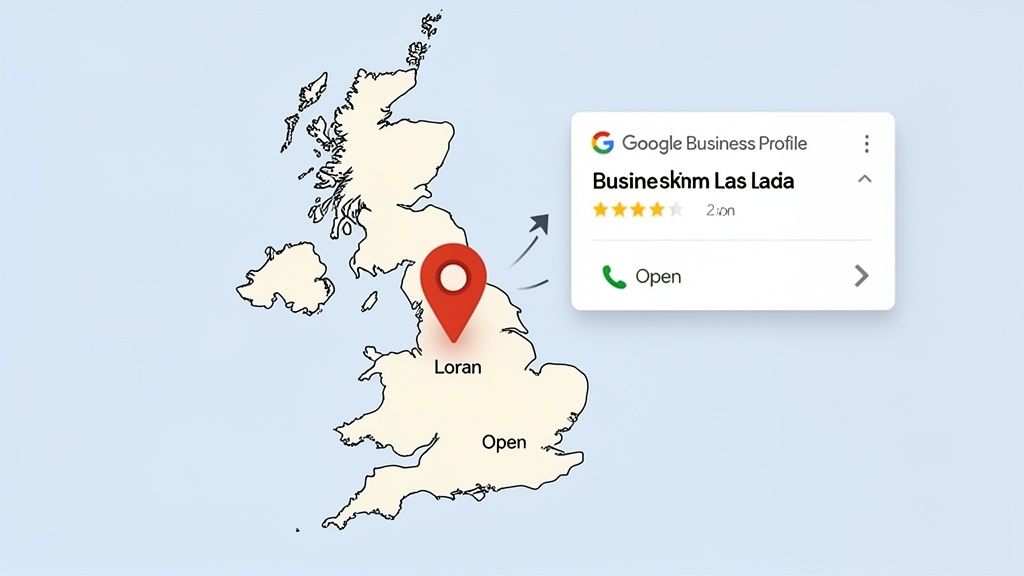
Before we even think about your website pages, we have to talk about your Google Business Profile (GBP). This is that free listing that shows up in Google Maps and the local search results. For any UK service business, it is without a doubt your single most important online tool.
Getting this right is not a choice. A fully completed GBP can bring in phone calls before a customer even clicks through to your website.
Here is what to get right:
- Complete Every Single Section: Fill out every field Google gives you. This means your exact service areas, hours, and a proper description of what you do. Do not be lazy here.
- Choose the Right Categories: Pick the most specific main category for your business (e.g., ‘Electrician’, not the general ‘Home Services’). Then, add other categories for all the other stuff you do.
- Upload Real Photos: Get plenty of high-quality photos up there. Pictures of your team on the job, your sign-written vans, and your finished work. This stuff builds huge trust and shows you are a real local business.
Connecting Your Website and GBP
Think of your website and your GBP as a team. They need to work together. The first step is to link your website directly from your profile. This is a clear signal to Google that they are connected and that your site is the official online home for your business.
Now for the key bit: make sure your business name, address, and phone number (what we call NAP) are listed exactly the same on your website's contact page and your GBP. Being consistent is everything. Even a tiny difference like "St" vs "Street" can confuse Google and hurt your rankings. If you need a full guide on getting this spot on, you can learn more about local SEO for service businesses in our complete guide.
Here’s a simple way to think about it: your GBP is the sign above your shop, and your website is the shop itself. The sign grabs their attention, and the shop convinces them to buy. They must be telling the same story.
On-Page SEO for Local Services
Right, let's get your actual website pages ready to pull in local customers. This is what is known as on-page SEO. It means making small but powerful changes to your content that shout your location and services to Google.
The easiest win is with your page titles. The title is the main headline that shows up in Google’s search results. It has to be very clear, including what you do and where you do it.
For example, instead of a general service page title like "Our Plumbing Services", a much better title would be:
"Expert Plumbers in Manchester | Blocked Drains & Hot Water"
That title immediately tells both Google and a potential customer exactly what you do and the specific area you cover. You need to do this for every single one of your main service pages.
The Power of Reviews and Updates
Seeing what other people think is very powerful in local search. Google wants to recommend businesses that other people trust. And nothing says "trustworthy" like a bunch of positive customer reviews.
Make a habit of asking every happy customer to leave you a review on your Google Business Profile. Send them a direct link to make it super simple. And make sure you reply to every review, good and bad. It shows you are paying attention and you actually care.
Finally, use the 'Updates' feature on your GBP. Treat it like a mini-blog for your business. Post short updates with photos of recent jobs, announce a special offer, or share a quick tip. This not only shows Google that your business is active but also keeps your profile fresh and interesting for people searching. These simple actions make a huge difference in how often you show up.
Launching and Maintaining Your New Website
Seeing your new website go live is a great feeling, but the work is not quite finished. A proper launch is not just flipping a switch. It means doing a final check of everything to make sure it is all running smoothly from the moment your first customer lands on the page.
Think of it as your final quality check. This is where you catch the small problems that can lose you a lead, like a broken contact form or a button that leads nowhere.
Your Pre-Launch Checklist
Before you start telling everyone about your new site, it is a good idea to run through this simple but key checklist. Make sure you do this on a couple of different devices, like your laptop and your phone, to get the full picture.
- Test Every Form: Send test messages through your own "Get a Quote" and contact forms. Do you get the email straight away? Does the customer see a clear "Thank You" message saying their message was sent?
- Click Every Link and Button: Go page by page and click every single link, button, and phone number. You are looking for dead ends and making sure everything points to the right place.
- Hunt for Typos: Give all your text one final proofread. Small spelling and grammar mistakes can make a professional business look sloppy.
Setting Up Your Tracking Tools
Right, everything works. Now it is time to install your tracking so you can actually see what is happening. Without it, you are flying blind.
The one you absolutely must have is Google Analytics. It is free and gives you a lot of information on your visitors: where they came from, which pages they looked at, and how long they stayed. Getting this connected before launch is a must.
Launching a website without tracking is like driving a van with no dashboard. You are moving, but you have no idea how fast you are going, how much fuel you have left, or if there is a problem with the engine.
Keeping Your Website Healthy and Secure
Your website is live, looking great, and ready to bring in work. The job now is to keep it that way. Just like your van or your power tools, your website needs regular tune-ups to stay in top shape. We call this website maintenance.
In the UK's competitive market, there are 135 companies offering web design services. This shows just how much demand there is for professional websites. But a past report also found that 3 out of 10 IT projects in the country hit delays. This is why it is so important to have a clear plan for both launch and ongoing care.
A good maintenance routine keeps your site secure from hackers, running fast for customers, and backed up in case the worst happens. Once your site is live, this ongoing care is vital. You can look into different website maintenance packages to find a plan that keeps your site secure and working at its best.
Here is a simple monthly routine to follow:
- Run Backups: Always have a fresh copy of your entire site saved somewhere safe. If it ever breaks, you can get it back in minutes instead of having to build it all again.
- Update Everything: WordPress, your theme, and all your plugins release regular updates. These often have important security fixes, so keeping them up to date is very important.
- Check Your Security: Run a quick security scan to make sure no new weak spots have popped up.
This careful approach makes sure your investment continues to pay for itself. A well-maintained site is a reliable, secure, and fast tool for getting leads that will serve your business for years to come.
Your Questions Answered
When you are busy running a service business, getting a new website can feel like a huge task. We get it. Here are some simple answers to the questions we hear most from UK businesses, from costs and timeframes to what really makes a website work.
How Much Does a Professional Service Website Cost?
The price tag on a new website changes depending on your needs, but there is a realistic starting point. For a small service business in the UK, a sharp, professional website typically starts in the range of £2,500 to £4,500.
This usually covers the key pages you need to get the phone ringing: a Home page, an About Us, a detailed Services page, and a Contact page. It also makes sure the site looks and works perfectly on mobile phones, which is a must-have these days.
If you need extras like an online booking system or a neat gallery that pulls from your Instagram feed, the cost will naturally go up. The key is to see this as an investment, not an expense. A website built to get customers should pay for itself many times over by bringing in a steady stream of new enquiries.
How Long Does It Take to Build a New Website?
For a standard website for a tradesperson or local professional, you can expect the whole process to take around three to six weeks from our first chat to launch day. This timeframe gives us enough room to get everything right.
The process is broken down into a few key stages:
- Planning: Nailing down your goals and getting your text and photos sorted.
- Design: Creating a look and feel that builds instant trust.
- The Build: Putting all the pages together in WordPress.
- Testing: Making sure every single button, form, and link works perfectly.
Honestly, the biggest thing that affects the timeline is how quickly you can give feedback and provide things like photos of your work. Any good web design agency will have a smooth process to get you a high-quality site in a few weeks. Be careful of anyone promising a custom website in just a few days. Quality work simply takes time.
What's More Important: SEO or Good Design?
That is a brilliant question, but here is the honest answer: it is a false choice. You absolutely need both working together. Trying to succeed with one but not the other is like trying to drive a car with only two wheels.
A great design is what builds trust. It makes your business look real and professional. It guides visitors smoothly toward getting in touch. It is the difference between a casual browser and a paying customer. That is what good services website design is all about.
But brilliant design is useless if no one ever sees it. That is where SEO comes in.
You could have the most beautiful, user-friendly website in the world, but if no one can find it on Google, it might as well be invisible. On the other hand, if you rank number one but your site is ugly, slow, or confusing, people will hit the back button without a second thought.
A website that actually grows a business gets both right. It is built well, so it shows up when locals search on Google. And it gives those visitors a fantastic experience, making it an easy choice for them to pick up the phone and call you.
Ready to build a website that does not just look good, but actually gets your phone ringing with local leads? The team at Four Stripes specialises in creating websites that get results for UK service businesses just like yours. Learn more about how we can help you dominate local search and turn clicks into calls.