So, how much do Google sponsored ads actually cost? The short answer is always going to be: it depends.
For a typical service business here in New Zealand, you're usually looking at a monthly budget somewhere between NZ$450 and NZ$2,500. But that's just a ballpark figure—not a fixed price tag. Your real-world cost comes down to your industry, where you're located, and frankly, how good your ad campaigns are.
Decoding Your Google Sponsored Ads Cost

If you're a Kiwi business owner trying to get your head around Google Ads, you're not alone. It’s one of the first questions we get asked, but the answer isn't just a number. It’s better to think of it less like buying something off the shelf and more like a live auction—one where being smart and strategic often beats just having the deepest pockets.
The good news is that the price you pay isn't set in stone. It's part of a system you can learn to influence and control. It's also worth keeping an eye on how people find information, as the rise of AI assistants replacing Google searches is starting to change the game.
The Game of Quality Over Bids
At its heart, Google’s system is built to reward quality. This is a crucial point: you don't always have to be the highest bidder to win the best ad spots.
In this guide, we're going to pull back the curtain on the key factors that determine your Google sponsored ads cost, so you can start making smarter decisions. We'll break down:
- Core Pricing Concepts: Simple, no-fluff explanations of things like Cost-Per-Click (CPC) and Quality Score.
- The Auction Mechanic: A look at how Google decides which ads get shown and what you actually end up paying.
- Influencing Your Costs: Practical, real-world tactics you can use to lower your ad spend while getting better results.
The goal here is to shift your mindset. Stop seeing Google Ads as just another business expense and start treating it as a controllable investment. When managed properly, a good campaign becomes a predictable, profitable source of jobs—not just a hole in your marketing budget.
Our aim is to give you a clear path forward, helping you turn your ad spend into a reliable stream of customer calls. For a deeper look at the fundamentals, our complete PPC advertising guide for NZ businesses offers extra strategies to get you started on the right track.
How Google Prices Your Ads In The Auction
To get a real grip on google sponsored ads cost, you need to peek behind the curtain at how the whole system works. It’s not like walking into a shop where everything has a fixed price tag. Instead, every single time someone in your area searches for a keyword you’re targeting, Google runs a lightning-fast auction to decide which ads to show and where to place them.
Think of it like a real-world auction, but with a clever twist. The highest bidder doesn't automatically get the top spot. The auctioneer—Google—also cares a lot about each bidder's reputation. This is the absolute core of the Google Ads system, and it’s where you can get a serious edge over the competition.
It All Starts With A Bid
For most service-based businesses here in New Zealand, the most common pricing model is Cost-Per-Click (CPC). This is a good thing—it means you only pay when someone is interested enough in your ad to actually click on it. You get to set a maximum bid, which is simply the most you’re willing to pay for a single click.
But your bid is only half the story. Just because you're willing to pay more than the next guy doesn't guarantee you'll be shown first. Google’s number one priority is to give its users the most relevant, helpful results possible, and that rule applies to ads, too.
This hierarchy diagram shows how the auction sits right at the heart of Google Ads, ultimately deciding your final cost per click.
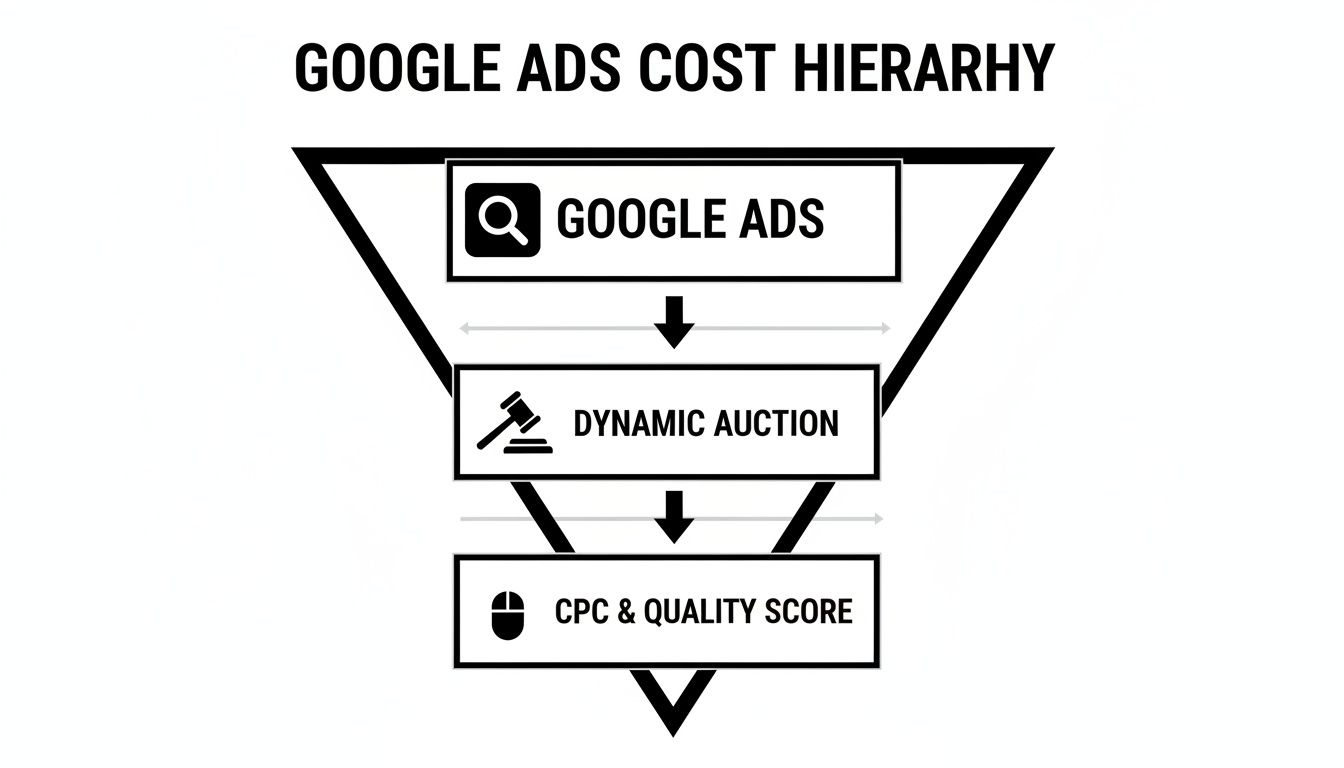
As you can see, what you end up paying is a product of both the competitive auction and how good your own ads, keywords, and landing pages are.
The Power Of Quality Score
This is where the magic really happens. Google uses a metric called Quality Score to measure the relevance and quality of your ads. Think of it as your reputation score in the auction. Google gives each of your keywords a score out of 10 based on three main things:
- Expected Click-Through Rate (CTR): Based on your past performance, how likely are people to click your ad when Google shows it to them?
- Ad Relevance: How closely does your ad copy match the keyword someone just searched for? An ad for "emergency plumber Hamilton" is a perfect match for that search.
- Landing Page Experience: When someone clicks your ad, does the page they land on follow through on the ad's promise? Is it relevant, easy to use, and quick to load?
Google then takes your maximum bid and multiplies it by your Quality Score to figure out your Ad Rank. The advertiser with the highest Ad Rank wins the best position on the page.
Ad Rank = Maximum CPC Bid x Quality Score
This simple formula is why focusing on quality is a game-changer. A high Quality Score can help you beat a competitor with a much bigger budget.
Better yet, the actual price you pay is calculated to be just one pence more than what was needed to beat the Ad Rank of the competitor directly below you. This means a higher Quality Score doesn't just get you a better ad spot—it directly lowers your actual cost-per-click. By focusing on giving searchers a great, relevant experience, you actively drive down your costs, making every dollar in your budget go further.
What To Expect To Pay For Google Ads In New Zealand
Alright, the theory behind the ad auction is great, but let's get down to brass tacks. What does this actually mean for your wallet? This is usually the biggest question mark for Kiwi businesses thinking about Google Ads, so having some real numbers to work with is crucial.
You don't need to rely on confusing overseas data. Here in New Zealand, most small to medium businesses spend between NZ$450 and NZ$2,500 per month on their ad clicks. If you're just dipping your toes in, a budget of around NZ$450–$900 is a smart place to start. It gives you enough fuel to test the waters and see what works before you open the throttle. For a bit more local flavour, you can check out these insights on realistic monthly plans for Kiwi businesses.
Whether you're a builder in Auckland or a landscaper in Invercargill, this gives you a practical starting point.
Breaking Down Local Ad Costs
The biggest factor influencing your google sponsored ads cost is your industry. A frantic search for an "emergency plumber" at 2 AM has a completely different level of urgency—and value—than someone casually browsing "garden design ideas." Because of this, the competition is fiercer, and the price for that click is much, much higher.
You'll almost always see higher click costs in trades where the problem is urgent and high-value. Think about fields like:
- Emergency electrical services
- 24/7 plumbing and drainage
- Locksmiths and security services
- Specialised legal advice
Here’s a simple way to look at it: what your competitors are willing to pay comes down to the potential value of a single lead. If landing one new client is worth thousands of dollars, businesses will bid aggressively to get that click. That drives up the average CPC for everyone in that space.
Example Monthly Google Ads Budgets for NZ Tradies
To paint a clearer picture, let’s see what different monthly budgets can look like in practice. Just remember, these are estimates. Your mileage will vary based on your specific trade, location, and how well your campaigns are set up.
Here's a simple breakdown to help set some expectations for what your investment might get you.
Example Monthly Google Ads Budgets for NZ Tradies
| Budget Tier | Monthly Spend (NZD) | Focus | Estimated Clicks (at avg. CPC) |
|---|---|---|---|
| Starter | $500 – $800 | Testing core services in a local suburb or smaller city. | 100 – 160 Clicks |
| Growth | $800 – $1,500 | Expanding to multiple suburbs or a larger metropolitan area. | 160 – 300 Clicks |
| Dominator | $1,500 – $2,500+ | Aggressively targeting a major city and surrounding regions for high-value keywords. | 300 – 500+ Clicks |
A "Starter" budget is perfect for figuring out which keywords actually make the phone ring. Once you know what's working, a "Growth" budget lets you scale that success across a wider area.
The key is to start smart, not necessarily big. By proving the model on a smaller scale and optimising as you go, you can increase your spend with confidence, knowing every dollar is working to grow your business.
Proven Tactics To Drive Down Your Ad Costs
Understanding the auction and setting a budget are the foundations, but this is where you take control. Getting a lower google sponsored ads cost isn’t about finding some secret trick; it's about applying proven strategies that make your advertising a whole lot more efficient.
These tactics are all about stopping the money leaks and starting to get more qualified leads for every single dollar you spend. It all starts with getting inside the head of your ideal customer—understanding exactly what they type into Google when they need you most.
Start With Laser-Focused Keywords
The single biggest mistake we see businesses make is bidding on keywords that are way too broad. A painter in Christchurch bidding on the keyword "painter" is just throwing money away. You'll end up paying for clicks from people looking for art painters, house painters in Auckland, or even just pictures of paintings.
The key is to use long-tail keywords. These are longer, more specific search phrases that show you exactly what a person is looking for. They might have a lower search volume, but their intent is sky-high, which means better leads at a lower cost.
Think about the difference:
- Broad: "glazier"
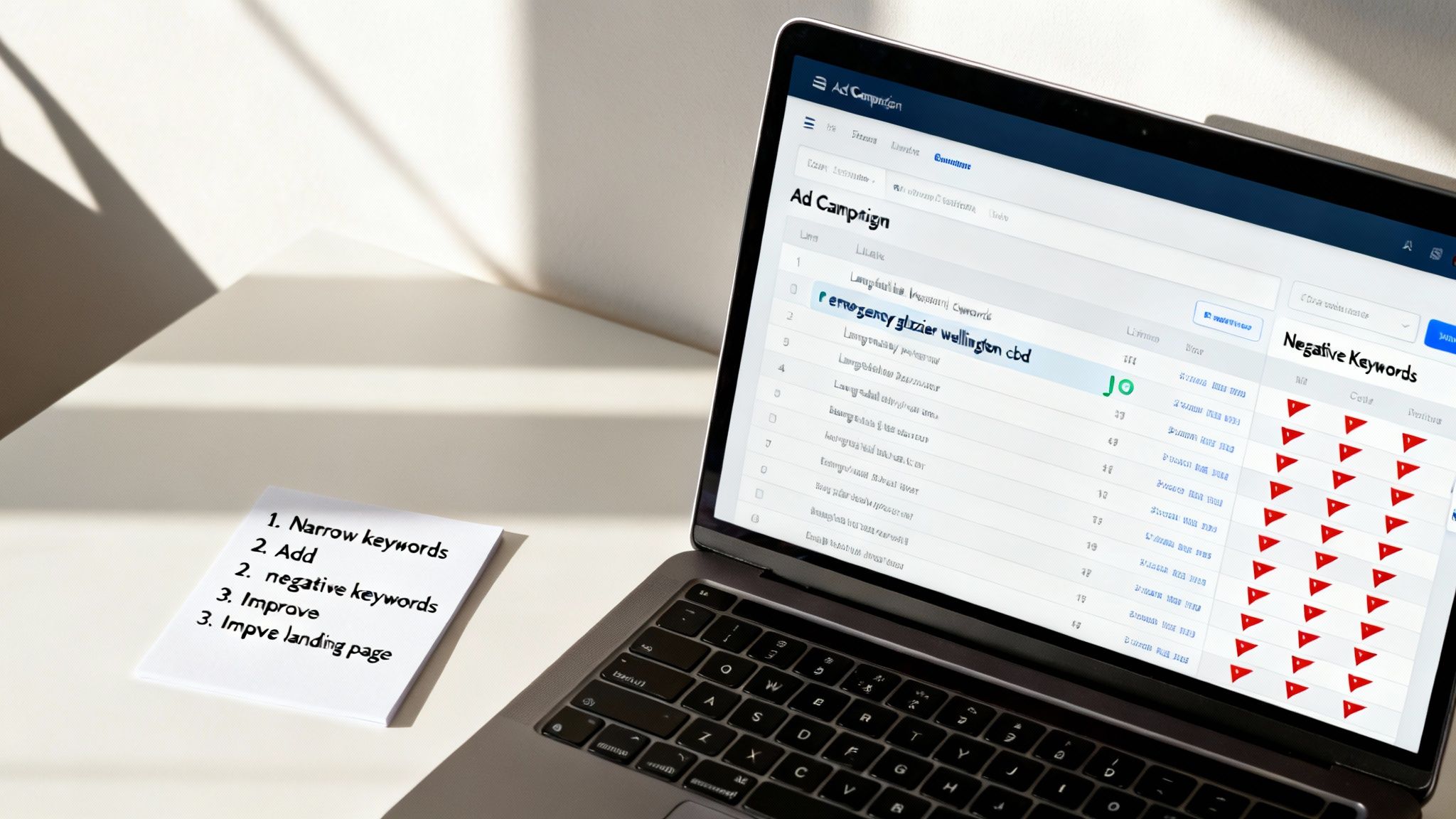
- Long-tail: "emergency glazier wellington cbd"
That second searcher has a real, urgent problem and knows exactly where they need help. Winning that click is far more valuable and often cheaper because you aren't competing with every glazier in the country.
Stop Wasting Money With Negative Keywords
Just as important as choosing what to target is choosing what not to target. Negative keywords are terms you add to your campaign to stop your ad from showing up for irrelevant searches. Think of them as your best defence against wasted ad spend.
Imagine you’re a residential electrician. You’d want to add negative keywords like:
- "car" (to avoid paying for clicks from people searching for auto electricians)
- "jobs" or "apprentice" (to block job seekers from seeing your ad)
- "how to" or "DIY" (to filter out people looking for free advice instead of a pro)
Every irrelevant click you prevent is money saved that can be put towards a click that actually turns into a job. For more advanced strategies, explore our guide on Google Ads best practices for 2025 to build a solid negative keyword list from day one.
Write Ad Copy That Actually Converts
Your ad is your three-second elevator pitch. It needs to grab attention, speak directly to the searcher's problem, and give them a compelling reason to click your ad over a competitor's. Don't just list what you do; show them you can solve their problem.
A great ad connects with the user's immediate need. Instead of "Plumbing Services Available," try "Blocked Drains? Fixed Today. Call Now For A Free Quote." It hits the pain point and offers a clear, immediate solution.
This tight connection between the search term and your ad copy is a massive factor in your Quality Score. A higher Quality Score means a lower cost-per-click, which directly reduces your expenses.
Optimise Your Landing Page and Track Everything
Your ad makes a promise, and your landing page has to deliver on it. When someone clicks your ad for "emergency roof repairs," they need to land on a page that is only about that service—not your generic homepage. The page must be fast, mobile-friendly, and make it incredibly easy for them to call you or fill out a form.
And finally, solid tracking is non-negotiable. You have to track every single phone call and form submission that comes from your ads. Without it, you’re flying blind and can't know your true return on investment. This data is what tells you which keywords and ads are actually making the phone ring, allowing you to cut what isn't working and double down on what is.
How To Maximise Your Investment From Day One
Getting your Google Ads setup right from the get-go is the single best way to avoid burning through your budget. Competition is fierce and bidding is getting smarter, so launching a tightly controlled campaign from day one is non-negotiable for getting a decent return on your money.
The mission is to make every dollar count, especially when you’re just starting out and gathering that initial data. A smart, disciplined launch builds the foundation for a profitable lead-generating machine and helps you sidestep the expensive mistakes so many businesses make.
Start With A Strong Structure
A well-organised account is your first line of defence against wasted spend. This means building your campaigns around specific services and locations. For instance, a plumber in Auckland should have separate ad groups for "hot water cylinder repairs" and "blocked drain services," each with its own laser-focused keywords and ads.
This tight structure makes your ads super relevant to what people are searching for. That boosts your Quality Score and, you guessed it, lowers your google sponsored ads cost. It also stops you from running lazy, generic ads that don't speak to a customer's immediate problem.
Another game-changer is precise geo-targeting. Don't target the whole of New Zealand, or even all of Auckland, if you only service a handful of suburbs.
By narrowing your location settings to only the specific areas you work in, you immediately stop paying for clicks from customers you can't actually help. This simple step is one of the fastest ways to cut waste.
Leverage Every Advantage Possible
When you're starting out, any extra budget helps you learn what works, faster. Keep an eye out for promotional credits, like Google’s common spend-match offers, which can literally double your initial testing budget. For Kiwi businesses, these offers are a huge leg-up.
These credits are vital, as click costs in New Zealand can range from pocket money to over NZ$10–$15 for competitive keywords. Making every dollar work harder is crucial for protecting your return.
Finally, build a solid negative keyword list before you spend your first dollar. This simple list stops your ads from showing up for irrelevant searches like "jobs," "training," or "DIY," making sure your budget is only spent on clicks from actual potential customers. To see if all this effort is actually paying off, it’s crucial to regularly calculate your Return on Ad Spend (ROAS).
Your Partner For Profitable Google Ads
Let's pull it all together. Your google sponsored ads cost isn't just another bill to pay—it's a controllable investment that absolutely must deliver a solid return. Getting it right comes down to three things: truly understanding how the ad auction works, setting a realistic budget based on what’s happening in your local market, and never stopping the optimisation process.
This is where Four Stripes comes in. We live and breathe this stuff, navigating all the complexities for Kiwi tradies just like you.
We’re a client-first agency, plain and simple. Our proven 'First Page, First Call' system is designed to turn your ad spend into a reliable stream of qualified phone calls and job enquiries. We handle all the technical nuts and bolts so you can get back to doing what you do best—running your business.
When you partner with experienced Google Ads agencies, you’re not just hiring someone to click buttons. You're getting a genuine advantage in a crowded market.
We take the complicated data and turn it into simple, profitable results, making sure every dollar you spend works as hard as you do. Our whole mission is to build you a predictable lead source that helps your business grow month after month. It's about taking the guesswork out of your marketing and delivering results you can actually count on.
Frequently Asked Questions
Even with all the facts, it’s normal to have a few lingering questions. We get it. Here are some of the most common ones we hear from Kiwi tradies and service businesses trying to make sense of Google Ads.
How Long Does It Take To See Results?
Everyone wants the phone to start ringing on day one, but it’s best to think of the first 30 to 90 days as an essential learning phase. This isn’t about just spending money; it’s about gathering real-world data on what actually works for your business.
During this time, we’re figuring out which keywords drive qualified calls, what ad copy gets the best clicks, and which parts of your website convince people to get in touch. You’ll likely get leads coming through, but the real magic happens after this initial period when the campaign is dialled in and starts producing a steady, predictable flow of jobs. A little patience upfront pays off big time down the track.
Is It Better To Have A Higher Budget Or A Better Quality Score?
This is a bit of a chicken-and-egg question we get all the time. The honest answer is you need both—they work together. A great Quality Score is like getting a discount on every single click, making your ad budget stretch way further and slashing your overall google sponsored ads cost.
But here's the catch: you can't improve your Quality Score without data, and data comes from getting enough clicks. That’s where your budget comes in. The goal is to set a budget that's big enough to learn from, then use those learnings to constantly boost your Quality Score. It’s a cycle where a smart budget fuels a better score, which in turn makes your budget more powerful.
Should I Run Google Ads Myself Or Hire An Agency?
Going DIY versus hiring an agency really comes down to what you have more of: time or money. Managing your own campaigns gives you 100% control, but be prepared for a steep learning curve. It’s a massive time sink to learn the platform, stay on top of changes, and continuously optimise everything to avoid burning cash.
An experienced agency, on the other hand, brings proven systems and expertise from day one. They know how to sidestep the costly mistakes that trip up most beginners and can get you profitable results much faster. For most busy business owners, partnering with a specialist lets them focus on quoting jobs and running their crew, while the experts handle turning clicks into customers.
Ready to turn your ad spend into a predictable stream of profitable jobs? The team at Four Stripes uses a proven system to help Kiwi tradies dominate local search and get the phone ringing. Get in touch today for a no-obligation chat about your business goals.