
Forget the fancy words for a minute. Social media is just about talking to people who might need your help, where they already hang out—online. For a Kiwi tradie, this isn't about becoming famous online. It's about building local trust and getting your phone to ring with real job requests from homeowners in your area.
What Is Social Media Marketing and Why Should a Tradie Care?
Let's be honest. You're a builder, plumber, or sparky—not a social media expert. The term "social media marketing" probably sounds like a lot of nonsense and a huge waste of time you don't have.
But what if you looked at it differently?
Think of social media as your new digital toolbox. You have a special hammer for framing and the right wrench for a tough pipe. In the same way, social media gives you the tools to build your business's good name and find your next customer.
It has nothing to do with posting pictures of yourself or trying to get thousands of followers. For a service business anywhere in New Zealand, from Auckland down to Christchurch, the goal is very simple: make the phone ring with calls from local people who need your skills.
Your Digital Word-of-Mouth
A long time ago, a good name was built one job at a time, mostly through people talking at the local pub or hardware store. Today, that "local hangout" has moved online. Social media is where the people who might hire you are looking every single day.
Think of it this way: Social media is just the modern way a happy customer tells their neighbour about the great job you did. It just happens on a screen instead of over the back fence.
This whole idea is about showing, not just telling. Instead of just saying you do great work, you can post a photo of that nice new deck you just finished in Howick. That picture proves your skill faster and better than a simple newspaper ad ever could. You can learn more about the overall benefits of digital marketing for NZ businesses in our detailed guide.
It's All About Winning Local Jobs
For a tradie, the real power here is being able to connect with people in your specific area. You're not shouting into thin air; you're talking directly to homeowners in the exact suburbs you want to work in. This guide is a simple plan to get you real jobs, not just a few online "likes."
And if you're just getting used to all this, a good guide on social media marketing for beginners can be a huge help to get the basics right from the start.
When you use these sites correctly, you can:
- Show off your work: Post before-and-after photos that are clear proof of your skills.
- Build trust: Let people see the face behind the business. It makes you seem much friendlier.
- Reach local customers: Talk to homeowners in the specific suburbs you serve.
- Get real leads: Turn that online interest into actual phone calls and quote requests.
Choosing the Right Tools for the Job: Which Sites to Use
You wouldn't use a hammer to fix a leaky pipe. The same idea works for your marketing. Jumping onto the wrong social media site is one of the fastest ways to waste time and money you don't have.
With so many choices, it’s easy to feel stressed and think you need to be everywhere at once. But the key is to pick just one or two sites where your ideal local customers are already spending their time, and get good at using them.
The good news? For most service businesses in New Zealand, the choice is actually pretty simple.
Start With the Pictures
If you’re a tradie or a service professional, your work speaks for itself—with pictures. A freshly painted living room, a brand new deck, or a perfectly tidy garden all look fantastic in photos and short videos. This is exactly why sites built for images and video are your best choice.
They let you show potential customers how good your work is, rather than just telling them about it. That kind of visual proof builds trust way faster than a page of text ever could.
For Kiwi tradies, this means focusing on two main players:
- Facebook: It's still the best for reaching local communities. You can post photos of your work, share great customer reviews, and connect directly with people in the specific suburbs you serve.
- Instagram: Think of this as your business's online photo album. It’s perfect for showing off high-quality "before and after" photos and short video clips that show off your skill.
Honestly, for most service businesses starting out, a solid mix of Facebook and Instagram is the perfect place to start. You really don’t need to look much further to start seeing real results.
If you're still not sure, this simple chart breaks it down.
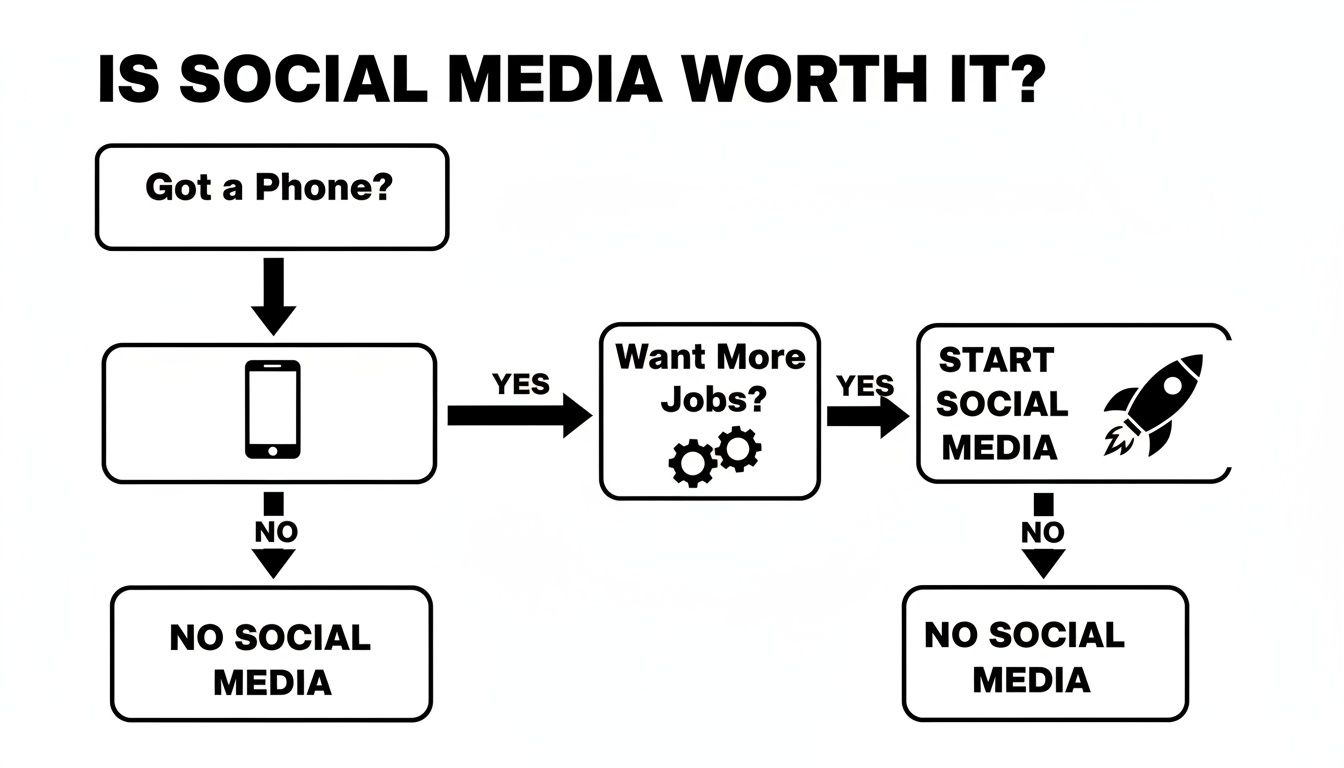
As you can see, if you’ve got a phone and you want more jobs, social media is a pretty direct way to get them.
Which Social Media Site Is Best for Your NZ Service Business?
Feeling stuck? This quick table should help you figure out where to put your energy. We've focused on the sites that actually work for Kiwi tradies and professional services.
| Site | Best For | Example For a Tradie |
|---|---|---|
| Reaching a wide local audience, sharing reviews, and talking with the community. | An electrician posts photos of a recent switchboard upgrade in Howick, tagging the suburb and asking for comments. | |
| Building a visual photo album with high-quality "before and after" shots. | A painter creates a short video showing the change of an old house exterior, set to popular music to get more views. | |
| YouTube | Showing you are an expert and building trust through helpful "how-to" videos. | A plumber films a 3-minute video on their phone showing homeowners how to fix a common leaky tap, showing their knowledge. |
| Connecting with other businesses, not for finding homeowner clients. | A commercial builder connects with architects and project managers to find new commercial building jobs. | |
| TikTok | Fun content, generally for a much younger audience. | Not recommended for getting leads, as the users aren't usually looking for local home services. |
The main point here is simple: for getting jobs from local homeowners, Facebook and Instagram are your most important tools. YouTube is a great next step if you're keen to show you are a true expert.
But What About TikTok or LinkedIn?
You’ll always hear about the "next big thing" in social media, like TikTok or LinkedIn. But for most local service businesses, they just aren't the right tool for this particular job.
TikTok’s users are younger and are there for fun, not to find a good plumber for their leaky shower. And LinkedIn is a site for professionals—great if your clients are other businesses, but not so good if you're trying to reach homeowners in your suburb.
The best social media marketing plan is to get really good at one or two sites where your ideal customers actually are. Don't spread yourself thin trying to be everywhere at once.
It’s all about working smarter, not harder. By focusing your efforts, you can create much better posts and build a stronger presence where it really matters.
Your Customers Are Already There
The reason we keep saying this comes down to simple numbers. As of early 2025, New Zealand had 4.14 million active social media users—that’s over 79% of the whole population. On average, Kiwis spend more than two hours a day on apps like Facebook and Instagram. You can read the full research about Kiwi digital trends to see just how active your potential customers are.
That huge, active audience means the people who need your services are definitely on these sites. You just need to show up and put your great work in front of them.
And if you want to take things a step further, think about adding YouTube to the mix. It's a goldmine for showing your skills. A landscaper could create a short video on "5 Easy-Care Plants for Auckland Gardens," for example. This builds huge trust and makes you the go-to expert in your field. You don't need a fancy camera—your smartphone is more than good enough to get started.
Creating Posts That Actually Get You Customers
Knowing you need to be on social media is one thing; figuring out what to actually post is another. It’s easy to get stuck, but the good news is that you don’t need a fancy marketing degree. The best content for a Kiwi service business is simple, honest, and shows off the great work you already do.
Think of your social media page as your online photo album. It’s a showcase of your skills, your good work, and your happy customers. Forget the fluff—focus on creating posts that build real trust with local homeowners. That's what turns someone just scrolling into your next paying customer.
Show Your Work, Don't Just Talk About It
The most powerful tool you have is proof. Homeowners want to see what you can do before they even think about picking up the phone. This is where your smartphone becomes your best marketing tool.
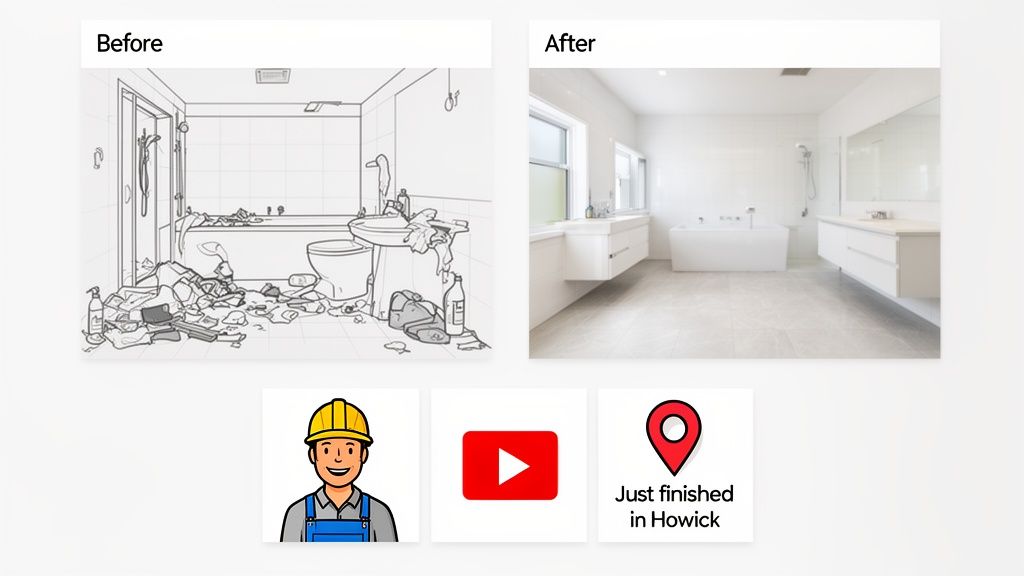
Your number one type of post should always be before-and-after photos. They are very simple to create and tell a powerful story of change in a single look. A messy, old bathroom turning into a modern, clean one is more powerful than any sales pitch you could ever write.
This visual proof works because it helps potential customers imagine the same result in their own homes. It’s not just about showing a finished job; it’s about showing the problem you solved.
Put a Face to the Business
People hire people, not logos with no face. One of the biggest mistakes small business owners make is hiding behind a company name. Showing your face—and your team's—makes your business feel more human and friendly right away.
When a potential customer sees a photo of you on a job site, it builds a quick connection. They feel like they know who they'll be letting into their home, which is a very big part of building trust. You're no longer just "a plumber"; you're "John, the friendly plumber from down the road."
A quick photo of you or your team with a smile after finishing a job can do more for your business than a perfectly designed picture. It shows you're real, local, and proud of the work you do.
This simple act of being seen separates you from the bigger companies and makes you the first choice for homeowners who like a personal touch.
Simple Post Ideas You Can Use Today
Feeling stuck? Don't overthink it. The goal is to post regularly, not to create a Hollywood movie every day. If you need some help with this, you can learn more about the content creation process for a local business in our other guides.
Here is a ready-to-use list of very simple post ideas that get results:
- The "Job Done" Post: Just finished a project? Take a quick photo and post it with a simple caption like, "Just finished up a new fence for a lovely family in Howick! On to the next one." This shows you're busy and active in the local community.
- Customer Reviews: Did a customer send you a nice text or email? Take a picture of it (ask for permission first!) and share it. A real message from a happy customer is worth more than any ad.
- Short Video Clips: You don't need fancy editing. A 15-second video walking through a newly redone kitchen or showing a freshly painted wall is very effective. It brings your work to life.
- Meet the Team: Post a photo of one of your team members with a short, friendly introduction. This builds that all-important human connection we talked about.
- Tool of the Week: Share a photo of a special tool you use and briefly explain why it helps you do a better job. This shows you are a smart professional who uses quality tools.
These ideas require almost no extra time but are very good at building a list of local work. The key is to just start. Grab your phone on your next job and take a few pictures—you'll be surprised at how easy it is to create posts that win you new customers.
Your Simple Guide to Using Paid Social Media Ads
Posting photos of your work online is a great start, but sometimes you need to give it a little push to get in front of the right people, right now. That's where paid social media ads come in. They might sound hard or expensive, but for a service business, they’re one of the most direct and powerful tools you can have.
Think of it like putting a leaflet in the letterbox of every home in a certain neighbourhood. With sites like Facebook, you can do the online version of this—only much, much smarter. You get to choose exactly who sees your ad, making sure every pound you spend is working hard to find your next customer.
Honestly, it’s the fastest way to get your phone ringing with new requests, especially when you need to fill a quiet week.
How Paid Ads Work for Your Business
The big idea behind paid social ads is simple: you pay a small amount of money to show your post or a special ad to a very specific group of people. You’re not just shouting into the wind; you’re whispering your message directly into the ears of the people most likely to hire you.
For example, imagine you’re a painter based in Auckland. You could set up an ad that only shows to:
- Homeowners, not renters.
- Who live in certain suburbs like Remuera or Ponsonby.
- And who have shown an interest in things like "home renovation" or "DIY".
This level of control means you stop wasting money on people who will never become customers. You can start with a tiny budget, even just $10 or $20 a day, to test it out and see what works.
The real power of paid ads isn't about reaching everyone; it's about reaching the right one. By aiming at your ideal customer, you turn your marketing from a guessing game into a sharp tool for getting leads.
Getting Started With Your First Ad
You don't need a marketing degree to create your first ad. The sites are made to walk you through it, step-by-step. The most important parts are getting your audience and your offer right.
Here’s a basic plan to follow:
- Choose Your Goal: When you create an ad, Facebook will ask what you want to achieve. For a service business, this is usually "get more messages" or "get more website requests".
- Define Your Audience: This is where the magic happens. Select the age, gender, location (right down to the suburb), and interests of your perfect customer.
- Set Your Budget: Decide how much you want to spend each day. You can turn the ad on or off whenever you like, so you’re always in complete control of your spending.
- Create Your Ad: Use a great photo or a short video of your work. Your image is the first thing people see, so make it a good one. To learn more about how paid advertising can help your business grow, check out this PPC advertising guide for NZ businesses.
Make Your Offer Clear
The final, and most important, piece of the puzzle is your offer. Your ad needs to tell people exactly what you want them to do next. A confusing ad gets ignored.
A clear offer, also known as a call-to-action, is direct and simple. Don't just show a picture of a finished deck; tell people what to do about it.
Examples of strong, clear offers include:
- "Call us today for a free quote on your next paint job."
- "Send us a message with a photo of your garden for a quick estimate."
- "Click here to see more of our bathroom makeovers and book a chat."
This clarity removes all the guesswork for the customer. It guides them from seeing your great work to picking up the phone and becoming a lead. If you need some ideas, it can be helpful to see what works for others. To get ideas for your own ads, look at these pay per click advertising examples across search, social, and display.
How to Know If Your Social Media Is Actually Working
It’s easy to get caught up in chasing likes and followers. But let’s be honest, they don’t pay the bills. These numbers are what we call vanity metrics – they look good and make you feel good, but they tell you nothing about whether your marketing is actually making you money.
For a Kiwi service business, the whole point of spending time and money on social media is to get more jobs. It’s about growing your business, not just becoming popular online. So, you need to track the numbers that really matter.
Forget Likes, Track Leads
Stop worrying about how many people liked your last post. Instead, you need to focus on the actions that directly lead to new work. These are your real business numbers, and they’re surprisingly simple to watch.
Your only goal here is to measure how many real, potential customers are coming from your social media.
Here’s what you should be counting:
- Phone Calls: How many people picked up the phone after seeing your ad or a post? This is the most direct lead you can get.
- Website Requests: How many people clicked from Facebook or Instagram and filled out your quote form?
- Direct Messages (DMs): How many people sent you a private message asking for a price or more details on your services?
That’s it. These three things are the only results that truly count. Each one is a real person with a real problem reaching out for you to solve it, turning your online efforts into actual jobs.
The Most Powerful Question You Can Ask
So, how do you figure out if these calls and messages are coming from social media and not from somewhere else? Forget difficult tracking for a moment. There's one very simple, old-school method that works every single time.
You just have to ask.
Get into the habit of asking every single new customer the same question: "Just so I know for my marketing, how did you hear about us?" It’s the most sure way to figure out what’s working.
This one question cuts through all the noise. If you keep hearing, "I saw your work on Facebook," or "Found you on Instagram," you know your time and money are well spent. If no one ever mentions it, it’s a clear sign that something needs to change.
This feedback is like gold. It tells you exactly where to put more effort and where to pull back, making sure your marketing is a smart investment, not just another business cost.
How Social Media and Google Work Together
It's easy to think of your marketing in separate boxes. You’ve got your social media over here, your website over there, and then there’s Google, the big boss you’re always trying to please. But that’s the wrong way to look at it.
Think of it like a sports team. You wouldn’t send just one star player out to win the game. Your social media is a key player, but it’s most powerful when it’s working with your website and, most importantly, with Google. When they're all playing together, you create a simple but powerful system that brings in a steady stream of local jobs.
Too many business owners treat them as totally separate tasks. They post on Facebook, then they worry about their Google ranking later. The truth is, they directly help each other. What you do on social media can make a huge difference to how customers find you in a search.
How Your Facebook Page Helps Your Google Profile
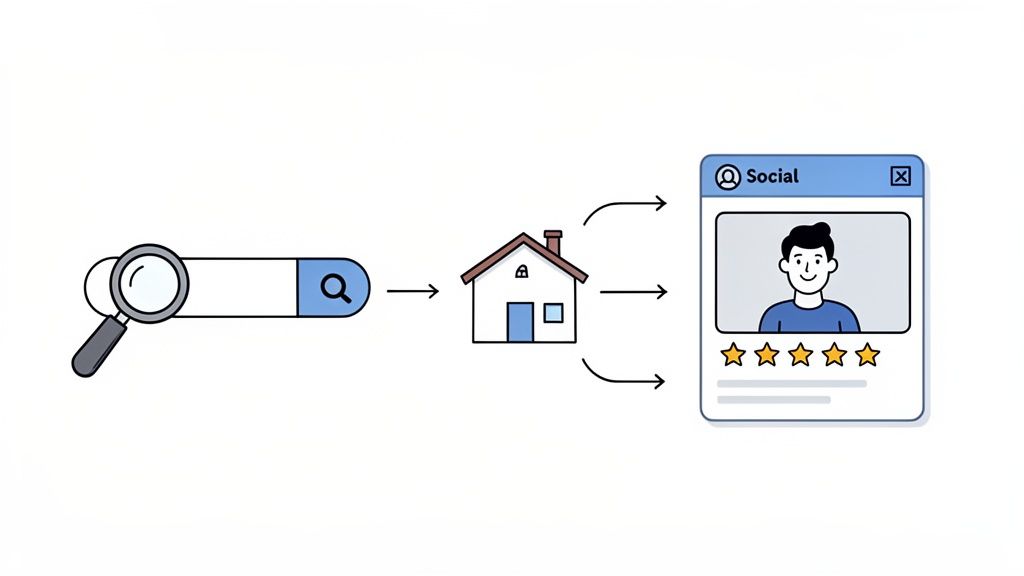
When a potential customer searches Google for "plumber in Howick," one of the first things they’ll see is your Google Business Profile. You know the one—the box with your business name, reviews, phone number, and photos. It’s a huge factor in whether they call you or click on a competitor.
This is where your social media work becomes your secret weapon. Google loves seeing fresh, relevant, local posts. By regularly posting photos of your completed jobs on Facebook, you're creating a constant supply of new images you can add to your Google Business Profile.
This simple act shows Google—and potential customers—that you're an active, busy, and trustworthy business.
Even better, a great review left on your Facebook page can be used again. Take a picture of it and add it as a photo to your Google profile. It's an instant trust boost.
Building Trust on Every Site
Being consistent is the key to trust. When a customer finds you on Google and then clicks to your social media, they need to see the same business name, the same logo, and a similar style of photos. This makes them feel sure you’re a real, professional business.
Think of it this way:
- Google gets them in the door: It puts you in front of customers who are actively searching for your service right now.
- Social media keeps them thinking of you: It shows off your quality work and your personality, making potential customers feel like they know and trust you before they’ve even picked up the phone.
When a customer sees your 5-star reviews on Google, then sees photos of your recent work pop up on their Facebook page, their confidence in hiring you goes way up.
The goal is to create a smooth experience. A customer shouldn't feel like they're dealing with two different companies. Your social media and your Google page should tell the same story: you're a trustworthy, high-quality local business.
A Simple System for Winning More Work
Getting these two powerful tools to work together doesn't have to be hard. It’s all about creating simple habits that help each other and strengthen your whole online presence, making your business much harder for local customers to miss.
Here’s a very simple process you can start today:
- Take photos on the job: Always have your phone handy to take some quick before-and-after shots. It takes 30 seconds.
- Post on social media first: Share your best photos on your Facebook or Instagram page with a quick description of the job and the suburb you were in.
- Update your Google Business Profile: Once a week, take a few of those same photos and upload them directly to your Google Business Profile.
- Share reviews everywhere: Get a great review on Google? Take a picture of it and share it on social media. Get a great comment on Facebook? Take a picture of that and add it to your Google profile's photos.
By linking them together, you create a powerful cycle. Your social media posts keep your Google profile fresh and believable, which helps you rank higher and get found by more customers who are ready to hire.
Frequently Asked Questions About Social Media
Getting used to social media for your business always brings up a few questions. We get it. Here are some simple answers to the most common things we hear from Kiwi service business owners just like you.
How Much Time Does This Actually Take?
This is the big one, especially for busy tradies, and it’s a fair question. The good news? You don’t need to be stuck to your phone for hours a day. It’s all about being smart with your time, not being ‘always on’.
Posting regularly is better than posting a lot at once. Aiming for just 15-20 minutes a day, a few times a week, is more than enough to see real results. Use that time to put up a photo from a recent job, reply to a couple of comments, and check your messages. Done.
Do I Really Need to Spend Money on Ads?
Not at all, especially when you're just starting out. You can absolutely get the phone ringing without spending a single cent. Just by regularly posting good photos of your work and getting involved in local community groups, you'll start building a solid presence for free.
Think of paid ads as an extra boost for when you need one. If you’ve got a quiet week coming up or you want to promote a new service in a certain suburb, even just $10 a day can get your business in front of hundreds of potential local customers who wouldn't have seen you otherwise.
The best way to go is to start with free posts to build your foundation. Once you’re in a good rhythm, you can try paid ads with a small budget to speed things up and get more leads, faster.
What If I Get a Bad Review?
Sooner or later, it’s going to happen. How you deal with it is what really matters. The absolute worst thing you can do is delete it or pretend it never happened. A single grumpy review among a bunch of positive ones won’t put people off—but seeing a business owner handle it badly definitely will.
Here’s a simple three-step plan for when it happens:
- Acknowledge it publicly: Jump on and reply to the comment politely. Thank them for the feedback and say sorry that their experience wasn’t good enough.
- Take it offline: In your reply, ask them to give you a call or send you an email so you can sort it out properly. This shows everyone else that you’re helpful and take issues seriously.
- Learn from it: Was there something you could have done better? Use the feedback to improve how you do things.
Handling criticism like a professional builds way more trust than having a perfect record of only five-star reviews. It shows you stand by your work and care about your customers.
Ready to stop worrying about your marketing and start getting more calls? The team at Four Stripes specialises in building a powerful online presence for Kiwi service businesses just like yours. Let's build a system that turns clicks into customers. Find out how we can help at https://fourstripes.co.nz.