
For a busy service business owner in New Zealand, trying to find the right web development company can feel like you’re just throwing your hard-earned cash at a wall and hoping something sticks. You know your website should be your best salesperson, working 24/7 to bring in calls and quote requests. It shouldn't just be a pretty online brochure that gathers dust.
This guide is designed to cut through all the tech-speak and give you a straight-up, actionable plan for finding a partner who gets it—a partner who understands that the only thing that really matters is making your phone ring.
Moving Beyond a Digital Brochure to a Lead Generation Engine
Let’s be honest: your website has one critical job, and that’s to generate qualified leads for your business. If it’s not doing that, it’s failing. Too many Kiwi service businesses end up with a good-looking site that just sits there, doing nothing to attract genuine customers.
The problem usually starts with hiring the wrong kind of "web designer." A website isn't just a creative art project; it’s a powerful business tool. When you bring on a web development company, their number one focus should be your business goals, period.
Shifting Focus from Aesthetics to Action
A nice design is great, but it’s just one piece of the puzzle. A website that actually performs is built from the ground up with one purpose in mind: conversion. This means every single element, from the headline at the top to the contact form at the bottom, is strategically designed to push a visitor towards taking action.
For most service businesses like yours, those actions are pretty straightforward:
- Making a phone call: A big, bold, click-to-call phone number is non-negotiable, especially for customers on their mobiles.
- Submitting an enquiry form: This lets potential customers request a quote or ask a question whenever it suits them, day or night.
- Booking an appointment: For some businesses, adding a simple scheduling tool can be a game-changer, letting you capture leads instantly.
Your website must make it incredibly easy for a potential customer to get in touch. Any friction, like a hard-to-find phone number or a complicated form, will cost you business.
This guide will walk you through the entire process of picking a web development company that actually understands this. We’ll cover exactly what to look for, the right questions to ask, and how to spot the red flags so you can invest your money in a genuine lead-generating machine, not just another pretty website.
Defining Your Website Goals and Realistic Budget
Before you even think about talking to a web development company, you need to get crystal clear on two things: what you want your website to actually do for your business, and what you’re prepared to invest to make that happen.
Going in without clear goals is like asking a builder to construct a house without giving them a floor plan. You'll end up with something, sure, but it probably won’t be the functional, lead-generating asset you desperately need.
So, are you after a simple online brochure to build a bit of trust, or a high-performance machine that consistently brings in new jobs? Nailing this down is the first step to setting a clear direction and a sensible budget.
Pinpoint Your Primary Website Goal
Think for a moment: what is the single most important action a visitor could take on your website? For most Kiwi service businesses, this ‘conversion’ is pretty straightforward. It's not about getting thousands of clicks; it’s about getting the right people to take that crucial next step.
Your primary goal will likely be one of these:
- Generating Phone Enquiries: The visitor sees your number and calls for a quote. This is often the top priority for tradies who need to be responsive and get jobs booked fast.
- Receiving Form Submissions: A potential client fills out your contact form to request more info or a detailed proposal. This works brilliantly for services that need a bit more of a consultation process.
- Securing Direct Bookings: The user books an appointment or service right there on your site through an integrated calendar. Ideal for businesses that run on appointments.
Knowing this helps any potential web company focus their design and technical efforts on what actually makes you money. Everything else is just noise.
A website without a clear conversion goal is just an online brochure. A great website is a tool designed to produce a specific, measurable business result.
Setting a Practical Budget
Once you know what you need your website to achieve, you can start thinking about the budget. Website costs here in New Zealand can swing wildly depending on how complex the job is and the experience of the company you're talking to. A simple starter site might run you a few thousand dollars, while a fully custom solution with unique features is a much more significant investment.
When you're figuring out your budget, it's really important to understand what actually goes into the cost. A bit of research here will save you a lot of headaches later. To get a feel for the numbers, have a look at our detailed guide on website design pricing—it gives some practical benchmarks for the local market. For a slightly broader view, it's also worth understanding website design costs in a similar market like Australia.
Walking into a meeting with a clear goal and a realistic budget makes the whole process smoother and more effective. It shows you’re serious and lets a web development company pitch a solution that genuinely aligns with your business goals right from the start.
What to Look for in a Modern Web Partner
Gone are the days when choosing a web development company was just about finding someone who could make a pretty website. Your site isn't a digital brochure that just sits there; it's a hard-working tool that should be bringing in jobs. A proper web partner gets this, and they'll offer a whole lot more than just design skills.
You need to look past the flashy portfolios and ask about the nuts and bolts. The right company builds your website on a solid foundation, ready for growth from day one. That means thinking about everything from how it looks on a phone to making sure local customers can actually find you on Google.
Mobile-First Design Is a Must-Have
Forget just being "mobile-friendly." The standard today is mobile-first. This means the design process starts with the smallest screen—a smartphone—and then scales up to tablets and desktops. It’s not just a nice-to-have; it's essential, especially when most of your potential customers are searching for your services on their phones.
A mobile-first website makes sure the important stuff, like your phone number or enquiry form, is front and centre and dead easy to use on the device people are actually holding. This is a core part of creating a good experience for visitors, something a skilled user experience designer lives and breathes.
WordPress vs a Custom Build: What’s Right for You?
For most service businesses in New Zealand, the choice usually boils down to WordPress or a fully custom-built website. A custom build offers total freedom, but that often comes with a hefty price tag and a much longer timeline.
WordPress, on the other hand, runs over 43% of all websites on the internet for a good reason. It hits the sweet spot between flexibility, ease of use, and the ability to grow. For a typical service business, a well-built WordPress site is the smart choice.
- Ready for SEO: It’s built in a way that Google loves, which is crucial for showing up in local search results.
- Grows with you: Need to add a blog, a booking system, or a gallery of your work down the line? Easy.
- Cost-effective: You get a powerful, reliable platform without paying someone to reinvent the wheel.
A great web development company won’t just build you a site. They’ll build it on a platform that sets you up for future growth, without locking you into their own expensive, proprietary tech.
To put this into perspective, think about what you want your website to do. This little decision tree can help you see how your main goal should shape your budget and platform choice.
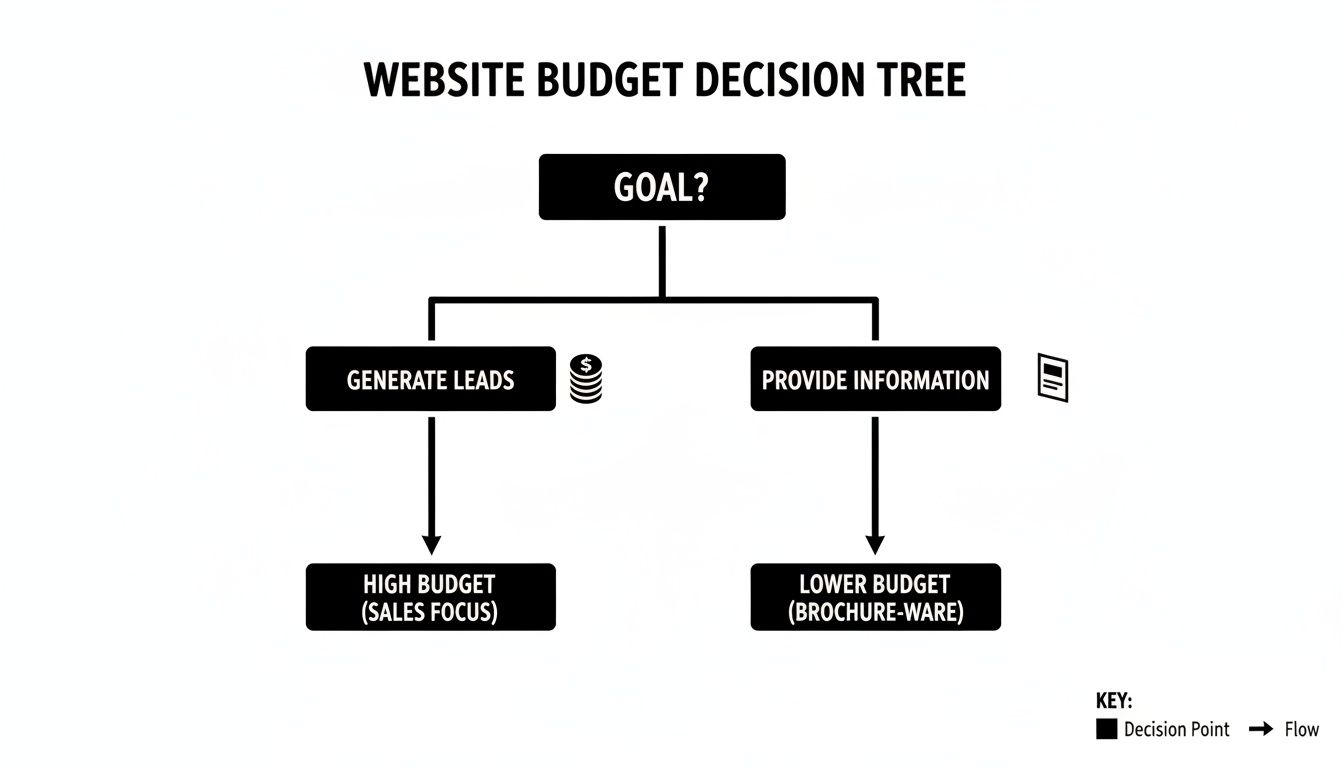
The key takeaway here is simple: a website designed to bring in leads is an investment, not just an expense like a basic online flyer.
This idea is more important than ever. New Zealand's software market, which is the engine room for our local web development industry, is expected to hit US$2.35bn in revenue by 2025. This isn't just some abstract number; it shows the massive opportunity for Kiwi businesses to team up with agencies that can turn a website into a reliable source of quality enquiries.
A good partner agency should also be a well-oiled machine behind the scenes. Efficient internal processes, often powered by good remote team communication tools, mean your project runs smoothly and stays on track. After all, you’re hiring them to build a performance-driven asset for your business, and that starts with their own performance.
WordPress vs Custom Build for Service Businesses
When you're a service-based business, every dollar counts. Choosing the right website platform is a big decision that impacts not just your initial budget, but your long-term marketing success. Here’s a straightforward comparison to help you decide between WordPress and a fully custom build.
| Feature | WordPress | Custom Build |
|---|---|---|
| Initial Cost | Lower. Built on an existing framework, reducing development time and cost significantly. | Higher. Everything is built from scratch, requiring extensive coding, design, and testing. |
| Time to Launch | Faster. A typical site for a service business can be live in 3-6 weeks. | Slower. Projects often take 3-6 months or longer, depending on the complexity. |
| Ease of Use | User-friendly. You can easily update text, add blog posts, or upload photos without a developer. | Depends. The admin area is custom-built, so its usability can vary. Often requires developer help. |
| SEO-Friendliness | Excellent. Natively SEO-friendly and can be supercharged with plugins like Yoast SEO. | Good, but requires expertise. SEO needs to be coded in from the ground up, with no room for error. |
| Scalability | Highly scalable. Thousands of plugins are available to add new features as your business grows. | Very scalable, but expensive. Any new feature must be custom-coded, adding to cost and time. |
| Best For | 99% of service businesses. Perfect for tradies, consultants, and local professionals needing leads. | Large enterprises or unique startups. Suitable for businesses with highly specific, complex requirements. |
For most Kiwi service businesses, WordPress is the clear winner. It gives you a powerful, professional, and lead-generating website without the massive overheads of a custom project. It’s the practical choice that lets you focus your budget on what really matters: getting more customers.
How to Vet Agencies and Ask the Right Questions

Alright, you’ve got a shortlist of potential agencies. Now it’s time to look past their slick portfolios and find out if they can actually deliver the goods.
An impressive-looking website is one thing; a website that consistently makes your phone ring and fills your inbox with quote requests is another beast entirely. Your goal here is to find concrete proof that a potential web development company can deliver measurable results for a Kiwi business just like yours.
This means asking direct, specific questions that force them to move beyond vague promises about "boosting your presence." You’re not just buying a website; you’re investing in a lead generation asset. You need to see evidence they know how to build one that actually works in the real world.
Digging into Their Track Record
Don’t just glance at their portfolio—interrogate it. Ask them to show you examples of websites they’ve built for other service-based businesses in New Zealand, ideally someone in a similar field. A company that builds fancy sites for big e-commerce brands probably doesn’t get what a local plumber in Auckland or a builder in Christchurch actually needs.
Once they show you a relevant project, go deeper. Get specific.
- “Can you walk me through the results this website achieved?” Don't let them get away with "more traffic." You want specifics like, "It increased their phone enquiries by 30%," or "It's now generating 15 qualified leads a month for them."
- “What was your strategy for local search?” They should be able to talk confidently about targeting specific suburbs and optimising the site to attract nearby customers.
- “How do you track conversions?” A top-tier agency will immediately start talking about setting up tracking for phone calls and form submissions, not just vanity metrics like website visitors.
Any web development company can show you a pretty design. The great ones can show you the data that proves their work actually made a client’s phone ring more often. If they get shifty or can’t provide clear, results-focused case studies, that’s a massive red flag.
Understanding Their Process and Communication
A website build can go off the rails fast without a clear process and open communication. You need to know exactly how they operate to avoid nasty surprises with timelines or the final bill. A disorganised agency almost always leads to missed deadlines and extra costs.
Ask them directly about their workflow:
- Who will be my main point of contact? You need one dedicated person you can rely on, not get passed around the office.
- How often will we communicate? A good agency will set up regular check-ins, like a weekly email update or a quick call, to keep you in the loop.
- What project management tools do you use? Even if it's just a shared document, this shows they have a structured process for keeping things on schedule.
- What do you need from me to keep the project moving? It's a two-way street. Knowing your responsibilities for providing feedback or content is critical to hitting your launch date.
This line of questioning also reveals how well they understand the bigger picture. For instance, a solid grasp of how web development impacts your search rankings is non-negotiable.
To get a better sense of this, it pays to understand what a top SEO company in New Zealand focuses on, because their technical priorities should be baked into your website from day one. By vetting their experience, process, and results, you can confidently choose a partner who will deliver genuine value, not just a pretty online brochure.
Critical Red Flags to Watch Out For
Choosing the wrong web company is an expensive mistake. I've seen it too many times—a business ends up with a dead-end website that brings in zero leads and eventually needs a complete, costly rebuild from scratch. Spotting the warning signs early on is the best way to avoid a bad partnership.
Steering clear of a bad fit isn't just about avoiding a dodgy design; it’s about protecting your investment and your future growth. With the right questions and a keen eye, you can spot a partner who genuinely cares about your success, not just their sales targets.
Vague Promises and No Clear Plan
This is one of the biggest red flags. An agency makes grand promises about "getting you more leads" or "boosting your online presence" but gets fuzzy on the details. If they can't tell you how they're going to do it, run.
A proper web partner should be able to walk you through their exact plan. They'll talk about optimising your site for the specific towns and postcodes you service. They'll also tell you precisely which Key Performance Indicators (KPIs) they'll track to prove it’s working—things like phone calls, form submissions, or online bookings.
A great web partner sells a clear strategy with measurable outcomes. A poor one sells vague promises and hopes for the best. If they can’t tell you precisely how they’ll get you leads, they probably won’t.
Long-Term Lock-In Contracts
Be extremely wary of any company that pressures you into a long-term, lock-in contract for your website or hosting. These agreements almost always benefit the agency, trapping you in a relationship even if the service is terrible.
A web company that's confident in its work doesn't need to lock you in. Their results should be what keeps you on board. Look for partners offering flexible, month-to-month arrangements for ongoing things like hosting and maintenance. This puts the pressure on them to deliver value, month after month, to keep your business. It's a sign of a real partnership.
Confusion Over Website Ownership
This one is a deal-breaker. You must have 100% ownership of your website and everything that comes with it once the job is done. No exceptions.
This includes:
- Your domain name: It has to be registered in your name, not theirs.
- Your website files: All the code, images, and content are yours.
- Your hosting account: You need full admin access.
Some companies build sites on their own custom platforms, which effectively holds your website hostage. If you decide to leave, you can't take your site with you and have to start all over again. A reputable agency builds on a common platform like WordPress and hands you the keys when it's finished.
Always ask this question directly: "Will I own my domain and all website files outright?" If the answer is anything but a straight "yes," walk away.
Making the Final Call (and Getting it Right)
You’ve done the hard yards, completed your research, and now you’ve got a few proposals sitting in your inbox. This is the moment of truth. Picking your web design partner isn’t just about the price tag; it's about finding the team that genuinely gets what you're trying to achieve.
The best proposal won't feel like a cookie-cutter template. It will feel like they’ve actually listened, referencing your specific business, your local Kiwi market, and your goals. You're looking for a partner you can trust to turn your investment into a steady stream of phone calls and quote requests.
Forget Price, Focus on Value
When you lay the proposals out side-by-side, try to look past the bottom-line figure. Instead, ask yourself where the real value is. A cheap quote can be tempting, but it often means they're cutting corners on things that actually get you leads, like proper local SEO setup or conversion tracking.
Run each proposal through this final mental checklist:
- Who really understood my need for more local leads?
- Whose plan seems most likely to attract customers in my service areas?
- Who was the clearest communicator? Do I trust their project plan?
A great proposal doesn't just list features; it connects them to a business outcome. For instance, "mobile-first design to capture the 60% of local customers searching on their phones" is a world away from just saying "responsive design."
This focus on real results is critical. New Zealand’s web development scene is packed, with over 116 companies out there, according to some lists. It's a reflection of how much NZ's tech sector has boomed, growing its digital capabilities by a massive 64% between 2015 and 2019 alone. You can get a sense of the local web development market on TechBehemoths.com.
Kicking Off a Great Partnership
Once you’ve made your choice and signed on the dotted line, a good web development company will have a clear, simple onboarding process. This isn’t just admin; it’s about starting the project off on the right foot.
Usually, they'll need a few things from you to get cracking:
- Your Brand Stuff: This means your logo files, brand colours, and any flyers or business cards you have.
- Content & Photos: Get together any photos of your team or your work, along with descriptions of your services and a bit about your business.
- Communication Plan: You’ll sort out who your main point of contact is and how often you'll get updates.
Getting this sorted quickly means your chosen partner can get to work faster, bringing you that much closer to launching a website that actually works for you.
Frequently Asked Questions
When you're choosing a web design company, a few big questions always come up: How much will it cost? How long will it take? And what happens after it's live? We hear these from Kiwi business owners all the time, so let's get them answered.
How Much Should a Small Business Website Cost?
This is the big one, isn't it? The honest answer is that it varies, but for a professional WordPress website that’s built to get you leads, you should budget somewhere between $3,000 and $7,000.
If you need more complex features, like custom calculators or booking systems, that number can climb well over $15,000. The most important thing to remember is the return on investment. A cheap site that doesn't make your phone ring is always the most expensive mistake you can make.
How Long Does It Take to Build a New Website?
For a typical service business website, we usually tell clients to expect a 4-6 week turnaround, from our first chat to launch day. This can speed up or slow down depending on how complex the design is and how quickly you can get back to us with feedback and content for the pages.
With a streamlined process, an agency that knows what they're doing can often get a high-converting site live in under a month.
Remember, a good web partner will provide a clear project timeline upfront. This ensures everyone is on the same page and helps avoid delays.
Do I Really Need Ongoing Website Maintenance?
Yes, 100%. Think of it like a WOF for your car. Your website is a valuable business asset, and leaving it unmaintained is asking for trouble.
Ongoing maintenance keeps it secure from hackers, running fast for customers, and ensures all the software is up-to-date. Most good agencies offer a monthly plan that covers security checks, updates, and backups. It's a small investment to protect your most important marketing tool.
Ready to build a website that actually makes your phone ring? The team at Four Stripes specialises in creating conversion-focused websites for service businesses across New Zealand. Get in touch today to see how we can help you turn clicks into calls.