
Think of your website as your best salesperson. It’s on the clock 24/7, never takes a sick day, and is often the very first interaction a potential customer has with your business.
A user experience designer, or UX designer, is the expert who trains that salesperson. They turn it from a simple online brochure into a persuasive, helpful guide that makes people want to hire you.
What Exactly Is a User Experience Designer

Imagine walking into a massive hardware store, completely lost. You need one specific part, but you’re surrounded by thousands of options. Just as you’re about to give up, a staff member walks over, asks what you’re working on, and leads you straight to the right aisle. They don’t just point; they explain which screw is best for your job and why. You’re in and out in minutes, feeling confident and relieved.
That helpful staff member? That’s what a UX designer does for your website.
Their job isn’t just about making things look pretty—that’s more in the realm of a graphic or UI (user interface) designer. Instead, a UX designer is the architect of the customer’s entire journey on your site, making sure it’s logical, intuitive, and gets them to a solution without any fuss.
Solving Problems Before They Happen
The real magic of UX is anticipating what your customer needs before they even have to think about it. A good UX designer lives inside your customer’s head, asking the critical questions that shape how your website works:
- A potential customer has a burst pipe and lands on our site in a panic. What’s the very first thing they need to see?
- How do we make the “Get a Quote” button so obvious that it’s impossible to miss?
- Is it dead simple for someone to find our contact number and the specific suburbs we service?
By getting the answers right, they build an online experience that feels helpful, not frustrating. It builds trust and smoothly guides visitors towards the goal—whether that's calling your phone, filling out a form, or booking a job.
A huge piece of this puzzle involves understanding what information architecture is—which is basically the art of organising and labelling everything on your website so people can find what they’re looking for without getting lost.
A great user experience designer doesn’t just build a website; they build a solution. They turn frustrating clicks into confident calls by making it easy for customers to achieve their goals.
At the end of the day, their job is to connect what your business wants (more leads) with what your customers need (a fast, easy solution). For a service business here in New Zealand, that’s the difference between a website that just sits there and one that actively fills your calendar with qualified jobs.
The Real Business Impact of Smart UX Design

Hiring a professional user experience designer is about much more than getting a flash-looking website. For a service business in New Zealand, thoughtful UX design translates directly into money in the bank. It turns your website from a simple online brochure into your hardest-working employee.
Think about it like this: every potential customer who gets fed up and leaves your website is a lost job. If your site is a nightmare to use on a phone, takes forever to load, or buries your contact number, you're literally turning away business. A great user journey does the opposite—it smoothly guides curious visitors into becoming qualified leads.
This laser focus on the user pays off, big time. While the international stats can sound a bit out there, global studies show that for every dollar put into UX, companies can see returns as high as $100. Bringing that back to NZ, even a modest 10–20% bump in your website's conversion rate means a serious revenue boost for a local trades or service business. For more on this, check out MindInventory's breakdown of the incredible ROI of UX design.
Making Your Marketing Budget Work Harder
A brilliant user experience has a massive knock-on effect on your paid advertising, especially your Google Ads campaigns. At the end of the day, Google just wants to send people to useful, relevant websites. It actively rewards businesses that deliver a smooth experience.
That reward comes in the form of a higher Quality Score. A site that's a breeze to navigate, loads in a snap, and works perfectly on mobile signals to Google that you’re a quality result for someone's search.
A higher Quality Score isn’t just a nice-to-have metric. It directly leads to a lower cost-per-click (CPC). This means your advertising budget goes further, pulling in more leads for the exact same spend.
Put simply, a well-designed user experience makes every marketing dollar you spend more efficient. You stop wasting money on ads that lead to a dead end and start seeing a real return on your investment.
Dominating Local Search Results
For any Kiwi service business, showing up in local search is everything. When someone in an Auckland suburb is desperately searching for an emergency plumber, they need answers, and they need them fast. A huge part of what a UX designer delivers is a fast, mobile-friendly site—two of the most critical factors for local SEO.
Google gives top priority to websites that work flawlessly on smartphones. A site properly optimised by a UX pro will:
- Load instantly on a mobile connection, so impatient customers don't just give up and leave.
- Show contact details clearly, making it dead simple to tap and call you.
- Be structured logically, which helps Google understand exactly what services you offer and where.
This mobile-first thinking is the key to snagging those top spots in the Google Map Pack, which is exactly where most local customers find and call businesses. Effective small business website design in NZ is the foundation for getting these high-value calls.
Core Skills of an Effective UX Designer
A top-tier UX designer brings a lot more to the table than just a good eye for design. Their real value is in a methodical, customer-focused process that turns your business goals into a website that actually works—and makes you money. If you know what skills to look for, you can spot a genuine expert from a mile away.
It all starts with user research. This isn’t a guessing game. It’s the groundwork, the deep dive into who your customers really are, what problems they’re trying to solve, and what they actually expect from your website.
For example, a UX designer working for an Auckland electrician won’t just assume what customers need. They’ll dig into search data or even talk to homeowners to discover that when a pipe bursts, people are frantically searching for "24/7 emergency service" and a massive, clickable phone number. That single insight changes everything about how the site should be built.
From Blueprint to Interactive Model
Once a designer gets inside the user’s head, they start mapping out the website's blueprint. This is where wireframing comes in. Think of a wireframe as the architectural drawing for a house—a simple, black-and-white layout. It strips away all the colours and images to focus on one thing: structure. Where do the buttons go? How does a user get from A to B?
Getting this right first saves a huge amount of time and money down the line. After the blueprint is agreed upon, the designer creates a prototype. This is an interactive, clickable mock-up that looks and feels like the real thing. It lets you click through the pages and test the entire journey before a single line of code is written.
Prototyping is the crucial dress rehearsal before opening night. It lets you test and refine the user flow with real people, making sure the final website is intuitive and effective from day one.
Finally, a skilled UX designer never flies blind; they rely on usability testing. This means putting the prototype in front of real users and just watching. Where do they get stuck? What confuses them? What makes them give up? Seeing these struggles firsthand provides honest, unfiltered feedback.
These insights are gold. They drive the final refinements, ensuring the website is built on proven user behaviour, not just what someone thinks looks good. This is especially critical for mobile users—a massive chunk of your audience. As you’ll see when you learn why mobile SEO matters for NZ businesses, a site that hasn’t been tested on a phone is a site that’s already failing.
The Proven UX Process That Delivers Results
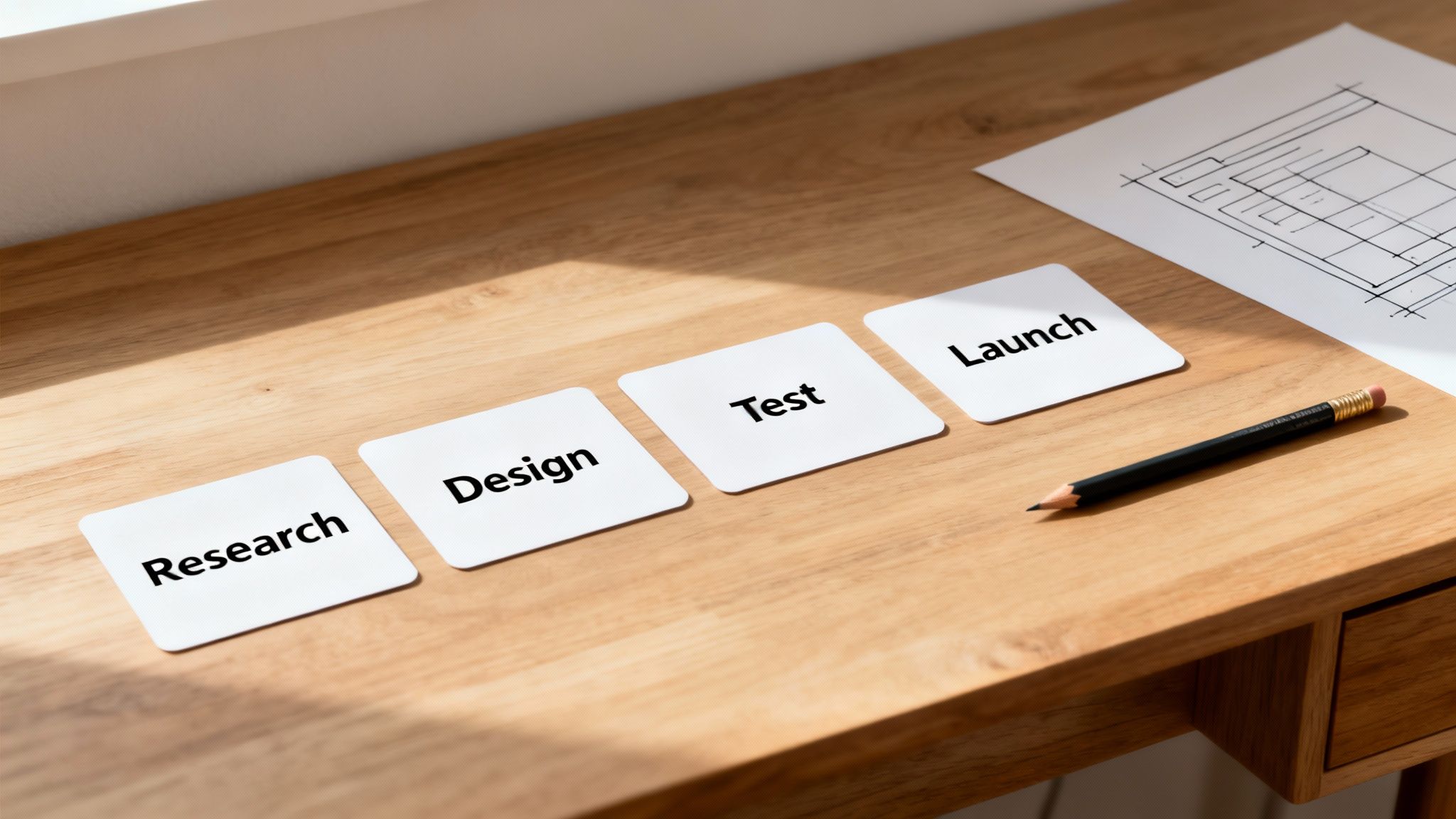
A website that consistently brings in new business isn't built on guesswork. It’s not about a designer’s favourite colours or what the business owner thinks customers want. It’s the result of a deliberate, repeatable process that removes assumptions and puts your ideal customer at the heart of every decision.
This methodical four-stage journey is what separates a pretty online brochure from a genuine lead-generating machine. A professional UX designer follows this proven path to make sure the final product actually works.
Stage 1: Research and Discovery
Before a single line is drawn, the work begins with deep listening. A good UX designer needs to get inside the heads of two groups of people: you (the business) and your customers. The goal is to uncover what your customers actually need, not what you assume they do.
This discovery phase is all about finding answers to the real questions:
- What problem is a potential customer trying to solve when they land on your site?
- What words are they typing into Google to find services like yours?
- What are the big frustrations they have with your competitors' websites?
- What’s the one piece of information they need to see before they’ll pick up the phone?
Getting these answers right lays a solid foundation. It ensures the whole website is built around real-world needs and behaviours, not just industry jargon.
Stage 2: Design and Prototyping
With a clear picture of the user, the designer starts mapping out the website’s structure. It doesn't start with colours and images. It starts with low-fidelity wireframes—simple, black-and-white blueprints that focus entirely on function, flow, and where everything should go.
Think of it like an architect's floor plan before the interior decorator comes in.
Once that blueprint is locked in, it’s turned into an interactive prototype. This is a clickable mock-up that looks and feels like a finished website. It lets you and your team test the entire user journey—from the homepage to the contact form—before a single pound is spent on coding.
Stage 3: Testing and Feedback
This is the moment of truth. The prototype gets put in front of real people who match your target customer profile. A UX designer will sit down with them (in person or virtually) and watch as they try to complete basic tasks, like finding your phone number or requesting a quote.
Watching a real person get stuck or confused is more valuable than a hundred internal meetings. Usability testing gives you unfiltered, undeniable insights into what needs fixing to make the experience seamless.
Stage 4: Iteration and Launch
The feedback from those tests is gold. The designer takes those real-world insights and uses them to refine the prototype, fixing the confusing bits and smoothing out any bumps in the road.
This cycle of testing and tweaking might happen a few times, but it’s crucial. It ensures the website is fully optimised to convert visitors into leads before it goes live.
Only when the design is user-validated and proven to work is it handed over to the developers for the final build. It’s a system designed to guarantee your new website isn’t just another pretty expense—it’s an engine built to make your phone ring.
How to Hire a UX Designer in New Zealand
For a lot of small businesses here in New Zealand, the idea of hiring a full-time user experience designer feels completely out of reach. With demand driving up salaries, especially in cities like Auckland and Wellington, just finding the right person can feel like a massive hurdle.
This isn't just a hunch; it's the reality of the market right now. As more Kiwi companies have moved their focus online, the need for skilled UX designers has exploded. A 2025 skills analysis even flagged UX/UI design as one of the top 10 tech skills in the country. Auckland alone is expected to have over 34,000 ICT roles by 2025. That kind of competition makes finding an experienced designer tough and expensive.
This leaves business owners with two realistic paths: bring on a freelancer or partner with a specialist agency.
Freelancer vs Agency
Hiring a freelancer can be a smart move for specific, well-defined projects. They often bring flexibility and can be a cost-effective way to get smaller jobs done. But a freelancer is still just one person. They might be a brilliant designer, but they probably don’t have deep expertise in SEO, copywriting, or Google Ads—the very things that turn a good design into a machine that generates leads.
On the other hand, partnering with a digital marketing agency gives you access to an entire team. This integrated approach means every single decision the user experience designer makes is connected to your wider business goals.
An agency offers a complete solution where UX, Local SEO, and paid ads all work together. For a service business, that synergy is everything—you need a website that not only looks great but also ranks on Google and makes the phone ring.
The Smart Choice for Lead Generation
For most service-based SMEs, working with an agency is a more reliable and direct path to getting results. You get all the specialist skills without the cost and hassle of a full-time employee. An agency's team knows how to connect the dots between a smooth user journey on your site and a lower cost-per-click in your Google Ads campaign.
This is exactly what a digital marketing strategist does—they make sure every piece of your online presence is working together to grow your business. And if the local talent pool feels a bit thin, you could also look into how to source talented remote designers from other markets.
Ultimately, the best choice is the one that aligns your budget and goals with a partner who understands how to get you more customers.
A Simple Checklist for Evaluating a UX Portfolio

When you’re ready to bring a designer or agency on board, their portfolio is the best window you have into what they can actually do. The trouble is, it’s easy to get wowed by flashy visuals and completely miss the things that actually matter for your business.
Don’t just look for pretty pictures. A strong portfolio from a skilled user experience designer tells a story—a story of solving real problems and delivering tangible results. This quick checklist will help you cut through the noise and assess a portfolio like a pro.
Look for Process, Not Just Polish
Anyone can make a finished website look good. A real UX professional will show you their working, laying out exactly how they got from the initial business headache to the final, effective solution.
A great portfolio will show you things like:
- Case Studies: A proper walkthrough of a project that covers the client's challenge, the research they did, their design thinking, and the final outcome.
- Wireframes or Prototypes: Examples of the early-stage blueprints. This proves they think about structure and how a user will move through the site before they even think about colours and fonts.
- Clear Problem Statements: A simple explanation of what the client’s actual business problem was. For example, "The old website wasn’t getting any quote requests from people on their phones."
Seeing this stuff shows a methodical approach. It tells you they’re focused on solving your business challenges, not just decorating web pages.
Focus on Business Outcomes
Let's be blunt: a beautiful website that doesn’t make your phone ring is a failure. The portfolio you're looking at must connect the design work to real-world business results.
An effective UX portfolio doesn't just say, "Here's a website we made." It says, "Here's how we increased our client's qualified leads by 35% in six months." Look for hard numbers, client testimonials, and measurable improvements.
As you look through their work, ask yourself these simple questions:
- Is it obvious they’ve designed for mobile phones first?
- Is the design clean, uncluttered, and dead simple to navigate?
- Does every page have a clear, obvious next step or call to action?
Using this checklist will give you the confidence to pick a design partner who actually knows how to build a website that grows your Kiwi business.
Frequently Asked Questions About UX Design
Even after getting the rundown on user experience design, many Kiwi business owners still have a few questions about how it all works in practice. We get it. Here are some straight-up answers to the common queries we hear from tradies and service businesses across New Zealand.
How Is UX Different from a Graphic Designer or Web Developer?
It helps to think of it like building a house.
The user experience (UX) designer is your architect. They’re the ones drawing up the blueprints, figuring out the flow of the house, where the rooms go, and making sure it’s actually liveable and meets the family’s needs.
The graphic designer (or UI designer) is the interior decorator. They choose the paint colours, the furniture, the lighting—all the things that make the house look amazing. And the web developer? They’re the builder, turning those blueprints and design choices into a physical structure. You need all three, but they have very different jobs.
How Long Does a Proper UX Process Take?
It’s definitely not an overnight job. The timeline really depends on how complex your website is, but for a typical service business, you can expect the initial research and design phases to take several weeks.
That upfront investment pays for itself, though. It’s far cheaper and quicker to spot a problem in a simple blueprint than it is to knock down walls after the house has already been built. Getting the UX right from the start saves a massive amount of time, money, and headaches down the track.
Investing a few weeks in solid UX research and design can save months of frustration and thousands of pounds trying to fix a website that doesn’t turn visitors into customers.
What’s the Biggest Mistake Businesses Make with UX?
The most common trap is assuming you know what your customers want. You’re an expert in your trade, no doubt about it, but you are not your customer. Their perspective is completely different.
A professional UX designer takes the guesswork out of the equation. They don’t rely on your personal opinion, what your gut tells you, or what your competitor down the road is doing. Instead, they use actual research to see what real people do. Every decision is based on data, not assumptions. That’s the secret to a website that solves customer problems and actually generates leads.
Can I Afford a UX Designer for My Small Business?
Hiring a full-time, in-house designer is a big expense, and it’s often out of reach for small businesses. But that doesn’t mean you have to miss out. Partnering with an agency that bundles UX into their website design and marketing services makes it far more accessible.
When UX is integrated with services like SEO and Google Ads, you get a much better return. The website is built from day one with a clear goal in mind: getting your phone to ring. It stops being just another business expense and becomes a powerful asset that actively brings in work.
Ready to build a website that doesn’t just look good but actively grows your business? The team at Four Stripes combines expert UX design with proven local SEO to turn your online presence into a reliable source of qualified leads. Learn more at https://fourstripes.co.nz.