
Getting An Overview Of Google Ad Fees
Running a campaign on Google Ads feels a bit like settling your monthly household bill—there are utilities, groceries and rent all rolled into one statement. Each fee type adds its own line item, and understanding how they stack up is the first step to keeping your budget on track.
Consider these core charges:
- Cost-Per-Click (CPC): You pay when someone clicks your ad, usually between NZD $0.90 and $2.00 per click.
- Cost-Per-Thousand Impressions (CPM): Charged every 1,000 ad views, this varies by industry and placement.
- Platform Transaction Fees: A small percentage Google tacks on for processing your spend or conversions.
- Management Fees: What you pay an agency or in-house team to optimise and report on your campaigns.
- 15% GST: Statutory tax applied to all ad spend in New Zealand.
Overview Of Google Ad Fee Categories
Before we dive deeper, here’s a snapshot of each cost component and its typical range:
| Cost Component | Description | Typical Range (NZD) |
|---|---|---|
| Cost-Per-Click (CPC) | Paid whenever a user clicks your ad | $0.90 – $2.00 per click |
| Cost-Per-Thousand (CPM) | Fee for every 1,000 views of your ad | $4.00 – $10.00 |
| Platform Fees | Percentage charge on overall ad spend or per conversion | 1% – 3% |
| Management Fees | Agency or in-house monthly retainer for campaign services | $500 – $2,000+ |
| GST (15%) | New Zealand goods and services tax on total ad expenditure | 15% of ad spend |
These figures will shift based on your industry, audience targeting and competition—use them as a ballpark when planning your next budget.
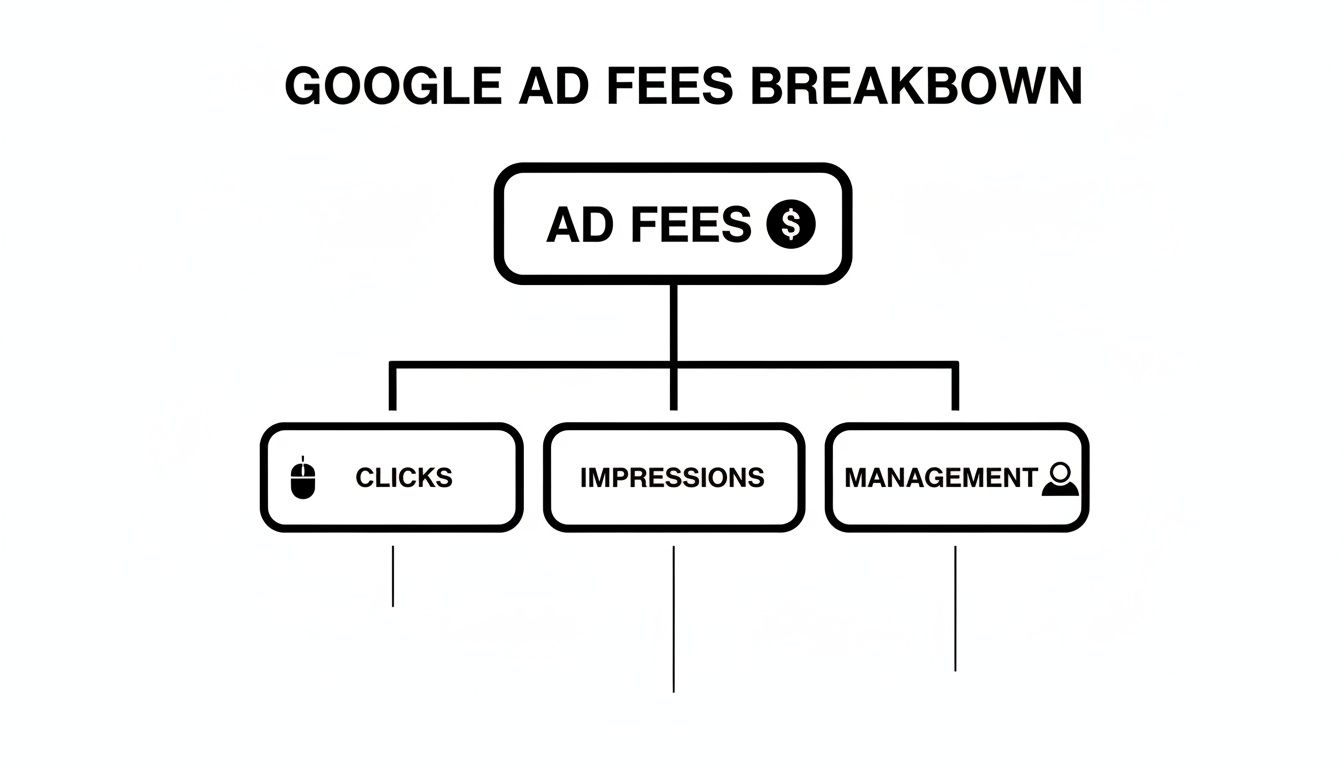
The diagram above shows that click and impression costs typically dominate your bill, with management and platform fees following behind.
Why Fees Matter
Every line on your invoice chips away at your return on investment. When you know how each charge functions, you can steer your budget towards the tactics that really move the needle.
Imagine you start with a NZD $1,000 ad budget. At $2.00 CPC, that nets you 500 clicks before tax. Add 15% GST, and you’re out of pocket NZD $1,150—that leaves only NZD $850 for management or bid testing. Those extra NZD $150 could cover a strategic audit or more aggressive bidding on high-value keywords.
“Understanding each fee line empowers you to negotiate better and reduce wasted spend,” says an Auckland PPC specialist.
Armed with this overview, you’re in a strong position to dissect cost types, refine billing approaches and sharpen your optimisation tactics.
Key Takeaways
- Know Your Numbers: Grasping CPC, CPM, management fees and GST lets you forecast the true cost of every campaign.
- Think Like A Household Bill: Comparing ad fees to utilities and groceries makes complex charges easier to digest.
- Optimise For Impact: Breaking down your spend uncovers opportunities to cut waste and boost ROI.
Next up, we’ll unpack each fee component in more detail—starting with Cost-Per-Click dynamics and the auction mechanics that help you pay only what you need for each click.
Exploring Different Cost Types
Google Ads can feel like an art auction—every bid you place shapes how much of your budget is spent.
You’ll encounter three main pricing models: Cost-Per-Click (CPC), Cost-Per-Thousand Impressions (CPM) and Cost-Per-View (CPV). Each one charges you in a slightly different way.
- Cost-Per-Click (CPC) means you only pay when someone clicks your ad. In New Zealand, the going rate usually sits between NZD $1 and $5 per click.
- Cost-Per-Thousand Impressions (CPM) bills you for every 1,000 views. Here in Aotearoa, expect NZD $4 to $12 per thousand impressions.
- Cost-Per-View (CPV) applies to video ads—your bill kicks in when viewers watch your clip or engage. Typical costs are around NZD $0.05–$0.30 per view.
Imagine you’re at an art fair. Each bid might win you a painting (a click), a glimpse of the artwork (an impression) or a short gallery tour (a video view). Google’s platform runs a similar auction behind the scenes, ranking ads by Ad Rank—a blend of your bid and your Quality Score.
How Auction Bids Shape Costs
In Google’s auction, Ad Rank = your bid × your Quality Score.
A higher bid or a more relevant ad pushes you up the results page—but it can also drive up your cost. Suppose you set a gross CPC of NZD $2.50; after platform fees and 15% GST, you might pay NZD $2.60 per click.
- Your bid amount sets the ceiling on what you’re willing to pay.
- Quality Score rewards relevance and landing-page experience, trimming your actual spend.
- Platform fees typically add 1–3% to your ad spend, covering processing and conversion tracking.
Expert tip: A strong Quality Score often slashes your paid cost per click.
Putting All Cost Types Together
Back at our art fair, winning a piece at NZD $50 with 15% GST takes you to NZD $57.50 out the door. That mirrors how CPC, CPM and CPV stack up in your overall Google Ads fees.
Breaking down each cost type uncovers where you can trim waste and boost your return on ad spend. Dive deeper into budget-friendly tactics in our PPC advertising guide for New Zealand.
Test different bidding strategies to see what works best:
- Manual CPC gives you fine-tuned control at the keyword level—but it demands frequent tweaks.
- Target CPA pushes spend towards conversions at your specified cost.
- Maximise Clicks uses automation to drive the highest volume of clicks within your budget.
Keep an eye on search queries to weed out irrelevant terms. Removing these can cut wasted impressions and lower your CPM costs.
Test variations. Adjust bids. Watch the savings add up.
Understanding Billing And Payments
Navigating invoices and payment schedules shouldn't feel like guesswork. You want a clear picture of when Google Ads fees land in your account and what triggers each charge.
Start by choosing the right payment method for your needs. Automatic payments charge your credit card or bank once you hit a spend limit, while monthly invoicing delivers a single bill at month end (you approve before it goes through). If you prefer hands-on control, a manual top-up lets you preload funds and guard against overspend.
- Automatic Payments trigger charges when you hit thresholds you set.
- Monthly Invoicing is ideal for high-volume accounts that prefer consolidated billing.
- Manual Top-Up gives you full control by pre-paying funds.
A smart move is setting payment thresholds so campaigns never stall. Start at NZD $50, then build trust and ramp up to NZD $10,000. That way, your ads keep running smoothly even when a threshold is reached.
Payment Cycles And Thresholds
In practice, Google bills you either as soon as a threshold is met or at the end of your billing period—whichever comes first. Over time, your thresholds climb when you pay on time, rewarding reliable accounts with higher limits.
Threshold examples:
- NZD $50 initial threshold
- NZD $500 after consistent payments
- Custom thresholds for enterprise clients
Invoice Reconciliation Tips
When it comes to audits, matching Google Ads statements to your ledgers is a lifesaver. Export invoices as CSV and tag each line item with its campaign name—this way, you see exactly where every dollar went.
“Reconciling Google Ads invoices can prevent surprise charges and keep budgets on track.”
For instance, assign each invoice ID to an expense code in your accounting software. You’ll cut down on manual errors and tighten financial controls.
Benchmarks collected by New Zealand digital agencies show most NZ small-to-medium businesses run Google Ads budgets between NZD $450 and NZD $2,500 per month, with larger campaigns often exceeding NZD $5,000 in metro areas. A service SMB budgeting NZD $1,000 at an average CPC of NZD $2 expects around 425 clicks after 15% GST, helping you model realistic lead volumes. Discover more insights about NZ advertiser spend patterns on Back9.
- Monitor spend thresholds weekly
- Enable email notifications for billing events
- Schedule reconciliation reviews each month
Simplify Your Finance Routine
A streamlined billing process means fewer surprises and more time to optimise campaigns. Give your finance team view-only access and set calendar reminders for invoice approvals.
- Set budget alerts in Google Ads
- Export invoices weekly for review
- Schedule monthly reconciliation meetings
- Adjust payment thresholds as needed
With a well-managed billing profile, your campaigns won’t pause unexpectedly. You’ll enjoy peace of mind—and more hours back to focus on performance.
Tip: Use Google’s billing export API to automate invoice retrieval each week.
Improving Quality Score to Lower Fees

Quality Score sits at the heart of your Google Ads costs. It decides both where your ad appears and how much each click will cost you.
Think of it like a campaign fitness test on game day. When your keywords, ads and landing pages are in sync, your score climbs. And with every point you gain, your cost-per-click can fall.
Small adjustments—refining keyword groups, tweaking ad copy or speeding up your landing page—are like targeted training sessions. Over time, they pay off with higher relevance, stronger click-through rates and lower fees.
Building Strong Keyword Foundations
- Group tightly related terms into ad groups for more precise targeting.
- Choose match types that strike the right balance between reach and control.
- Add negative keywords regularly to weed out irrelevant searches.
Well-organised ad groups help Google understand intent. For instance, combining “leak repair” and “blocked drain” in one group can lift your Quality Score above 7.
Expert tip: Treat every keyword update like a new drill—each refinement sharpens your overall performance.
Tuning Landing Page Relevance
- Mirror your ad copy and keywords in the landing page content.
- Optimise load times—fast pages keep people scrolling, not bouncing.
- Place clear calls to action above the fold.
- Prioritise mobile layouts—around 60% of clicks come from smartphones.
A landing page that feels cohesive with your ads can boost relevance scores and cut actual CPC by up to 20%. Track your click-through rate and conversions, then repeat the adjustments that work best.
Over time, this cycle of testing, analysing and refining builds top-tier ad performance and chips away at Google ad fees.
For more advanced tactics, explore our guide on Google Ads Best Practices 2025 at Four Stripes.
Consistent optimisation can unlock up to 30% more clicks for the same budget. When your campaigns hit a Quality Score of 8 or higher, you’ll see real-time savings on fees.
Real-World Results
| Business Type | Quality Score | Avg. CPC | Cost-per-Lead | Enquiry Volume |
|---|---|---|---|---|
| Local Plumbing | 5 → 8 | NZD $3 → $2 | 22% drop | 15% rise |
Key Takeaways
- Regularly group and refine keywords to sharpen your Quality Score.
- Align landing pages with ads and prioritise speed to lower CPC.
- Keep testing ad copy and page layouts to sustain peak performance.
Start small, measure impact and iterate. In just a few weeks, you could see double-digit cost reductions—just like that plumbing business did.
Comparing Agency Fee Structures
Picking the right fee model isn’t just bookkeeping—it shapes how your partnership performs. A clear structure can save you headaches and keep your budget on track.
Agencies tend to use three core approaches:
- Flat Retainer for predictable monthly costs
- Percentage Of Ad Spend to align growth incentives
- Performance-Based Fees that hinge on real results
Flat Retainer
A Flat Retainer means one fixed monthly invoice, no surprises. You can map out your marketing budget down to the last dollar. On the flip side, stellar campaign performance won’t lower your fee—and agencies might pace work evenly rather than sprint when results spike.
Percentage Of Ad Spend
With this model, agency earnings grow as your ad spend grows. For instance, a 15% management fee on a NZD 10,000 monthly budget equals NZD 1,500 in agency costs. This keeps your partner pushing for more volume—but be cautious: big budgets can balloon costs if there’s not a tight rein on efficiency.
Performance-Based Fees
Here, you pay only for agreed outcomes—leads, sales or other key metrics. It sounds like a win-win: you get results, they get paid. Just beware of fine print. Higher base rates, rigid qualification criteria and complex tracking can muddy up billing if your conversion tags aren’t spot on.
“Clear reporting cadence and agreed optimisation hours deliver transparency and ensure value,” says a Wellington digital specialist.
When you’re at the negotiating table, ask for:
- A detailed breakdown of deliverables and hours
- A capped initial fee or trial period
- Bonus pay for beating agreed targets
Assessing Service Levels
Transparent service commitments tell you exactly what you’re buying. Look for:
- Regular reporting and strategic meetings
- Agreed monthly optimisation hours (e.g., 10 hours included, extra at NZD 150/hr)
- Clear definitions of bid adjustments, A/B tests and planning support
One striking data point: Google NZ reported nearly NZD 1 billion in inter-company service fees for the year ending 31 December 2023. That figure illustrates just how big fee allocations have become in New Zealand’s ad ecosystem. Read the NZ Herald’s fee breakdown report: NZ Herald’s Fee Breakdown Report
Check our guide on Selecting the Right Google Ads Agency for deeper insights.
Benchmarking Costs for Trades and Services
When you’re running Google Ads for tradies and service businesses, every dollar matters.
We’ve gathered real New Zealand examples—plumbing, landscaping, legal advice and health services—to paint a clear picture of what you might pay per click and per acquisition.
- Plumbing campaigns often run at NZD $1.50–3.00 per click, with urgent-call keywords pushing you to the top end.
- Landscaping advertisers might see NZD $2.00–4.00 during busy spring and summer months.
- Legal Advice can spike to NZD $20–50 per click in a crowded market.
- Health Providers generally pay NZD $3.00–6.00 when patients search for urgent care.
On average, most Kiwi small-to-medium firms spend NZD $1.00–5.00 per click, though niche or high-stakes verticals often exceed that range. Remember to add 15% GST on top.
For a deeper dive into New Zealand ad spend trends, check out Lucid Leads’ NZ Cost Guide.
CPC Benchmarks By Industry
Here’s a quick snapshot of average cost-per-click rates across key service sectors in New Zealand. Use it to guide your budgeting and bid strategy.
| Industry | Typical CPC Range (NZD) | Notes |
|---|---|---|
| Plumbing | $1.50–3.00 | Peaks during emergency call-outs |
| Landscaping | $2.00–4.00 | Spring/summer seasons drive bids higher |
| Legal Advice | $20–50 | Fierce competition on high-value terms |
| Health | $3.00–6.00 | Urgent care searches command higher CPC |
This table gives you a baseline. Your own figures may vary, so keep testing and refining as your campaign data accumulates.
Modelling Click Volumes
Once you’ve locked in an average CPC, estimating click volumes is straightforward.
- Divide your monthly budget by your average CPC to get projected clicks.
- For instance, NZD $1,000 ÷ NZD $2.50 CPC = 400 clicks (before GST).
- Feed these click estimates into your lead forecasts using your known conversion rate.
This turns budget guesses into tangible numbers you can plan around.
Forecasting Leads And Return On Ad Spend
After modelling clicks, it’s time to translate those into leads and calculate your CPA.
- Multiply projected clicks by your conversion rate to predict lead volume.
- Divide total spend (including 15% GST) by your lead count to find your CPA.
- Compare revenue per lead against ad spend to measure ROAS.
For example, a landscaping campaign with NZD $2,500 at NZD $3.00 CPC delivers about 833 clicks. At a 5% conversion rate, you’d generate roughly 42 leads. From there, you can see whether your ad spend is pulling its weight.
“Breaking costs down step by step turns vague percentages into clear budget actions,” says an Auckland PPC specialist.
Ongoing Budget Refinement Best Practice Checklist
Once your campaign has run for a month, you’ll have enough real-world data to optimise further.
- Review performance after two weeks and pause low-intent keywords.
- Adjust bids by time of day and location to focus on your hotspots.
- Tweak landing pages to lift conversion rates.
- Test ad copy variations with A/B experiments to find your top performers.
- Set up weekly budget reviews to catch overspend before it happens.
This cycle of testing and tweaking will drive down your effective cost-per-lead over time.
Common Questions On Google Ad Fees
Running Google Ads often feels like watching small amounts vanish every time someone clicks. You’ve got clicks, platform charges, agency fees and of course, GST. Here’s a breakdown so you can see exactly where your budget goes.
- Cost-Per-Click (CPC): Typically NZD $1–5 per click.
- Platform Fees: Usually 1–3% of your ad spend or conversions.
- Management Fees: Agency support often ranges from $500–$2,000 monthly.
- GST (15%): Applies to all ad spend in New Zealand.
Next, let’s untangle how GST appears on your invoice.
Google automatically adds 15% GST to each charge, so your true cost is spend × 1.15. Invoices clearly list your pre-GST fees, the tax amount and the total.
That means if you budget NZD $1,000, after GST you’re looking at about 870 clicks at NZD $1.15 each.
Billing And Payment Methods
Google offers three main billing options. Pick the one that suits your cash flow:
-
Automatic Payments
Charges hit your card once you reach a set spend threshold. -
Monthly Invoicing
You get one consolidated invoice at the end of each month. -
Manual Top-Up
Preload your account to avoid any ad interruptions.
New accounts often start with a NZD $50 threshold. Pay on time and Google will bump that up for you.
Tip: Keeping on top of payments means fewer pauses and higher thresholds—so your campaigns never miss a beat.
Tips To Reduce Cost Per Lead
You don’t need a complete strategy overhaul to cut your cost per lead. Even minor tweaks can shave off 20–30%.
- Use negative keywords to filter out irrelevant clicks.
- Bid aggressively on high-intent terms where you know leads convert.
- Improve your Quality Score with tightly aligned landing pages.
- Run A/B tests on ad copy and pause anything that underperforms fast.
For example, a local plumber in Christchurch paused low-performing keywords and immediately saved 20% on their ad spend.
“Spot budget leaks weekly for instant savings.”
A few smart moves like these will stretch every dollar and drive more leads.
Partner with Four Stripes to master Google Ad fees and lower your cost-per-lead quickly.