
SEO for companies is more than just a box-ticking exercise. It's the bridge that connects your business to customers who are actively searching for your exact services right now. It’s how you become the answer they find on Google.
This guide breaks down how a smart SEO strategy drives real-world results—more phone calls, more quote requests, and ultimately, more revenue in your bank.
Why Your Business Needs to Master SEO
Let's ditch the jargon for a minute.
Imagine your business is a fantastic shop. You’ve got incredible expertise, top-notch services, and happy customers. But your shop is tucked away down a dark, unmarked alley. SEO is the process of building a brightly lit, signposted super-highway that leads a steady stream of customers right to your front door.
It's about making sure that when someone in your area searches for a solution you provide, your business is the first one they see. Simple as that.

Without a solid SEO plan, you’re basically invisible to the vast majority of potential customers. The modern buying journey almost always starts with a Google search. Whether someone needs an emergency plumber, a business consultant, or a landscape gardener, their first move is to pull out their phone.
The Modern Customer Connection
In today's market, online visibility is credibility. Ranking high on Google doesn't just put you in front of more people; it builds instant trust. Why? Because we’re all conditioned to trust Google to show us the most relevant, reputable options first. Showing up on page one signals that you're a legitimate, authoritative player in your industry.
The urgency is real. Think about how often you use Google yourself. According to the 2025 Kiwi Search Habits Survey by IAB New Zealand, a massive 82.4% of Kiwis use search engines several times a day. It’s not just a marketing channel; it's an "always-on utility" baked into our daily lives.
From Visibility to Real Business Growth
Good SEO isn't just about getting seen. It's about attracting the right kind of traffic—people with a genuine problem who are ready to hire someone like you to solve it. For any business serious about this, understanding how to improve website SEO from the ground up is the first critical step.
SEO is not about trying to trick Google. It’s about partnering with Google to give its users the best possible answers. A well-optimised website is your promise to a potential customer that they’ll have a great experience, from the first click to the final phone call.
This whole process stands on a few key pillars that work together:
- Local SEO: Making sure you’re the first business people find in your immediate service area.
- Technical SEO: Ensuring your website is fast, secure, and dead simple for search engines to crawl and understand.
- Content Strategy: Creating genuinely helpful information that answers customer questions and proves you're the expert.
Get these elements right, and your website transforms from a static online brochure into an automated lead-generation machine that works for you 24/7.
Dominating Local Search and Winning the Map Pack
For most service-based companies, new business doesn't come from a nationwide search—it starts right in your own backyard. This is where the real action is, connecting you with customers actively looking for your skills in their immediate area. And it’s where mastering SEO for companies becomes a game-changer.
Think about how you'd look for a local tradie. You wouldn't just type "electrician." You'd search for "electrician in Auckland" or "emergency plumber near me." This is what we call local search intent, and it’s a massive signal that someone is ready to pick up the phone and book a job. Your goal is to be the first name they see.
Here in New Zealand, this means you're playing almost exclusively in Google's sandbox. The search giant owns a staggering 91.34% of the market, making it the front door for nearly every potential customer. For any Kiwi business, ignoring Google is like locking up your shop and hoping people notice you. You can see the full breakdown on New Zealand's search engine landscape at StatCounter.
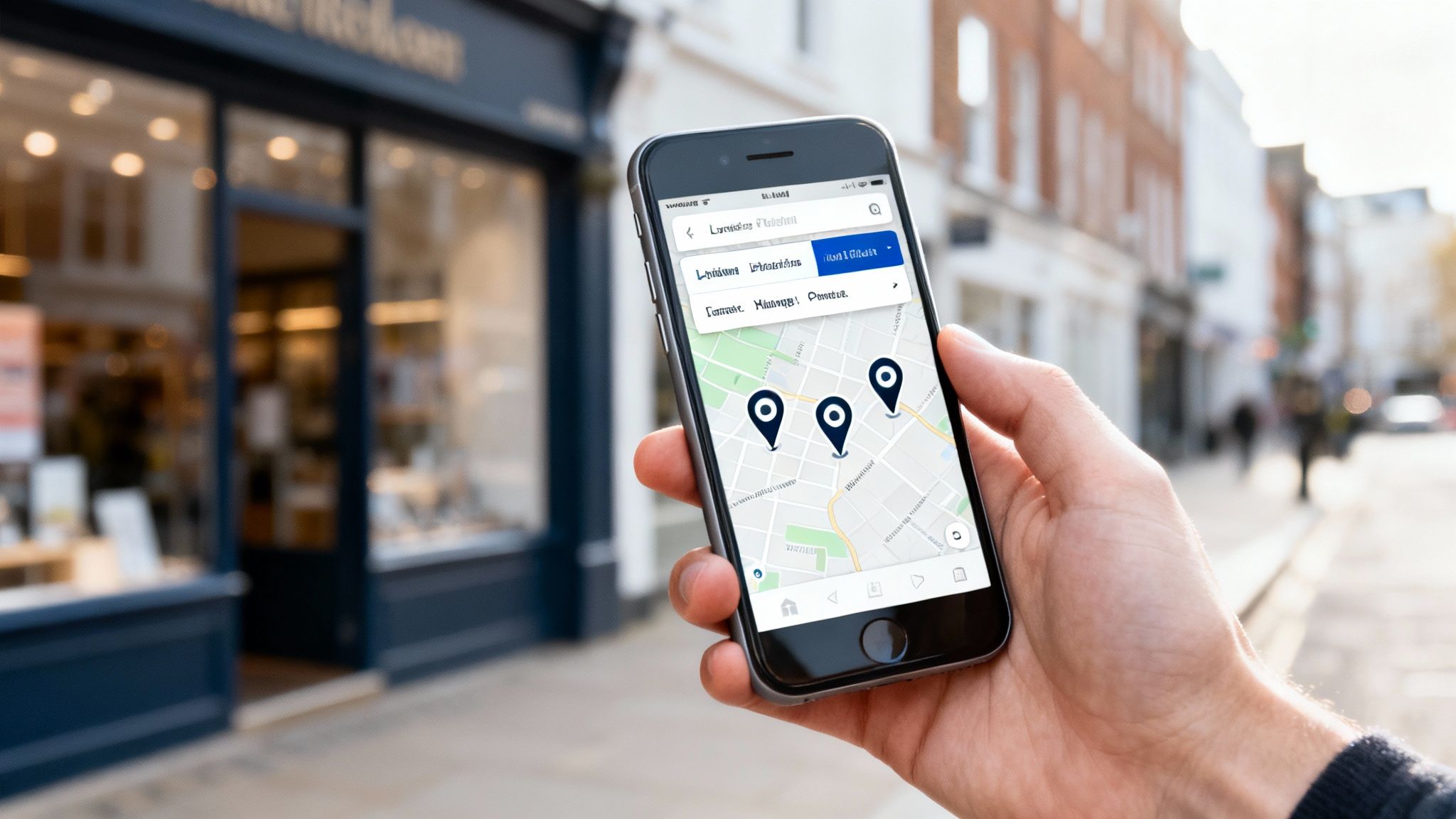
Your Digital Shopfront: The Google Business Profile
At the heart of all local SEO is your Google Business Profile (GBP). This isn't just another online listing; it’s your digital shopfront, your billboard, and your customer service desk all rolled into one. It’s the engine that powers your appearance in the coveted "Map Pack"—that little box showing three local businesses right at the top of the search results.
Landing in the Map Pack is like getting a prime retail spot on the busiest street in town, except it’s free. It gives you instant visibility, builds immediate trust, and often leads directly to a phone call. But getting there isn't luck; it requires careful and consistent work. Frankly, neglecting your GBP is one of the biggest mistakes a local business can make.
Think of it this way: if your website is your head office, your Google Business Profile is your flagship branch in every single neighbourhood you serve. It needs to be pristine, packed with helpful info, and inviting to everyone who walks past.
For a deep dive into making this free tool work for you, check out our guide on why your NZ business should be using Google My Business.
Getting Your GBP in Fighting Shape
Making your profile stand out isn't about secret tricks. It’s about being thorough and giving Google all the right signals to prove you're the best answer for a searcher's problem.
Here’s where to focus:
-
Nail Your NAP Data: Your Name, Address, and Phone number (NAP) must be exactly the same everywhere online. That means no little variations like "St" vs. "Street" or "Ltd" vs. "Limited." Consistency is the bedrock of trust for search engines.
-
Pick the Right Categories: Choose a primary business category that perfectly describes what you do (e.g., "Plumber," not "Home Services"). Then, add secondary categories for every other service you offer. This helps Google match you to more specific, high-intent searches.
-
Write a Compelling Business Description: You get 750 characters, so use them all. Explain who you are, what you do, the areas you cover, and what makes you the best choice. Weave in the keywords your customers are actually searching for.
-
Upload High-Quality Photos and Videos: In local search, photos build instant trust. Regularly add images of your team on the job, your van, your finished work, and even yourself. It shows you’re a real, active, and proud business.
Expanding Your Local Footprint
Beyond your GBP, a couple of other tactics are essential for truly owning local search. The first is building local citations. These are simply mentions of your business's NAP information on other relevant websites, like local business directories (think Finda or Yellow) and industry-specific sites. Each consistent citation acts as a vote of confidence, reinforcing to Google that you are who you say you are and you're based where you say you are.
The second is creating dedicated pages on your own website for each service and for the main suburbs you work in. A page titled "Gasfitters in Howick" has a far better chance of ranking for that specific search than a generic "Our Services" page ever will. This strategy lets you pull in highly targeted traffic from customers across your entire service area, effectively turning your website into a magnet for local leads.
Building a Strong Digital Foundation
Now that we’ve sorted your local presence, it's time to shift focus to the engine room of your entire online strategy: your website. I like to think of a website as a house. If you want visitors to feel welcome, stay a while, and ultimately buy from you, the entire structure needs to be solid from the ground up.
This is where two crucial pieces of SEO for companies click into place. First, there’s Technical SEO. This is the foundation, the wiring, and the plumbing—all the behind-the-scenes stuff that makes sure your site is fast, secure, and easy for search engines to crawl and understand. Then you have On-Page SEO, which is like the interior design. It’s about making every single page feel welcoming, clearly labelled, and furnished with content that serves a real purpose for both people and Google.

It's a huge mistake to neglect this foundation. You can offer the best services in your city, but if your website is slow to load, a nightmare to use on a phone, or just plain confusing, potential customers will hit the back button and go straight to your competitor. It’s that simple.
On-Page SEO: The Art of Interior Design
On-page optimisation is all about making each page on your site as clear, helpful, and valuable as possible. This starts before anyone even lands on your site—it begins with the first impression they see in the search results.
Your title tag (the blue clickable headline) and your meta description (the little snippet of text underneath) are your digital billboard. They have to be compelling enough to earn that click, accurately describing what's on the page while including the main keyword you're targeting. A generic title like "Home Page" is a wasted opportunity. Something specific like "Expert Electrical Services in Auckland | Four Stripes Electricians" tells both the user and Google exactly what you do and where you do it.
Once they're on your site, the structure is everything. Using headings (H1, H2, H3) breaks up your text, creating a logical flow that makes your content scannable and easy to digest. This also sends powerful signals to Google about the page's main topics.
And don't forget your images. They do more than just make the page look good; they’re another SEO opportunity. Giving images descriptive file names (like auckland-plumber-fixing-leaky-tap.jpg) and adding alt text—a short description for search engines and visually impaired users—helps Google get the full picture of what your page is about.
Technical SEO: Ensuring a Solid Structure
While on-page elements are what your visitors see, technical SEO is the invisible framework holding everything together. If your technical base is shaky, all your other hard work can be completely undermined.
A website with poor technical health is like a car with a dodgy engine. It might look great on the outside, but it won't get you very far. Fixing these issues is non-negotiable for any company serious about ranking well.
Here are the technical fundamentals you absolutely must get right:
- Site Speed: We live in an age of instant everything. A slow-loading website is a lead killer. Your pages need to load in under three seconds, full stop. A slow site frustrates users and is a direct negative ranking signal for Google. This is massively influenced by your choice of provider, which makes reliable web hosting in NZ a critical first investment.
- Mobile-First Design: The vast majority of local searches happen on a phone. Your website has to deliver a flawless, easy-to-use experience on a small screen. Google now primarily uses the mobile version of your site for indexing and ranking, so a clunky mobile design will tank your visibility.
- HTTPS Security: That little padlock icon next to your URL (showing "https") is no longer a nice-to-have. It’s essential. An SSL certificate encrypts the connection between your site and its visitors, building trust and protecting their information. Google actively flags sites without it as "not secure," scaring off potential customers before they even get a chance to see what you offer.
Get these on-page and technical elements working together, and you’ll create a digital foundation that not only impresses search engines but, more importantly, delivers a brilliant experience for your future customers.
Creating Content That Attracts and Converts
Smart SEO for companies is about much more than just listing what you do. It’s about becoming the go-to expert in your field by answering the questions your customers are already asking. This is where a clever content plan turns your website from a simple online brochure into a magnet for high-quality leads.
Forget shouting about how great you are. The goal here is to be genuinely helpful. Put yourself in your customer's shoes. A homeowner doesn't search for "plumber"; they search for "why is my boiler making a banging noise?" or "how to fix a constantly dripping tap."
When you create content that solves these specific problems, you're building trust and catching potential customers right at the start of their journey.
From Keywords to Conversations
This is all about shifting your mindset from selling to serving. Every single article or guide you publish should be a genuinely useful resource that helps your audience. It all comes down to understanding customer intent – the real reason behind someone’s Google search.
Think about it: someone searching "best heat pump for a small home" has a very different goal than someone frantically typing in "emergency heat pump repair." Your content needs to speak to both.
A great content strategy doesn't just chase rankings; it builds relationships. By consistently providing value, you position your company as the go-to expert, making you the obvious choice when it's time to hire someone.
This approach turns your website into a long-term asset, consistently pulling in the right kind of traffic—people who are far more likely to become paying customers. We break this down in more detail in our guide on the content creation process for a local business and how you can put it into action.
Building Your Content Arsenal
Your website needs more than just a homepage and a contact form. To really climb the search rankings and build that crucial authority, you need a mix of content types that meet different customer needs at different times.
Here are a few of the most powerful formats for service-based businesses:
- Helpful Blog Posts: These are the workhorses of your content plan. Create articles answering common questions like, "How Much Does a New Roof Cost in Auckland?" or "5 Signs You Need to Call an Electrician." These posts draw in people looking for information and cement your expertise.
- Detailed Case Studies: Nothing says "we get results" like showing you get results. Walk potential customers through a recent project: outline the client's problem, the solution you delivered, and the fantastic outcome. This builds incredible credibility and social proof.
- In-Depth Guides: Go deep and create a comprehensive guide on a topic your customers care about. A landscaping company, for example, could write "The Ultimate Guide to Low-Maintenance Gardens for Kiwi Homes." This positions you as a true industry leader.
Don't forget about video, either. To see how you can reach an even wider audience, check out this excellent small business video marketing guide for some practical tips.
Ultimately, a strong content plan is about building a library of resources that serves your community. Every article, guide, and case study is another doorway for a potential customer to find you, trust you, and pick up the phone. By focusing on being genuinely helpful, you create a sustainable growth engine that works for your business 24/7, turning clicks into calls.
Earning Trust with Links and Digital Referrals
Now we get to one of the most powerful, and frankly, most misunderstood parts of SEO for companies: link building. Forget the complicated jargon. The easiest way to get your head around it is to think of it as digital word-of-mouth. It’s the online version of a trusted colleague recommending your services.
Every time another credible website links to one of your pages, Google sees it as a vote of confidence. It's a signal that your business is a legitimate authority in its field, and those votes directly help you climb the search rankings.
Think of it like this: if a well-respected local newspaper writes an article about a new restaurant and links to its website, that link carries serious weight. It's an endorsement. On the flip side, a link from some random blog no one’s ever heard of is like a flyer left under your windscreen wiper—it’s just noise.
Quality Over Quantity Is the Only Rule
Years ago, the game was to get as many links as possible, from anywhere and everywhere. Not anymore. That old-school approach will get your website penalised, fast. Today, it’s all about earning high-quality, relevant links from reputable sources.
One single, powerful link from an industry authority website is worth more than hundreds of dodgy ones from irrelevant directories. Google's algorithm is incredibly smart and can easily spot manipulative link schemes or what's known as "parasite SEO," where spammers hijack a trusted site's reputation. Don't go there.
True link building isn't about shortcuts. It’s about building genuine relationships and creating content so valuable that other businesses in your industry want to reference it. That’s how you build a strong, sustainable backlink profile that lasts.
This is the only way to build long-term authority without risking a penalty that could wipe you off the map overnight.
Practical Strategies for Earning Links
So, how do you get these valuable digital referrals without resorting to risky tactics? You become a valuable member of your local and digital community. It's that simple.
Here are a few sustainable link-building strategies that work wonders for Kiwi service businesses:
- Local Business Directories: Getting listed in reputable local directories like Finda and Yellow is step one. It's foundational. This doesn't just earn you a link; it builds those crucial local citations we talked about earlier, reinforcing your location and services in Google’s eyes.
- Community Sponsorship: Sponsoring the local kids' rugby team, a school fair, or a community event often comes with a thank-you link from their website. This is a brilliant, feel-good way to get a high-quality local link while genuinely supporting the community you serve.
- Supplier and Partner Links: Got great relationships with your suppliers or other businesses you work with? Ask if they have a partners page where they can add a link to your site. It’s a simple win-win that builds relevant connections.
- Create Exceptional Content: This is the undisputed champion of link building. When you publish a genuinely helpful guide, an insightful case study, or a unique local report on your blog, you create an asset. Other websites will naturally want to link to it as a resource for their own audience.
By focusing on these clean, ethical strategies, you build a backlink profile that not only boosts your rankings but actually reflects the real-world trust and authority your business has earned.
Integrating SEO into Your Broader Marketing Strategy
Smart SEO doesn’t happen in a silo. Its real power is unleashed when you stop seeing it as just another task on your to-do list and start treating it as the engine for your entire online marketing machine. Sure, high rankings are great, but they’re just the first step.
The end goal isn’t just to get clicks; it’s to get phone calls, quote requests, and paying customers. This is where your SEO efforts must connect seamlessly with a conversion-focused web design. After all, what’s the point of being number one on Google if your website is confusing, slow, or makes it a nightmare for a potential customer to actually get in touch?
Every single visitor who lands on your site from a search needs to see a clear, easy path forward. We’re talking about prominent phone numbers, simple contact forms, and persuasive calls-to-action that nudge them towards making an enquiry. A website that turns traffic into leads is the non-negotiable partner to any successful SEO campaign.
The Powerful Synergy of SEO and Google Ads
Another critical connection is the one between your organic search efforts (SEO) and your paid search campaigns (Google Ads). Thinking of these as separate channels is one of the most common—and costly—mistakes we see. When you use them together, they create a powerful feedback loop that fast-tracks your growth and delivers a much better return on your marketing spend.
For instance, the data from your Google Ads campaigns is an absolute goldmine for your SEO strategy. Paid ads let you quickly test which keywords and ad copy actually generate valuable leads.
You can then take these proven, high-converting keywords and make them the focus of your long-term SEO content plan, knowing you're targeting terms that directly lead to new business.
This data-driven approach takes the guesswork out of the equation and focuses your time and money where they'll have the biggest impact.
Building a Cohesive Digital Presence
This holistic view also works in reverse. A strong organic presence, built through consistent SEO, can dramatically improve the performance of your Google Ads. When your business shows up in both the organic results and the paid ads for the same search, it massively boosts your credibility and makes it far more likely you'll get the click.
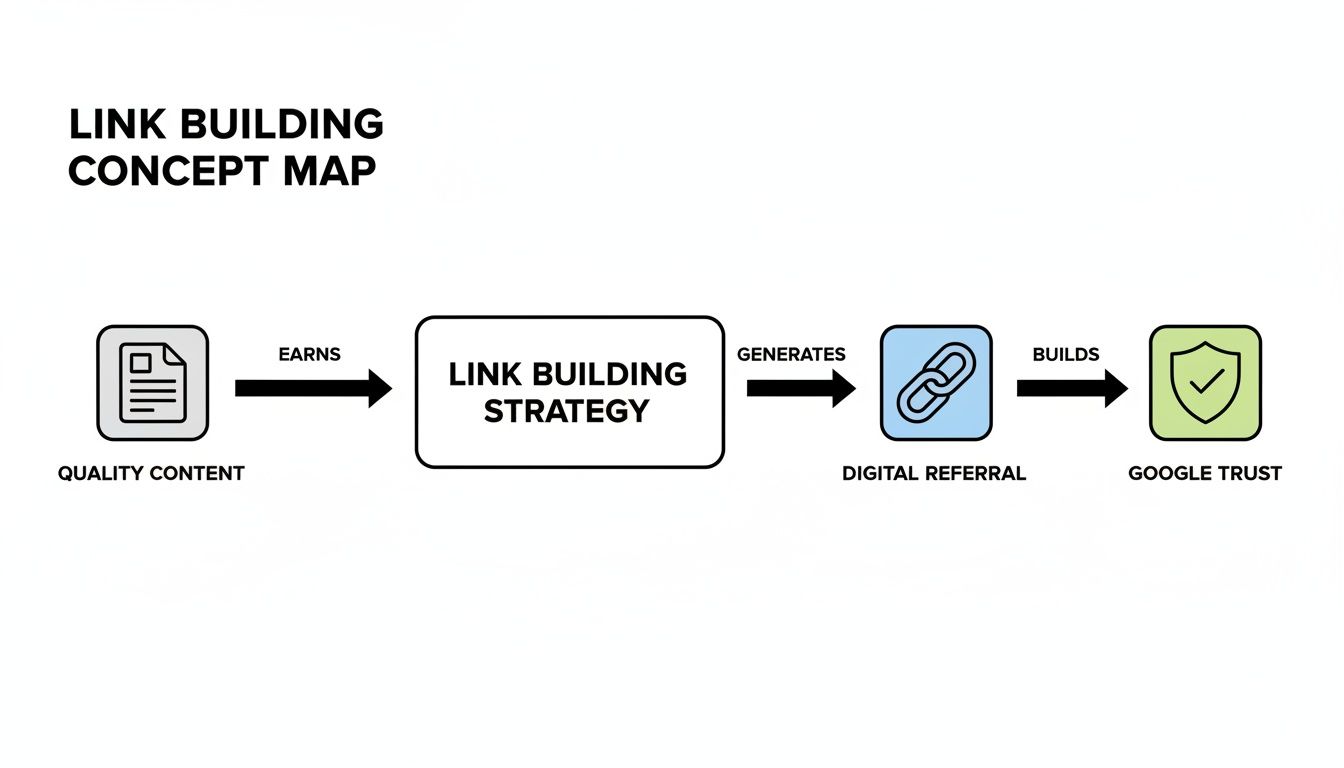
This infographic shows how quality content becomes the foundation for earning digital referrals, which in turn builds the kind of trust Google rewards.
This synergy is vital for building a dominant online presence. The search advertising market in New Zealand is booming as tech-savvy customers rely on search to compare their options and make decisions. As a Kiwi business, this means localising your SEO with NZ English and building trust through reviews and local links is key to standing out. You can explore more about the growth of search advertising in New Zealand via Statista's market forecast.
By weaving SEO together with a conversion-focused website and smart paid ad campaigns, you create a complete strategy designed for one thing: measurable growth.
Common Questions We Hear About SEO
When you're getting started with SEO, a few key questions always come up. Here are the straight-up answers to the most common ones we hear from Kiwi business owners, so you can move forward with a clear plan.
How Long Does It Take to See Real Results from SEO?
This is the big one. SEO isn't an overnight fix like running an ad; it's a long-term asset you're building for your business. You might see some small positive movements in the first few weeks, but you can expect to see a real, meaningful impact on your traffic and leads within 4 to 6 months.
Why the wait? Because Google needs time to find, understand, and trust the changes you've made. Building real authority with great content and earning quality links is a steady process that can't be faked or rushed. The businesses that win are the ones who stay consistent—their results compound over time, creating a lead generation machine that works 24/7.
Can I Do My Own SEO, or Should I Hire an Agency?
Honestly, it comes down to your time, your skills, and what you’ve got on your plate already. Most business owners are more than capable of handling the basics themselves, like keeping their Google Business Profile fresh and making simple tweaks to their website pages.
But the heavy lifting—things like technical SEO, building out a proper content strategy, and strategic link building—takes specialist knowledge and a serious time commitment. For most service businesses, a hybrid approach works best.
A smart way to start is by managing the day-to-day fundamentals in-house and bringing in an agency or consultant for the high-impact, technical stuff. That way, you get expert firepower where it counts, without handing over the keys to your entire online presence.
How Do I Actually Measure the ROI from SEO?
Measuring your return from SEO is about more than just checking where you rank. The real goal is to connect your efforts to what actually matters: money in the bank.
Forget the fluff. These are the key performance indicators (KPIs) you need to watch:
- More organic traffic: Are more people finding you through search? Tools like Google Analytics will give you the hard numbers.
- Better keyword rankings: Are you climbing the ladder for the valuable, "ready-to-buy" keywords your customers are searching for?
- More conversions: This is the most important metric of all. A conversion is a real action, like a phone call, a quote request, or a contact form getting filled out.
Once you know what a new lead is worth to your business, you can put a dollar value on the work being done. This turns SEO from a cost into a measurable investment that directly fuels your growth.
Ready to stop being invisible online and start getting the phone to ring? Four Stripes specialises in building unshakeable local authority for Kiwi businesses. Learn how we can help you dominate local search and get a steady flow of qualified enquiries.