
Picking the right web hosting in NZ is a bit like choosing the perfect spot for a physical shop. Get the location right, and customers can find you easily and have a great experience from the moment they walk through the door. Get it wrong, and you're practically invisible.
Why Your Web Hosting Choice Matters
Think of your website as your digital storefront. Everything on it—the text, the photos of your work, the contact form—is a file. Just like the products and furniture in a real shop, these files need a place to live so customers can see them.
That's what web hosting is. It's the plot of land on the internet where you build your online shop. A web hosting company rents you space on a powerful computer, called a server, to store all those files.
When a potential customer in Hamilton or Christchurch types your website address into their browser, they're essentially looking up your shop's address. Their browser then shoots over to your server, grabs all your website files, and displays your site neatly on their screen.
The Impact of a Good Location
Just like a dodgy physical location can turn customers away, a poor web hosting choice can kill your online presence before it even gets going. If your server is slow, unreliable, or on the other side of the world, your digital shop will suffer.
Potential customers will get stuck with frustratingly long loading times or, even worse, find your site is completely down. That first impression is everything. A slow website doesn't just annoy impatient visitors; it also tells search engines like Google that your site offers a poor user experience, which can seriously hurt your search rankings.
Your web host is the digital landlord for your business. Choosing a reliable one ensures your doors are always open, the lights are on, and customers have a fast, secure experience every time they visit.
The Growing Importance of Local Hosting
For New Zealand businesses, this decision is becoming more critical than ever, and the local market is stepping up. There are now 341 businesses operating in New Zealand's data processing and web hosting services sector.
That number grew by an incredible 20.9% in just one year. You can explore more data on this industry expansion to see just how fast things are moving.
This boom tells a clear story: Kiwi businesses are realising that where their website 'lives' directly impacts their bottom line. Choosing a local web hosting NZ provider gives you some serious advantages:
- Faster Loading Speeds: When your server is physically in New Zealand, the data doesn't have to travel halfway around the world to reach your local customers. The result? A noticeably faster website.
- Improved Reliability: Local hosts understand the NZ network. Their infrastructure is often optimised for it, meaning your website stays stable and online when you need it most.
- Better Search Engine Ranking: Site speed is a confirmed Google ranking factor. A faster site can give you an immediate leg-up on overseas-hosted competitors in local search results.
At the end of the day, your web hosting isn't just some technical box to tick. It’s a strategic business decision that lays the foundation for customer satisfaction, visibility on Google, and long-term growth.
The Home-Ground Advantage of Local NZ Hosting
When a potential customer in Auckland needs a local plumber, every single millisecond counts. Choosing a web hosting NZ provider with servers right here in New Zealand gives you a home-ground advantage that overseas hosts just can't compete with. Think of it like setting up shop on the main street of your target neighbourhood instead of in another city entirely.
This isn't just a small technical detail; it's a strategic move that directly boosts three critical parts of your business: website speed, customer support, and data security. Getting these right is often the difference between a customer calling you or clicking away to your competitor.
Give Your Website a Serious Speed Boost
The physical distance between your website's server and the person trying to view it is one of the biggest factors in how fast your site loads. If your site is hosted in the US or Europe, your data has to travel thousands of kilometres across undersea cables just to reach your Kiwi customers.
That journey, no matter how quick, creates a noticeable lag called latency. For a local NZ business, hosting your website on a server in Auckland or Christchurch cuts that distance right down. Data travels faster, your pages load quicker, and your customer gets a slick, professional experience without the wait.
This speed boost isn't just for show. A faster website directly translates to:
- A Better User Experience: Visitors are far more likely to stick around, browse your services, and actually make an enquiry if your site is snappy and responsive.
- Higher Google Rankings: Google has been very clear that site speed is a ranking factor. A faster site will help you climb the local search results, getting you in front of more customers.
- More Conversions: A quick, professional website builds trust and gives potential clients the confidence to pick up the phone and call you.
Get Help From People Who Understand Your Business Hours
Picture this: your website goes down at 10 AM on a Tuesday, right in the middle of your busiest time. You frantically contact support, only to find out they’re based on the other side of the world and won’t even be online for another six hours. This is an all-too-common and expensive headache for businesses using overseas hosts.
A New Zealand-based support team completely changes the game. They work when you work, meaning if you run into a problem during your day, they are right there to help you fix it.
With a local support team, you're not just another ticket number in a massive global queue. You’re talking to someone who gets the NZ business environment and is actually available when you need them most.
This local knowledge goes beyond just time zones. A Kiwi support team understands the unique challenges and opportunities here in New Zealand, so they can offer advice that’s far more relevant and practical for your business.
Build Trust with Local Data Sovereignty
People are more concerned about data privacy than ever, so where you store your business and customer information really matters. Data sovereignty is the concept that your digital data is subject to the laws of the country where it’s physically stored.
By using a local web hosting NZ provider, you're ensuring that all your website's data—including customer details from your contact forms—is kept safely within New Zealand's legal system. This gives you two massive advantages:
- Easier Compliance: You’re operating under one set of privacy laws that you’re already familiar with, which simplifies your legal responsibilities.
- Stronger Customer Trust: Being able to tell your customers that their data is stored securely right here in New Zealand is a huge trust signal for your Kiwi audience.
This focus on a local online identity is a clear trend. The total number of registered .nz domains just hit 756,719, with a year-on-year growth rate of 1.0%—the highest it’s been in two years. This signals a renewed confidence among NZ businesses in building a strong, local digital presence. Learn more about recent .nz domain growth and you'll see how it reflects what's happening in the market. Choosing local hosting aligns your business perfectly with this powerful movement.
Finding the Right Hosting Type for Your Needs
Picking a web hosting plan can feel a lot like finding your first business premises. You're faced with different sizes, price points, and levels of service, and the goal is to find that sweet spot: something that supports you perfectly right now but gives you room to grow.
To cut through the jargon, let's break down the most common types of web hosting in NZ with a simple analogy. Think of each one as a different kind of commercial property for your online storefront.
This flowchart gives you a quick visual on which path to take, depending on whether you're serving Kiwis or a global market.
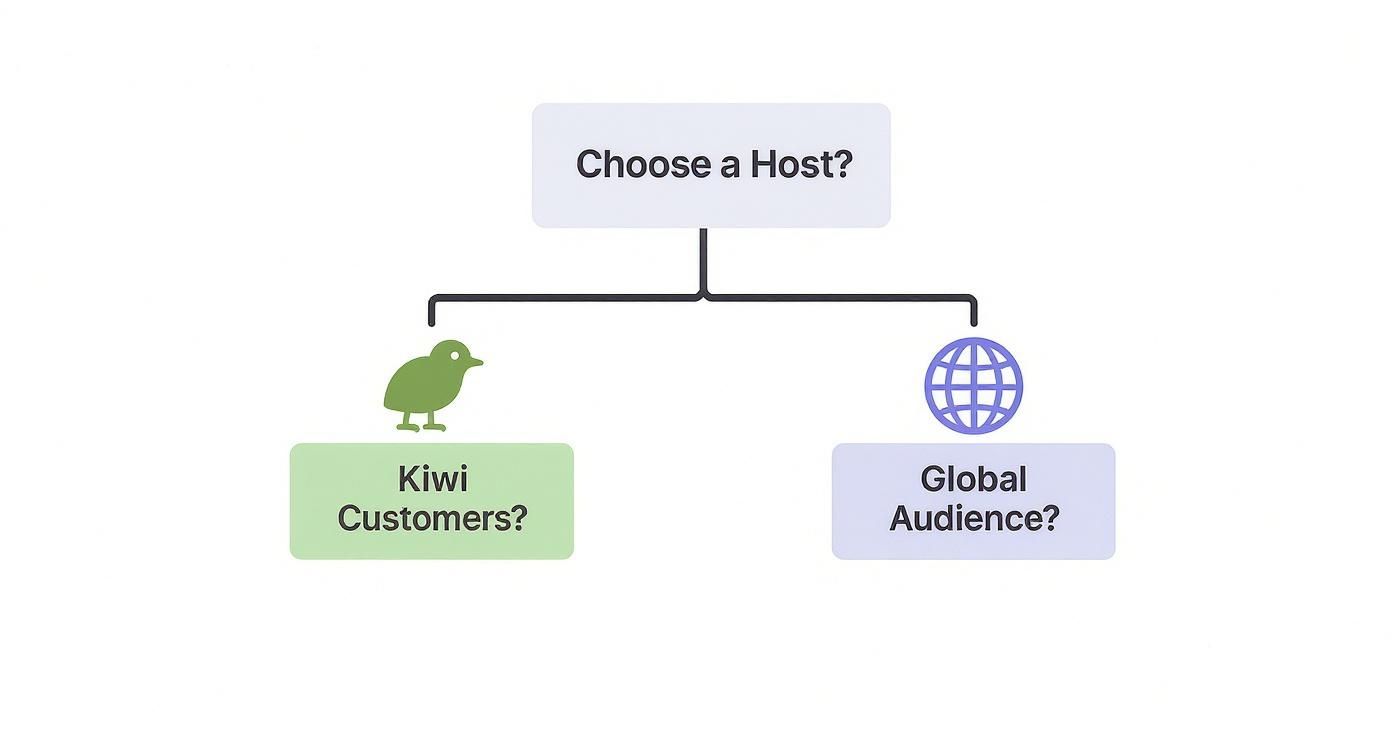
The main takeaway? Your audience is the first big decision. If you’re targeting locals, NZ-based hosting is a no-brainer for performance. If you're going global, you'll need a different setup.
Shared Hosting: Your Digital Co-working Space
Shared hosting is the go-to starting point for most new businesses, and for good reason. Think of it like renting a desk in a big co-working space. You get your own spot to work from, but you're sharing the building's main resources—the internet, the kitchen, the power—with dozens of other businesses.
In website terms, your site "lives" on a server with many others, all sharing that server's processing power (CPU), memory (RAM), and storage. This setup makes it incredibly affordable, perfect for startups, small service businesses, or any website that isn't expecting a flood of traffic from day one.
Why Choose Shared Hosting?
- Budget-Friendly: It’s the cheapest way to get online, with plans often starting at just a few dollars a month.
- Easy to Manage: Most hosts provide a simple control panel, so you don't need to be a tech whiz to get going.
- Great for Beginners: It’s an excellent entry point into web hosting without a hefty financial commitment.
But the "shared" part has its downsides. If another website on your server suddenly goes viral, it can hog resources and slow your site down—just like your co-working neighbours throwing a loud party while you're trying to take a client call.
VPS Hosting: Your Private Office in a Shared Building
As your business picks up steam, you'll likely outgrow that co-working desk. A Virtual Private Server (VPS) is the equivalent of upgrading to your own private, lockable office in a larger commercial building.
You’re still sharing the main building (the physical server), but your office space is yours and yours alone. A VPS cleverly partitions one powerful server into several private virtual servers. Each VPS gets its own guaranteed chunk of resources—CPU, RAM, and storage—that no one else can touch.
This gives you a massive jump in performance, security, and control compared to shared hosting. It's the logical next step for businesses with growing traffic or those running more complex sites that need rock-solid, predictable performance.
A VPS hits that perfect middle ground. You get many of the perks of your own dedicated server—like guaranteed resources and more control—but for a fraction of the cost.
Managed WordPress Hosting: Your Fully Serviced Office
Now, imagine renting a fully serviced office. You get a premium, high-performance workspace, and the building management handles everything else for you—security, maintenance, cleaning, the lot. That's Managed WordPress Hosting in a nutshell.
It’s a specialised service built purely for websites running on WordPress. The hosting provider takes care of all the technical heavy lifting, so you don't have to. For businesses weighing their options, it’s also worth understanding what’s involved with cloud hosting to get a fuller picture of modern web infrastructure.
With managed hosting, the provider automatically handles critical tasks like:
- WordPress Core Updates: Keeping your site's software patched and secure.
- Automatic Backups: Taking daily snapshots of your site so you can restore it in a click if anything goes wrong.
- Security Monitoring: Actively scanning for malware and blocking attacks before they happen.
- Performance Optimisation: Fine-tuning the server environment specifically for WordPress to make it lightning fast.
This premium, hands-off approach lets you focus on running your business, not wrestling with your website's backend. To see how this could work for you, you can learn more about dedicated WordPress website hosting and its specific advantages. It’s hands down the best option for serious business owners who value their time and want total peace of mind.
Comparing Web Hosting Types for NZ Businesses
To make it even clearer, here’s a side-by-side look at how these hosting types stack up for a typical New Zealand service business.
| Feature | Shared Hosting | VPS Hosting | Managed WordPress Hosting |
|---|---|---|---|
| Best For | New websites, startups, low-traffic sites | Growing businesses, e-commerce, high-traffic sites | Serious businesses who value time and performance |
| Cost | $ (Lowest) | $$ (Mid-range) | $$$ (Premium) |
| Performance | Basic – can be affected by other sites | High – guaranteed resources | Highest – optimised specifically for WordPress |
| Technical Skill | Beginner | Intermediate | Beginner (provider handles the tech) |
| Security | Basic – shared responsibility | High – isolated environment | Highest – proactive monitoring and hardening |
| Support | General support | Advanced support | Expert WordPress support |
Choosing the right plan really comes down to your budget, technical comfort level, and how critical your website's performance is to your business operations. Start where you're comfortable, but always pick a provider that makes it easy to upgrade as your business grows.
Essential Features of a Great NZ Hosting Provider
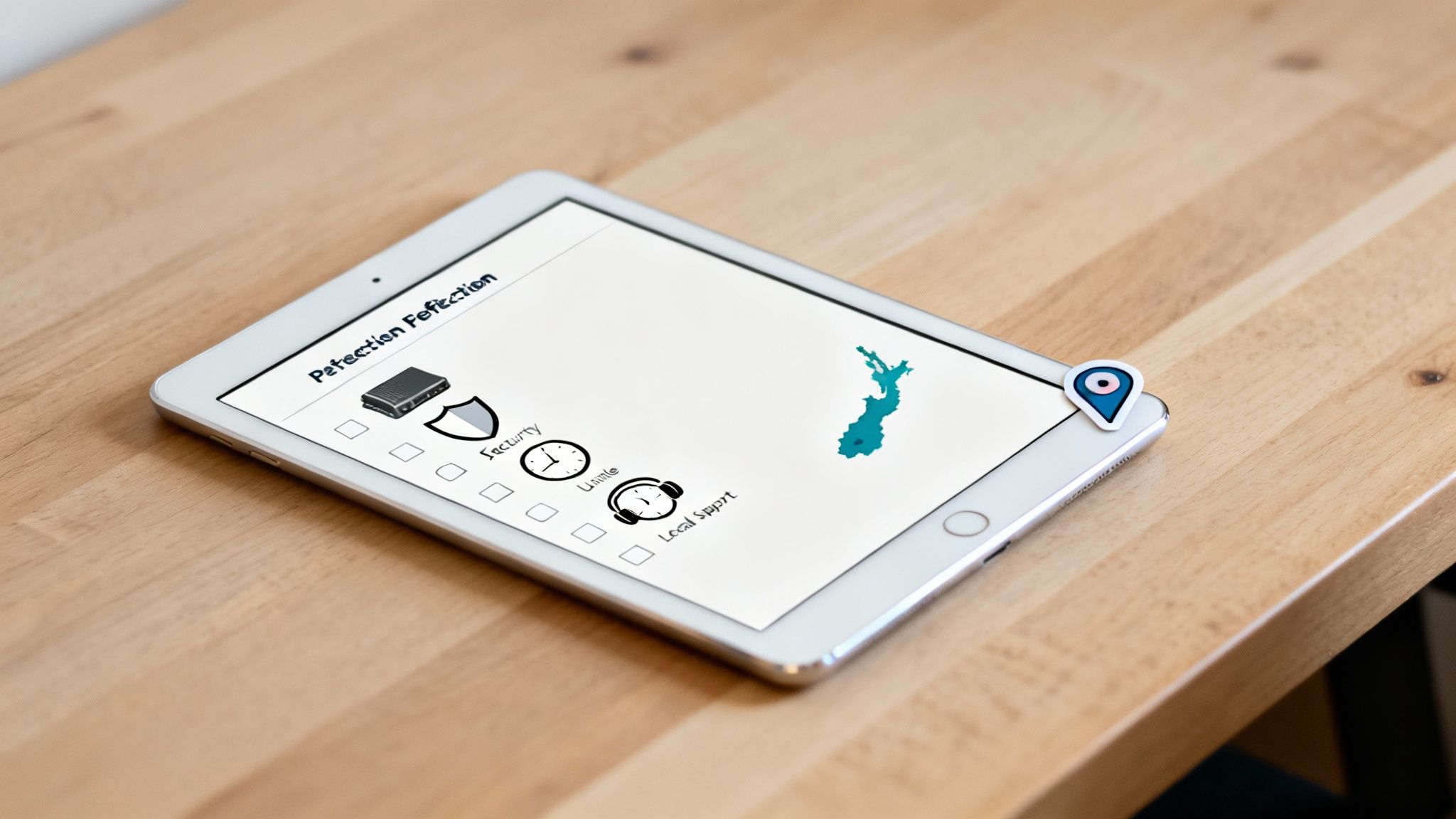
Alright, so you've got a handle on the type of hosting you need. The next step is to dig a bit deeper. Two providers might both sell "Managed WordPress Hosting," but the actual quality can be night and day. To find the best web hosting NZ has to offer, you need to look past the flashy marketing and focus on what actually makes a difference to your website's performance.
This is about checking under the bonnet. You need to know your website is running on a solid foundation of speed, security, and real human support. These are the non-negotiables that keep your digital shopfront open for business, protecting you and your customers.
The Technical Nuts and Bolts
Don't let the tech-speak scare you off; the basics are actually pretty straightforward. Think of these specs as the engine parts of your website—each one plays a crucial role in giving your visitors a fast, reliable experience.
Here’s what to look for on the technical side:
- SSD Storage: This stands for Solid-State Drive, a modern type of storage that’s miles faster than the old spinning hard drives. A host using SSDs means your website files load much more quickly, from your homepage images to the text on your contact page. Speed matters.
- Generous Bandwidth: Think of bandwidth as the monthly data allowance for your website. Every time someone visits, they use a little bit. If you've got a lot of images or expect a decent amount of traffic, you need enough bandwidth to handle it all without your site grinding to a halt.
- Uptime Guarantee: This is a big one. Uptime is simply the percentage of time your website is online and working. You want a provider that guarantees at least 99.9% uptime. Anything less means your site could be down for hours each month, which is time potential customers can’t find you.
These three things are the core of a high-performing website. A slow or unavailable site reflects poorly on your business, so getting these fundamentals right from the start is absolutely critical.
Non-Negotiable Security Features
Website security isn't some optional add-on anymore—it's essential. A single security breach can shatter customer trust and knock your business offline for days. A good NZ hosting provider understands this and includes these protections as standard.
Your website is a valuable business asset. Choosing a host with robust, built-in security is like hiring a 24/7 security guard for your digital shop—it proactively protects your investment and your customers' data.
Make sure any host you’re considering offers these basics:
- Free SSL Certificate: An SSL certificate encrypts the data between your website and your visitors. It’s what puts the little padlock icon in the browser bar, showing customers it's safe to fill out your contact form. Google loves it, and so do your customers.
- Automated Daily Backups: Things go wrong. A plugin update fails, you accidentally delete a page—it happens. With automated daily backups, you have a fresh, clean copy of your site ready to restore in minutes. It turns a potential catastrophe into a minor hiccup.
- Malware Scanning and Protection: The best hosts actively scan their servers for malicious software and use firewalls to block hacking attempts before they cause trouble. This proactive defence is your first and best line of protection.
The True Value of Local Support
Finally, never underestimate the power of good customer support. When something goes wrong with your website, you need to talk to a real person who can help you, and fast. This is where so many of the cheap overseas providers completely fall over.
Here in New Zealand, most of us are running small or medium-sized businesses. We need reliable service that's easy to deal with, and that includes getting personalised support when we need it.
Choosing a provider with a Kiwi-based support team means you get help in your own timezone, from people who get the local business culture. When you’re in a tight spot, that kind of local expertise is priceless. For a closer look at the key players, check out our guide to the top New Zealand hosting companies to compare what they offer.
Connecting Your Hosting to Local NZ SEO Success
Having a sharp-looking, high-performance website is a great start, but it doesn't mean much if your local Kiwi customers can't actually find you on Google. Choosing the right web hosting in NZ is more than just a box-ticking tech decision; it's a massive piece of your local search engine optimisation (SEO) puzzle. Get this right, and you'll show up when people in your area are actively searching for your services.
Your hosting choice has a direct, tangible impact on how well you rank in search results. Before you do anything else, you need to understand the core principles of Search Engine Optimization (SEO). This knowledge is the foundation for turning a simple website into a lead-generating machine.
The most obvious link between hosting and SEO is site speed. It's simple, really. A local NZ host means your website's data has less physical distance to travel to reach your customers' devices. That results in faster loading times, and since Google uses page speed as a key ranking signal, you get an immediate leg-up on competitors hosted in the US or Australia.
On-Site Optimisation for Local Search
Once your fast hosting is sorted, the next job is to send clear, unmissable signals to Google about who you are, what you do, and—most importantly—where you do it. This comes down to a few straightforward tweaks on your site that can make a world of difference for local searches like "plumber in Tauranga" or "electrician Christchurch".
Start with the dead-simple stuff. Make sure your website’s timezone is set correctly to New Zealand time. If you're using WordPress, you can find this under Settings > General. It's a tiny detail, but it's one more piece of evidence that tells search engines you're genuinely local.
Next, make your contact information impossible to miss. Your full business name, local NZ address, and a local phone number (not a generic 0800 number) need to be slapped all over your site.
- In the Footer: Chuck your details in the footer so they appear on every single page. Consistency is key.
- On the Contact Page: Build a dedicated contact page with your details, an embedded Google Map showing your location, and your business hours.
This consistency helps Google verify your location with confidence, which means it will be more likely to show your business to people searching nearby.
Think of your website as your digital business card. If your address and phone number are hard to find or inconsistent, it creates confusion for both customers and search engines, damaging trust and your local ranking potential.
Structuring Your Website for Local Keywords
To pull in the right kind of local traffic, you have to build your website around the exact words and phrases people are typing into Google. That means creating specific, dedicated pages for each of your core services.
For instance, a builder in Auckland shouldn't just have one generic "Services" page. A far smarter approach is to create separate, detailed pages for:
- New Home Builds in Auckland: This page would be laser-focused on people looking to build a house from the ground up.
- Auckland Home Renovations: This targets clients wanting to alter or add to their existing home.
- Kitchen and Bathroom Upgrades: This drills down into a specific, high-value niche of renovation work.
By creating these individual service pages, you're making it crystal clear to Google what you offer and where you offer it. This focused strategy massively boosts your chances of ranking for those valuable, high-intent local search terms. For a deeper look at these strategies, our complete guide to local SEO in NZ gives you an actionable roadmap.
When you pair these on-site SEO tactics with the raw speed benefits of quality web hosting nz, you create a powerful one-two punch for dominating your local search results.
Common Web Hosting Questions Answered
Even after getting the hang of the basics, it’s completely normal to have a few last-minute questions before you pull the trigger on a web host. The world of web hosting in NZ can feel a bit technical, but getting these practical points sorted is often the final step to making a confident choice.
Let's clear the air on some of the most common queries we hear from Kiwi business owners. This is about getting you over the finish line with a clear plan, so you can pick a hosting partner that actually helps your business grow.
How Much Should I Expect to Pay for Good Web Hosting in NZ?
This is usually the first question on anyone’s mind. The honest answer? It varies, but you absolutely get what you pay for. Chasing the rock-bottom cheapest deal is a trap. It almost always leads to slow speeds, support that’s nowhere to be found when you need it, and security holes that can end up costing you a fortune in lost business.
A much smarter way to look at it is as an investment in your business, just like your ute or your tools. Here’s a realistic idea of what you should budget for quality web hosting in NZ, based on the hosting types we've already covered:
- Shared Hosting: Perfect for new businesses or simple brochure-style websites. You should expect to pay between $15 and $30 per month. For that price, you should be getting fast SSD storage, a free SSL certificate, and proper Kiwi support.
- VPS Hosting: The right move for a growing business that needs more grunt. A solid entry-level VPS will set you back $40 to $80 per month. This buys you dedicated resources, meaning a faster, more stable website for your customers.
- Managed WordPress Hosting: The premium, hands-off choice for businesses that rely on their website for leads. Prices typically start around $50 per month and climb from there based on traffic. You're paying for peace of mind—expert management, iron-clad security, and peak performance.
Think of your hosting fee like digital rent for your shopfront. You could rent a cheap spot down a dark alley, but you'll get no foot traffic and dodgy security. Paying a fair price for a quality service puts your digital storefront on the main street where it's safe, secure, and easy for customers to find.
Can I Move My Website to a New NZ Host Later?
Absolutely. You are never locked in. If you’re fed up with your current host’s slow speeds, shocking support, or surprise price hikes, you can pack up your digital bags and move somewhere better. It’s a super common scenario.
This process is called a website migration. The best part? Most reputable NZ hosting companies will do the entire thing for you, for free, when you sign up.
They know it's a great way to win your business. Their tech team will carefully copy all your website files, databases, and even your emails from the old host to their new servers. They'll handle all the tricky bits to make sure the move is seamless with virtually zero downtime. Your customers won't notice a thing.
Before you commit to a new host, always ask them about their migration process:
- Do you offer a free migration service?
- How do you make sure my site stays online during the move?
- What info do you need from me to get started?
A confident, straightforward answer to these questions is a massive green flag. It tells you you’re dealing with pros who have their act together.
Do I Need to Buy My Domain and Hosting Together?
Great question. This one trips a lot of people up. The short answer is no, you don't have to. Your domain name (your .co.nz address) and your web hosting are two different services, and they can be bought from two different companies.
That said, for most small business owners, bundling them together is just plain easier.
Keeping Them Together (The Pros):
- Simplicity: One login, one bill, and one support number to call if anything goes wrong. It makes life so much easier.
- Seamless Setup: The hosting company automatically points your domain to your website, so you don't have to mess around with any technical settings.
Keeping Them Separate (The Pros):
- Flexibility: It can make it slightly simpler to change hosts later, but a good host with a free migration service makes this a non-issue.
- Price Shopping: You might save a few dollars a year by registering your domain with a dedicated registrar, but that saving is quickly eaten up by the extra hassle.
For the vast majority of Kiwi service businesses, the convenience of having everything under one roof with a single, reliable web hosting NZ provider is the winning formula. It lets you focus on your business, not on trying to remember which company does what.
Ready to build a powerful local presence with a website that gets the phone ringing? At Four Stripes, we combine conversion-focused web design with reliable, high-speed NZ hosting to deliver a steady flow of qualified enquiries for your service business. Find out how our First Page, First Call system can help you dominate local search by visiting https://fourstripes.co.nz.