
Choosing the right SEO services in New Zealand isn't just about ticking a box. It's about finding a partner who gets how to turn a simple Google search into a paying customer—someone who ensures that when a potential client in Auckland, Wellington, or Christchurch needs your skills, your business is the first one they see.
Ultimately, it’s about real, measurable growth that hits your bottom line.
Why SEO Is a Game-Changer for Kiwi Businesses

Let's be honest, standing out in the New Zealand market is tougher than ever. The days of relying on the Yellow Pages are long gone. Your customers are on their phones, searching Google for everything from an "emergency plumber Auckland" to the "best cafe in Queenstown." If you're not showing up, you're invisible.
This is where Search Engine Optimisation (SEO) comes in. Put simply, SEO is the process of getting your website to show up higher in Google's search results, making you more visible to people who are actively looking for exactly what you do. If you want a more detailed breakdown, this is a great resource on What is Search Engine Optimization (SEO).
Beyond Rankings to Real Results
Good SEO isn't just a vanity contest to get to the #1 spot. It's a proper investment that delivers tangible results. For a service business, that means a steady stream of qualified leads—real people who are ready to book a job or request a quote. Think of it as your best salesperson, working 24/7 to bring in business.
Here’s what that actually looks like:
- More Visibility & Brand Awareness: When people see your name pop up again and again, they start to trust you. You become the go-to name in your industry.
- Higher Quality Leads: SEO connects you with people who are already looking for a solution. They have a problem, and you have the answer. They're much closer to making a decision.
- Cost-Effective Marketing: Organic traffic from SEO provides a much better long-term return than constantly paying for ads. It’s sustainable growth.
Did you know? In New Zealand, 1 in 4 people live with some form of disability. A solid SEO strategy includes making your website accessible, ensuring you're not accidentally shutting the door on a huge chunk of potential customers.
The Local Advantage
For most Kiwi businesses, the battle is won locally. A customer in Hamilton doesn’t need a builder from Dunedin. This is why a laser-focused local strategy is non-negotiable.
By targeting local search terms and optimising for your specific service areas, you connect directly with the community you actually serve. We've written a whole guide on why local SEO matters for NZ businesses, which is a great place to start if you want to capture that valuable local market.
Defining What Success Looks Like for Your Business

Before you even think about looking at proposals for SEO services in New Zealand, you need to know where you're going. Diving into SEO without a clear definition of success is like setting off from Auckland on a roadie without knowing if you’re heading to Cape Reinga or Bluff. You’ll get somewhere, sure, but it probably won’t be where you wanted.
This groundwork is everything. Getting your goals straight transforms conversations with potential agencies from vague chats into sharp, strategic discussions focused on your bottom line.
Moving Beyond Vanity Metrics
It's tempting to get caught up in metrics that look great on a report but do absolutely nothing for your business. An agency might brag about a 30% jump in website traffic, but if none of those new visitors actually picks up the phone or fills out your contact form, who cares? It's just noise.
Real success is measured by Key Performance Indicators (KPIs) that directly impact your bank account. These are the numbers that matter.
For a Kiwi service business, that means obsessing over:
- Qualified Leads: The number of quote requests or form submissions coming from your key service areas.
- Phone Enquiries: Tracking the calls generated straight from your website or Google Business Profile.
- Conversion Rate: The percentage of website visitors who actually take action (like booking a job or calling you).
- Cost Per Acquisition (CPA): How much you're spending to get one new, paying customer through organic search.
Focusing on these KPIs from the get-go ensures your SEO investment is actually working to make your phone ring, not just to collect clicks. It helps you find a partner who gets that.
Performing a Quick Website Health Check
Before you start talking to agencies, it’s a smart move to get a quick read on where you stand right now. You don't need to be an SEO expert; this is just a quick health check to spot obvious problems and arm you for better conversations.
Start by thinking like a customer. Open a private or incognito browser window and search for what you do, where you do it. For example, search for "roof repairs Hamilton" or "electrician Ponsonby". Where do you show up? Are you on the first page, or are you buried somewhere on page three?
This simple test gives you a raw, unfiltered look at your visibility for the search terms that actually bring in jobs.
A critical part of this check is to do it on your phone. Most local searches in New Zealand happen on mobile. If your site is clunky, slow, or hard to use on a phone, you're losing customers. If they can't find your number in two seconds, they're gone.
Key Areas to Assess on Your Site
To build on your quick search, have a look at a few specific things. This isn't a deep technical audit, just a practical once-over.
Website Speed
How fast does your site load? Chuck your URL into a free tool like Google's PageSpeed Insights to get a score. A slow website is a lead killer.
Mobile-Friendliness
Does your site work properly on a phone? Can you read the text without pinching and zooming? Are the buttons big enough to tap easily?
Clear Call-to-Action
Is it dead obvious what a visitor should do next? Your phone number should be impossible to miss, and your contact forms should be simple and easy to find.
Walking into a meeting armed with this info gives you a massive advantage. You can skip the sales pitch and have a real conversation. You can say, "We're nowhere to be seen for our main services in Christchurch, and our mobile site is a dog. How will your strategy fix these specific problems to get us more qualified leads?"
That's how you find a partner who is genuinely focused on your success.
Mastering Local SEO to Win Your Neighbourhood
For most Kiwi service businesses, forget nationwide domination. The real money is made in your own backyard. Winning your local area is everything, and that's where local SEO becomes your secret weapon, turning nearby searches into phone calls and paying jobs.
Let's be honest, for a plumber in Tauranga, ranking for "plumber" is a waste of time. What you really want is to show up first for "hot water cylinder repair Mount Maunganui." Local SEO makes sure the people who can actually hire you are the ones who find you.
Why Google Is Your Local Battleground
Here in New Zealand, the game is simple: it's Google's world, and we're all just trying to rank in it. The numbers don't lie.
As of late 2025, Google absolutely owns the search market in NZ with a staggering 91.3% market share, according to data from Statcounter on New Zealand's search engine usage. That isn't just a statistic; it's a reality check. For any Kiwi business, SEO is Google SEO. Every strategy has to be built for Google's rules.
This Google-first world means that your local optimisation, especially your Google Business Profile, isn't just important—it's the cornerstone of your entire online presence.
Your Google Business Profile Is Your Digital Shopfront
Think of your Google Business Profile (GBP) as your most valuable piece of online real estate. It's that box that pops up in Google Maps and the 'Local Pack' search results, and it's often the very first impression a potential customer has of your business. Nailing it is non-negotiable.
A neglected or inaccurate profile isn't just a bad look; it actively loses you customers. It's the digital version of having your doors locked during business hours.
Here’s what a properly dialled-in GBP looks like:
- Complete and Accurate Info: Your business name, address, phone number, and hours must be 100% correct and consistent across the board. No exceptions.
- Smart Category Selection: Get specific. Choose "Plumber" as your primary category, not a vague term like "Home Services," then add any other relevant secondary categories.
- Show, Don't Just Tell: Keep a steady stream of high-quality photos coming. Pictures of your team on the job, your branded vans, and your finished work build instant trust and prove you're a real, active business.
- Define Your Turf: Clearly map out the suburbs and regions you actually serve. This tells Google exactly who to show your profile to.
Your Google Business Profile isn't a set-and-forget listing; it's a live marketing tool. Use Google Posts to share updates, special offers, or photos of recent projects. This keeps your profile looking fresh and signals to Google that you're an active, relevant business worth showing to searchers.
The Power of Customer Reviews and Consistent NAP
Once your profile is sorted, two other things will make or break your local rankings: a steady flow of reviews and rock-solid consistency in your business info online.
Reviews are the new word-of-mouth. A constant stream of positive, recent reviews is one of the strongest trust signals you can send to both Google and your potential customers. Make a habit of replying to every review, good or bad. It shows you're listening and you care.
Just as critical is your NAP (Name, Address, Phone number) consistency. Your core business details need to be identical everywhere they appear online, from Finda and Yellow.co.nz to your industry association's website. Even a small difference, like "Ltd" versus "Limited," can confuse search engines and drag down your rankings.
Your Playbook for Local SEO Success
Turning local searches into jobs doesn't require some dark art of SEO. It's about taking consistent, deliberate action on the things that matter most.
We've put together a simple checklist to get you focused on the tasks that will actually move the needle for your business.
Essential Local SEO Checklist for New Zealand Businesses
| Local SEO Task | Why It's Important for NZ Businesses | Action Item |
|---|---|---|
| GBP Optimisation | It’s your #1 local ranking factor and your digital storefront. A sharp profile gets you more calls and website visits, period. | Fill out every single section. Upload new photos weekly and use Google Posts for updates and offers. |
| Review Management | Reviews are pure gold. They build massive trust and heavily influence whether customers—and Google—see you as the top choice. | Make it easy for happy customers to leave reviews. Then, make sure you respond to every single one. |
| Local Citation Building | Getting listed correctly in Kiwi directories like Finda and Yellow verifies your location and tells Google you're a legit local business. | Check your existing listings for NAP consistency. Build new ones in directories relevant to your industry and area. |
| On-Page Localisation | Creating website pages for specific suburbs tells Google exactly where you work and what you do there, helping you rank for "service + suburb" searches. | Build out dedicated service pages for your key target suburbs, like 'Electrician Remuera' or 'Builder Pukekohe'. |
By working through these key areas, you build a powerful local footprint that pulls in customers from your target neighbourhoods.
If you want to go deeper, check out our full breakdown of what local SEO is in our NZ guide. Follow this playbook, and the next time someone in your area needs your services, you'll be the first business they find.
How to Vet and Compare SEO Agencies in NZ
Trying to find the right SEO partner in New Zealand can feel like navigating a minefield. There are so many agencies out there making massive promises, but how do you actually sort the genuine experts from the sales-driven cowboys?
The secret is to look past the slick pitch. Focus on their credibility, how transparent they are, and whether they have a proven track record with businesses just like yours. Properly vetting an agency isn't just about getting a price; it's about understanding how they work and whether they're truly invested in seeing you win. This is how you protect your investment and set your business up for real, sustainable growth.
Understanding Agency Pricing Models
First, you need to get your head around how agencies charge for their work, as this often tells you a lot about their approach. There’s no single “best” model – it all comes down to your needs, your budget, and the scope of the job.
- Monthly Retainer: This is the most common setup. You pay a fixed fee each month for ongoing SEO work, which usually covers content, technical fixes, and reporting. It’s perfect for long-term strategies, but it does require a consistent monthly investment.
- Project-Based Fees: With this model, you pay a one-off fee for a specific task with a clear start and finish, like a website audit or getting your local SEO sorted. It's great for tackling specific problems but doesn't include the ongoing optimisation that gets long-term results.
- Hourly Consulting: Some experts charge by the hour for high-level strategic advice or training. This works best if you have an in-house team that can do the work but just needs some expert guidance.
For most Kiwi service businesses, a monthly retainer makes the most sense. SEO is a long game, not a one-time fix.
Assessing Credibility and Experience
An agency’s website might look impressive, but you need to dig a bit deeper to confirm they actually know their stuff. The real proof is in the results they’ve delivered for other New Zealand businesses, especially those in the service or trade industries.
Don't be shy about asking to see case studies or examples of their work. Look for real, tangible results that go beyond vague claims like "we increased traffic." You want proof of more phone calls, more quote requests, and measurable growth for businesses similar to yours. And absolutely ask for references you can actually speak to.
A credible agency will be proud to show you their work and connect you with happy clients. If they get hesitant or secretive about past results, that’s a massive red flag. Transparency is non-negotiable when you’re choosing a long-term partner.
The experience of the team doing the work is also critical. Find out who will actually be working on your account, what their background is, and what specific experience they have with local SEO for service-based businesses in NZ.
Red Flags to Watch Out For
Unfortunately, the SEO industry has its share of dodgy operators. Knowing the warning signs can save you a whole lot of time, money, and frustration down the track.
Be extremely wary of any agency that:
- Guarantees #1 Rankings: This is the oldest trick in the book. No one can guarantee a specific ranking on Google – the algorithm is far too complex and always changing. It's an outdated and unethical sales pitch.
- Is Secretive About Their Methods: If an agency calls their strategy "proprietary" or won't explain what they'll actually be doing, walk away. A good partner will be an open book and educate you on their process.
- Focuses Only on Backlinks: Links are important, sure. But a strategy that relies solely on building heaps of low-quality links is dangerous and can get your site penalised by Google.
- Offers Unbelievably Cheap Packages: Proper SEO takes time, skill, and resources. If a price seems too good to be true, it almost certainly is. You’ll end up with poor-quality work that does more harm than good.
Finding a great partner takes a bit of diligence, but getting it right is one of the best investments you can make for your business. If you want to dive deeper, you can learn more about how to choose an SEO company in New Zealand that truly aligns with your goals.
A solid online presence for a local business isn't built overnight. It follows a clear path, starting with a perfectly optimised profile, building out local citations, and then consistently managing your online reviews.
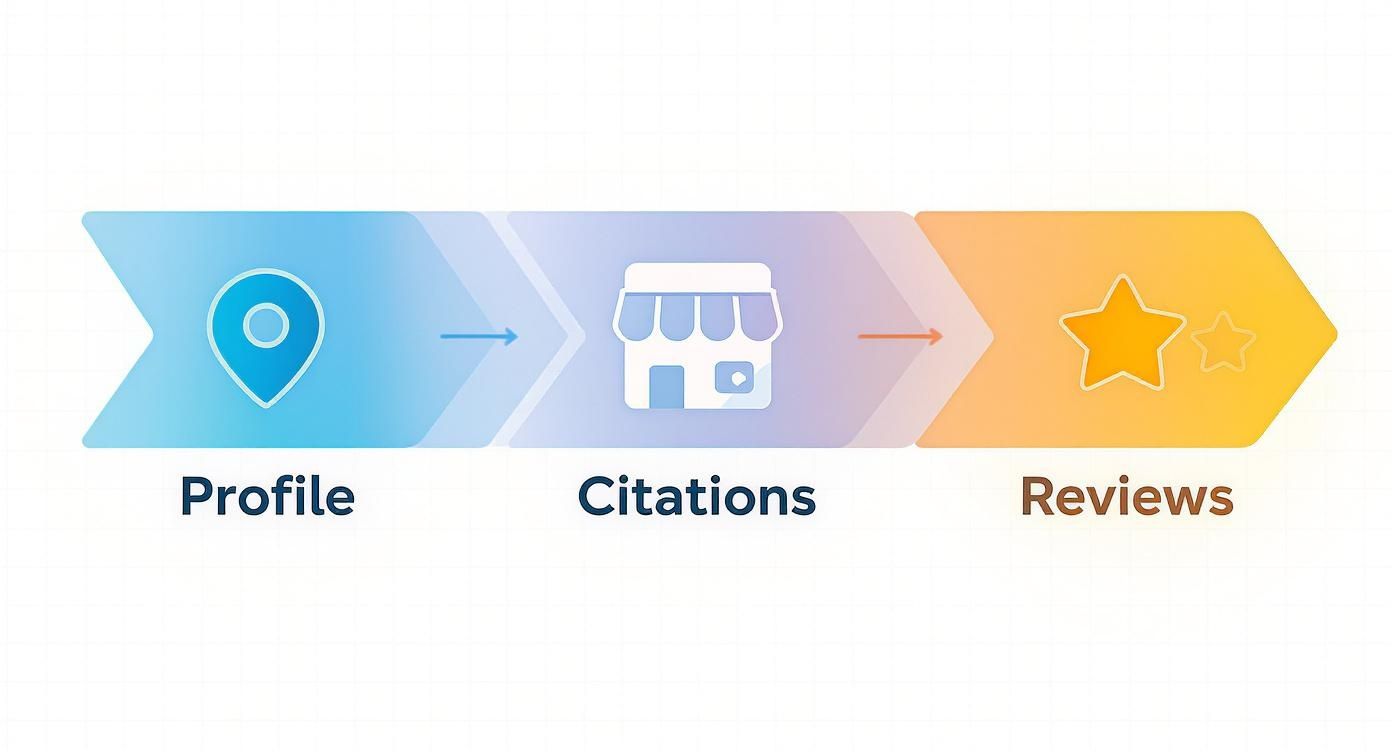
Think of it like building a house. Each step lays the foundation for the next, ultimately leading to greater visibility and trust with your local customers.
Making Sense of SEO Proposals and Reports

Alright, you’ve shortlisted a few agencies and the proposals are starting to land in your inbox. This is the moment of truth. You need to look past the price tag and figure out what you’re actually getting for your money.
A good proposal isn’t just a quote; it’s a strategic roadmap. It’s your best glimpse into how an agency thinks, how well they’ve listened, and whether they genuinely understand what it takes to get the phone ringing for a Kiwi service business like yours.
Deconstructing the SEO Proposal
Let's be honest, SEO proposals can be a confusing mess of jargon and charts. But a quality proposal from a decent agency offering SEO services in New Zealand should be clear and make sense. Don’t just flick to the last page to see the price. Dig into the scope of work—that's where the real value is.
Here’s what you should be scanning for:
- Proof They’ve Done Their Homework: Does it read like a copy-paste template, or does it mention your specific services, competitors, and target suburbs? If they haven't bothered to understand your local market, that’s a major red flag.
- A Clear Scope of Work: The proposal needs to spell out exactly what they’ll be doing. Look for things like technical SEO fixes, on-page optimisation, content creation, Google Business Profile management, and their approach to building local authority.
- Actual, Tangible Deliverables: Vague promises like "we will improve your content" are worthless. You want specifics. Will they create three new suburb-focused pages per month? Will they optimise your top five existing service pages? Get it in writing.
- A Realistic Timeline: SEO doesn’t happen overnight, but a good agency can give you a rough schedule. For instance, month one might be the technical audit and keyword mapping, while month two is focused on implementing on-page changes.
Any proposal that obsesses over rankings alone is missing the point. A true SEO partner will talk about leads, phone calls, and quote requests—the stuff that actually pays the bills.
Asking the Right Questions
Once you have the proposal, get them on the phone. This is your chance to poke and prod at their strategy and see if they know their stuff. Don’t be afraid to challenge their assumptions.
Try asking things like:
- How are you going to balance the technical website fixes with the ongoing content we need to attract customers?
- Our Google Ads are running well. How will your SEO work complement that, not compete with it?
- What's your process for finding keywords that bring in actual jobs, not just website visitors?
- Can you show me a sample monthly report? I want to see exactly how you measure success.
How they answer will tell you everything you need to know about their experience and transparency.
Demystifying SEO Reports
After you sign on, the reports start coming. A bad report is just a spreadsheet of vanity metrics—rankings and traffic numbers with zero context. This is how businesses end up paying retainers for months without seeing any real return.
A meaningful report from a top provider of SEO services in New Zealand connects their activity directly to your bottom line. It should focus on the KPIs that matter to a service business.
Insist on seeing these metrics in every report:
- Organic Lead Generation: The actual number of quote forms, emails, and enquiries from organic search.
- Phone Call Tracking: How many calls came from your Google Business Profile and website thanks to their work.
- Organic Conversion Rate: What percentage of search visitors actually took action? This tells you if they’re attracting the right kind of traffic.
- Visibility in Your Key Suburbs: How are you tracking for your most important "service + location" searches?
A good report tells a story. "Here’s what we did, here’s the impact it had on your leads, and here’s our plan for next month." It’s about accountability and proving a return on your investment.
And speaking of ROI, SEO consistently delivers for Kiwi businesses. Data from the New Zealand market shows organic search drives around 53% of all website traffic, dwarfing the 15% from paid search. For some local industries, like financial services, conversion rates from SEO can be over seven times higher than from PPC ads, proving its power to attract customers ready to buy. You can find more stats on the power of organic search in New Zealand.
Setting Realistic Expectations for SEO Results
Let's be upfront: partnering with an SEO provider in New Zealand is an investment in the long-term health of your business. It's not like flicking a switch on a paid ad campaign where you see results overnight. SEO is a marathon, not a sprint, and it takes patience and consistent effort to build momentum that lasts.
So, how long does it actually take? The honest answer is you’ll typically see significant, needle-moving results from SEO in about six to twelve months. This isn't because your agency is slow; it’s just the reality of how search engines like Google operate. They need time to find and crawl the changes, index your pages, and then weigh up your site's authority against all your competitors.
What Speeds Up (or Slows Down) Your SEO Timeline?
Every business is starting from a different place, and your SEO journey will be unique. A frank discussion about these factors with any potential agency is a must.
Your starting point is a huge one. A brand-new website with zero online history is basically starting from scratch. On the other hand, a site that’s been around for a while, even if it’s poorly optimised, at least has a foundation we can build on.
Other key things that impact your timeline include:
- How Fierce the Competition Is: Trying to rank as a plumber in a crowded Auckland suburb is a much tougher fight than ranking for a niche service in a smaller town. More competition means a longer and more intensive battle for visibility.
- Your Budget and Resources: A more aggressive investment means more content can be created, more technical fixes can be rolled out, and more authority-building can happen each month. This can definitely speed things up.
- The Technical State of Your Website: If your site is sluggish, a nightmare to use on a phone, or riddled with technical errors, the first few months will be all about fixing those foundational issues. You have to sort that out before you can even think about ranking for new keywords.
SEO is like planting a tree. The work you do today—fixing your site’s structure, publishing genuinely helpful content, and building your local authority—won’t provide shade tomorrow. But in six months, you'll start to see real, sustainable growth that keeps delivering value for years to come.
Measuring What Really Matters: Long-Term ROI
While seeing your keyword rankings creep up is encouraging, the only metric that truly matters is your Return on Investment (ROI). You need a dead-simple way to connect what you're spending on SEO to the actual revenue it's bringing into your business.
It all starts by figuring out what a lead from an organic search is worth to you. By tracking how many website enquiries and phone calls turn into paying customers—and knowing the average value of those jobs—you can put a real dollar figure on your SEO efforts. For instance, if you're investing $2,000 a month and it generates five new jobs worth $1,000 each, the ROI is crystal clear.
This data is gold. It lets you properly compare how cost-effective SEO is against other marketing channels, like Google Ads or even print ads, helping you make smarter budget decisions. A massive part of this is managing client expectations right from the get-go, so everyone’s on the same page about what success looks like and how it's being tracked.
Kiwi search behaviour also backs up this long-term view. The way New Zealanders look for services is always changing, and with around 82% of Kiwis using search engines multiple times a day, being consistently visible is non-negotiable. You can read more about the next era of Kiwi search habits on iab.org.nz.
Ultimately, investing in SEO is a commitment to building a valuable, long-term asset for your business—one that generates leads, builds trust, and solidifies your spot as a leader in your local market.
Ready to build an unshakeable local presence and get your phone ringing? At Four Stripes, we combine conversion-focused web design with expert local SEO to deliver a steady stream of qualified leads for Kiwi service businesses. Let's talk about growing your business.