
A top-tier New Zealand SEO company doesn’t just chase traffic. They focus on what actually grows your business: getting qualified leads and boosting your sales revenue.
They do this by blending local SEO, smart website optimisation, and content that actually speaks to your customers. The goal is simple: connect your business with Kiwis who are actively looking for the exact services you offer.
Setting Clear Goals Before You Hire an SEO Agency
Looking for an SEO partner without knowing exactly what you want to achieve is like setting off on a road trip with no destination in mind. You'll just burn fuel.
Vague goals like "get more website traffic" or "rank number one" sound great, but they're useless for measuring real success or return on investment. The very first thing you need to do—before you even speak to an agency—is to define what winning looks like for your business.
This means turning fuzzy ideas into specific, measurable Key Performance Indicators (KPIs). Instead of just wanting more traffic, you need to define who that traffic should be and what you want them to do when they find you.
From Vague Ideas to Tangible Outcomes
Let's look at a few real-world examples for Kiwi service businesses.
- For an electrician in Auckland: The goal isn’t just "traffic." It’s "increase qualified quote requests from North Shore suburbs by 25% within six months." See how specific that is? It's measurable and has a deadline.
- For a financial adviser in Wellington: A much better goal than "ranking for finance keywords" is "secure 10 new client consultations per month that came from an organic search, within the next three months."
- For a roofing contractor in Christchurch: Instead of a generic aim for visibility, they might target "ranking on the first page of Google for ‘roof repair Christchurch’ and generating an average of 15 phone calls a week from the website."
When you establish these precise KPIs from the get-go, you're giving any potential SEO company a crystal-clear brief. This forces them to align their strategy with your actual business growth, not just vanity metrics that look good in a report.
This simple but critical process involves defining your goal, figuring out how to measure it, and making sure it aligns with where you want your business to go. It's the foundation of any successful SEO partnership.
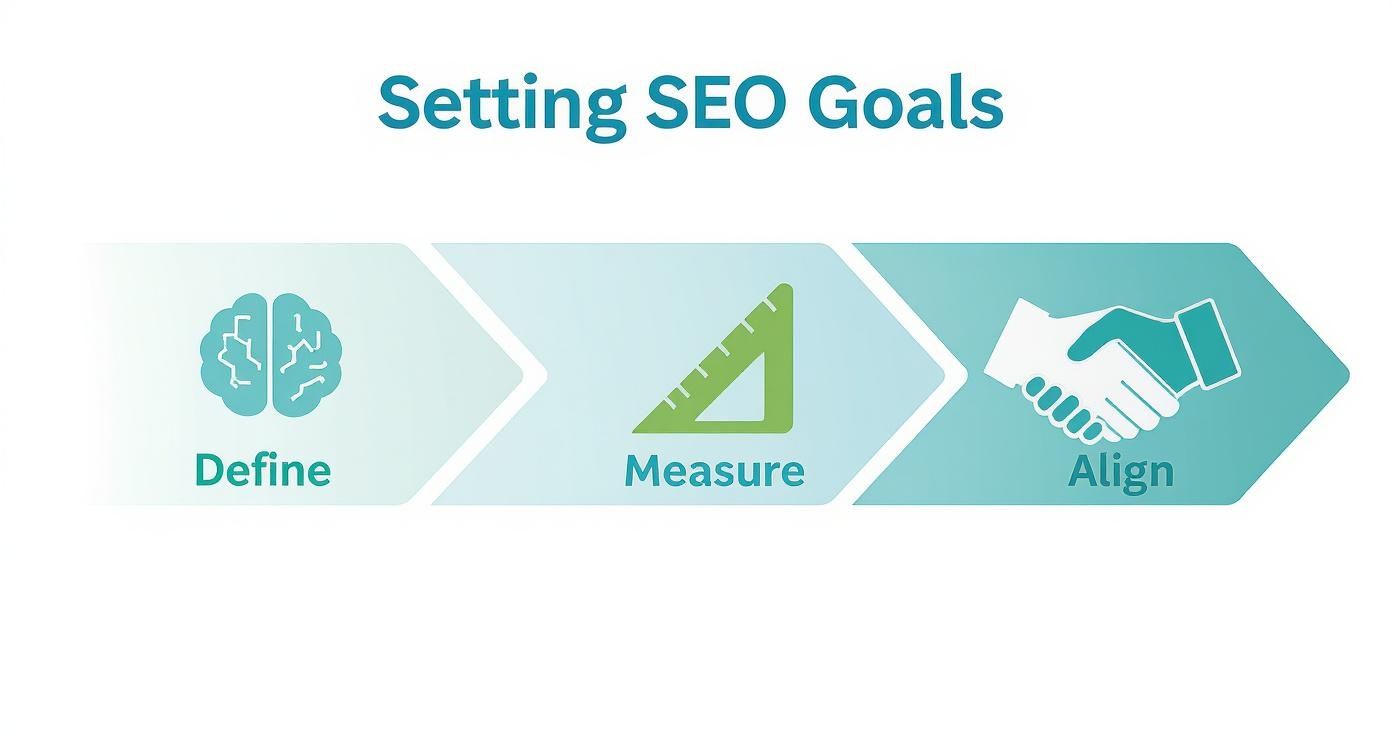
This visual shows the simple flow: define what you want, establish how you'll measure it, and align it all with your business objectives. Follow this path, and you'll ensure your SEO investment is directly tied to real results.
The Power of Data-Driven Goals
There's a good reason to get this specific. Organic search is an absolute powerhouse for growing a business in New Zealand.
It accounts for around 53% of all website traffic here, blowing the 15% from paid ads out of the water. For tradies and home services, a solid SEO strategy can deliver up to five times the return on investment compared to paid ads because it's so good at attracting valuable, ready-to-buy leads.
Having clear goals lets you track this return accurately and hold your agency accountable for the results they promised.
If you're struggling to nail down these objectives, working with a good digital marketing strategist can make a world of difference. They can help you refine your goals and build a plan where SEO fits perfectly into your bigger business strategy. Start with a clear picture of success, and you’ll be in a much stronger position to pick the right partner to get you there.
What to Look for in an Agency's SEO Services
Okay, you've got your goals sorted. Now it's time to dig into what a potential New Zealand SEO company actually does. Not all agencies are created equal, and their services can range from genuinely effective to downright useless. A real pro will have a solid strategy that covers the three essential parts of modern SEO.
Your website’s health is the absolute foundation of any campaign. The first thing you need to grill them on is their approach to on-page and technical SEO. This isn't just about sprinkling a few keywords onto your pages; it's about making your entire website better for both your customers and for Google.
This means they should be doing a deep dive into your site's structure, making sure it’s logical and dead easy for search engines to crawl and understand. They also need to be obsessed with site speed and making sure your site works perfectly on a mobile phone—these aren't nice-to-haves anymore, they're critical ranking factors.
A Strategy Built for the Kiwi Market
Here in New Zealand, one search engine is king. Google holds a staggering 91.3% market share, so any SEO strategy that isn't completely focused on what Google wants is a total waste of money. The agency you pick must have a deep, practical understanding of Google’s ecosystem and its relentless updates. You can see the latest numbers for yourself over on gs.statcounter.com.
A huge sign of a competent agency is how they handle keyword research. They shouldn't be chasing generic, pie-in-the-sky terms. They need to show you a proper plan for targeting keywords with strong local intent—the exact phrases your actual customers in New Zealand are typing into Google to find services like yours.
A key part of this should be a thorough look at what your competitors are doing. A good agency will show you how they analyse the competition to spot gaps in their strategies, giving you the blueprint to ethically steal competitors' keywords and get some quick wins.
Beyond Your Website Walls
What happens off your website is just as crucial as what happens on it. This is where off-page SEO, especially link building, enters the picture. But you need to tread carefully here, because dodgy, low-quality tactics can get you penalised and do more harm than good.
Ask a potential agency how they build backlinks. Their answer must be about quality, not quantity. You want to hear about strategies that involve:
- Creating genuinely useful content: Earning links because your blog posts, guides, or resources are so good that other sites naturally want to reference them.
- Local directory listings: Getting your business listed in reputable New Zealand business directories to build up your local authority.
- Digital PR: Building relationships with local news sites, bloggers, or industry websites to earn high-authority mentions and links.
Any agency worth its salt will be completely transparent about its link-building methods. If they get secretive, sound vague, or promise you hundreds of links overnight, run for the hills. Real authority is built through legitimate, high-quality endorsements from other trusted sites, not by using cheap tricks. This careful, strategic approach is what separates a professional New Zealand SEO company from the amateurs.
Evaluating Their Local SEO Expertise
For the vast majority of Kiwi service businesses, winning online means winning locally. It doesn’t matter if your website is seen by someone in another country; what matters is getting in front of customers in your city, your suburb, and your street.
This is why you have to get serious about vetting any potential New Zealand SEO company on their local expertise. A generic, one-size-fits-all SEO plan just won't cut it. You need a partner who lives and breathes the local market, understanding everything from regional search habits to the power of a "plumber near me" search typed into a smartphone.
Their entire strategy has to be laser-focused on your geographical service area.
Mastering Your Google Business Profile
Let’s be clear: your Google Business Profile (GBP) is probably the most powerful local marketing asset you have. It's that interactive snapshot that pops up in Google Maps and the coveted local "Map Pack" results. A top-tier agency won't just 'optimise' it; they'll have a detailed plan to turn it into a lead-generating machine.
This goes way beyond just plugging in your address and phone number. You need to ask them specifically about their game plan for:
- Review Management: How will they help you generate a steady stream of 5-star reviews? What’s their process for responding to every single one? Fresh, positive reviews are a massive trust signal for both customers and Google's algorithm.
- Google Posts and Q&A: What's their strategy for using Google Posts to showcase offers, highlight jobs, and keep your profile active? How will they manage the Q&A section to get ahead of customer questions?
- Service Area Optimisation: How do they define and optimise your service areas within the profile? This is crucial for making sure you show up in searches across all the key suburbs you serve, not just where your office is.
A well-managed Google Business Profile is completely non-negotiable for local visibility. It's your modern-day storefront. Any agency that treats it as an afterthought isn't the right partner for a Kiwi service business.
Building Local Authority Beyond Google
While your GBP is the main event, a solid local strategy also means building your presence across the wider local web. This is where local citations come in. Think of them as mentions of your business's name, address, and phone number (NAP) on other relevant websites.
A good agency will have a clear, systematic process for this. They should be focused on getting you listed in high-quality, relevant New Zealand directories like Finda and Yellow.co.nz, plus any directories specific to your trade. Consistency is everything—every mention of your business online must be identical.
This consistent digital footprint reinforces your location and legitimacy in Google's eyes, helping to cement your rankings.
Finally, this local focus has to extend to your website content itself. Ask to see examples of location-specific pages they’ve built for other clients. A sharp agency will create dedicated pages for each of your key services in your main service areas—think "Electrical Services in East Tamaki" or "Plumbing Repairs in Ponsonby."
This is how you capture customers with high local intent. To dive deeper, check out our guide on 7 essential local SEO strategies for small NZ businesses.
Essential Local SEO Vetting Checklist
Use this checklist when you're talking to a potential SEO partner. Their answers will tell you everything you need to know about their local SEO chops.
| Area of Expertise | Key Question to Ask | What a Good Answer Looks Like |
|---|---|---|
| Google Business Profile (GBP) | "Walk me through your process for optimising and managing a client's GBP from day one." | They should mention a full audit, optimising all sections (services, photos, Q&A), a strategy for ongoing Posts, and a system for generating and responding to reviews. |
| Local Citations | "What's your strategy for building local citations, and which NZ-specific directories do you focus on?" | They'll talk about cleaning up existing citations for consistency (NAP), and building new ones on quality Kiwi sites like Finda, Yellow, and industry-specific directories. They should stress quality over quantity. |
| On-Page Local SEO | "Can you show me examples of location-specific service pages you've created for other businesses?" | They should provide links to pages like "Service in Suburb" that are clearly written for both users and search engines, with local landmarks, testimonials, and schema markup mentioned. |
| Local Link Building | "How do you plan to earn local backlinks to prove to Google that we're a trusted local authority?" | They should mention strategies like sponsoring local sports teams, joining community groups, or getting featured in local news or business association websites. If they just say "guest posting," be wary. |
| Review Strategy | "What system or software do you use to help us consistently get more customer reviews?" | They should have a proven, non-aggressive system—often using simple software or email/SMS follow-ups—to prompt happy customers for feedback. They should never suggest buying reviews. |
If an agency can give confident, detailed answers to these questions, you're likely talking to a team that truly understands what it takes for a New Zealand service business to dominate its local market.
Analysing Case Studies and Proof of Results
Talk is cheap, especially in the marketing world. Any agency can put together a slick sales pitch, but a top-tier New Zealand SEO company will have a solid track record of delivering results you can actually measure. Your job is to look past the fancy graphs and dig into their proof of performance.
This means getting forensic with their case studies. Don't just glance at the numbers; ask for the full story. A good case study isn't just a highlight reel. It should clearly lay out the client's problem, the strategy the agency used to fix it, the hurdles they hit along the way, and—most importantly—the real business outcomes they delivered.

Looking for Relevant Success Stories
The only case studies that really matter are the ones from businesses like yours. If you're a plumber in Hamilton, a glowing report about a nationwide e-commerce store is pretty much useless to you.
You need to ask for results that are specific to your situation:
- Similar Industries: Have they actually ranked other tradies, professional services, or businesses in your specific field?
- Similar Locations: Can they prove they've helped a business dominate local search in a city like yours? Think Auckland vs. Tauranga—the competition is different.
- Similar Goals: Look for proof they’ve hit the KPIs you care about. That could be more phone calls, more booked jobs, or more qualified leads coming through your website form.
An agency with runs on the board in your niche already knows the unique challenges and what your customers are searching for. That kind of specialised knowledge is gold and can seriously speed up the time it takes to see a return on your investment.
Vetting an agency's past work is all about connecting their claims to real-world business growth. Focus entirely on outcomes that impact your bottom line—leads, calls, and sales—not superficial vanity metrics like traffic or impressions.
How to Verify Their Claims
It’s perfectly fine to be a bit sceptical. In fact, a confident agency will expect you to do your homework. While they might not be able to share a client's private data, there are still ways to verify their claims.
For example, you could ask to see an anonymised report from Google Analytics or Search Console showing the growth in organic traffic and conversions.
Even better, ask for client references. Nothing beats speaking directly to a current or former client—especially one in a similar trade. You'll get an unfiltered view of the agency's communication, their reporting, and whether they actually deliver on their promises. If they get cagey about providing references, that’s a massive red flag.
Understanding SEO Pricing Models and Contracts
Trying to make sense of SEO proposals and contracts can feel like you're reading another language. Before you sign on the dotted line, you absolutely have to get your head around the common pricing structures and the sneaky clauses that can trip you up. Getting this right from the start is a massive part of finding a transparent New Zealand SEO company that will actually partner with you, not just bill you.
Most agencies here in New Zealand use one of three main models. The most common is the monthly retainer, where you pay a set fee each month for a specific scope of ongoing work. This is the best fit for steady, long-term growth, because SEO is a marathon, not a sprint.
Another route is a project-based fee. This works well for one-off jobs with a clear start and finish, like a technical SEO audit to fix your website's foundation or a complex website migration. Lastly, some offer hourly consulting, which can be useful for a bit of specific advice or training but gets expensive fast if you're trying to run a full campaign.
Decoding the Different Pricing Models
Each pricing model has its place, depending on your business needs and what you’ve got budgeted. Knowing the pros and cons helps you pick the one that actually lines up with what you want to achieve.
Here’s a quick comparison of the three main models to help you see which might be the best fit.
SEO Pricing Models Comparison
| Pricing Model | Best For | Pros | Cons |
|---|---|---|---|
| Monthly Retainer | Businesses seeking sustained, long-term growth and consistent lead generation. | Allows for building momentum, consistent effort, and a holistic strategy. | Requires a longer-term commitment to see the best results. |
| Project-Based Fee | Businesses with a specific, one-off need like a website audit or a penalty recovery. | Cost is fixed and known upfront. Clear deliverables. | Not suitable for ongoing SEO which requires continuous work. |
| Hourly Consulting | Businesses needing expert advice on a specific issue or for team training. | High flexibility; pay only for what you need. | Can be the most expensive per-hour option. Difficult to budget. |
For most Kiwi service businesses that need a steady flow of leads to fill the calendar, a monthly retainer is almost always the most effective path forward—as long as the scope of work is crystal clear.
The right pricing model isn't about what's cheapest. It's about what aligns with your business goals. For most service businesses trying to generate leads consistently, a monthly retainer with a transparent scope of work is the way to go.
Critical Contract Clauses You Cannot Ignore
The fine print is where you can get stung. A good, trustworthy agency will have nothing to hide and should be more than happy to walk you through every single clause, explaining it in plain English.
Make sure you pay laser-focus attention to these three areas:
- Contract Length and Cancellation Terms: Watch out for agencies trying to lock you into an iron-clad, 12-month contract from day one. A confident agency will often offer a shorter initial term (say, three to six months) or a month-to-month agreement after that. The cancellation policy needs to be fair, clear, and give a reasonable notice period. No nasty surprises.
- Ownership of Work: This is a big one. The contract must state, without any ambiguity, that you own all the work they produce for you. This means any website changes, every blog post written, and all the accounts set up in your name (like Google Analytics). If you ever decide to part ways, you need to walk away with full control and ownership of these assets.
- Reporting and Communication: Vague promises of "monthly updates" just don't cut it. The agreement should spell out exactly how often you'll get performance reports and what format they'll be in. It should also outline the key metrics that will be tracked and the frequency of your meetings to discuss what’s working and what’s not.
For a deeper look into what separates the pros from the cowboys, check out our full breakdown of the top-rated SEO companies in New Zealand.
And just as a final point, when you're exploring how an agency manages costs, it’s worth being aware of things like SEO group buys. While not always a red flag, understanding the risks associated with these practices can sometimes give you an insight into an agency's ethics and approach to their work.
Common Questions About Choosing an SEO Partner
Investing in SEO is a big step, so it’s completely normal to have questions before you jump in. We get asked the same things by Kiwi business owners all the time—they’re keen to work with a New Zealand SEO company but just need a few things cleared up first.
Let's get into some of the most common queries we hear.
One of the first questions out of the gate is always, "How long until I see results?" It's a fair question, but the honest answer is, it's not an overnight fix. SEO is a long game.
You can typically expect to see some positive movement in your rankings and website traffic within three to six months. But for the big, valuable results—like consistent leads from competitive search terms—you’re usually looking at closer to six to twelve months. Things like how competitive your industry is, what your competition is doing online, and the state of your website right now all have a big say in the timeline.
SEO vs Google Ads What Is the Difference
Another thing that often trips people up is the difference between SEO and Google Ads. The easiest way to think about it is buying versus renting a house.
SEO is like buying your house. You're building a valuable, long-term asset. It takes time and consistent effort, but once you earn those top rankings, the organic traffic is essentially "free." Your authority grows and pays dividends for years to come.
Google Ads, on the other hand, is like renting. You get instant visibility right at the top of the search results—you can literally turn the traffic on and off like a tap. The catch? You pay for every single click. The moment you stop paying, your ads vanish, and so does your visibility.
For a lot of businesses, the sweet spot is using both. Google Ads gets the phone ringing right away, while SEO builds sustainable, long-term growth in the background.
A common misconception is that SEO is a "set and forget" service. In reality, it's a collaborative partnership. Your involvement is crucial for success, especially when it comes to content and performance reviews.
Your Role in the SEO Process
A good agency doesn't just take your money and disappear for a month. They need your brain. Your industry expertise is the secret sauce for creating content that actually connects with your ideal customers.
Here’s where you’ll need to be involved:
- Content Approval: You’ll get to review things like blog posts and new service pages. This is your chance to make sure everything is technically accurate and, just as importantly, sounds like you.
- Performance Reviews: We’ll have regular catch-ups (usually monthly) to go over what’s working, what isn’t, and make sure the SEO strategy is still lined up with what’s happening in your business.
- Sharing Customer Insights: You know your customers better than anyone. Telling your SEO partner about the common questions you get from clients is pure gold for creating killer content.
Competing with Bigger Companies
This is a big one. Can a small local business really go toe-to-toe with the big national brands and their massive marketing budgets?
Absolutely, yes. Especially when it comes to local search.
You might not outrank a corporate giant for a broad keyword like "plumbers NZ," but you can absolutely own the search results in your local area. By zeroing in on specific, local phrases (think "emergency plumber Papakura"), getting your Google Business Profile humming, and building a stellar local reputation, you can carve out a very profitable space for yourself.
A sharp New Zealand SEO company will see your local knowledge and agility as a massive advantage, not a weakness.
Ready to turn your website into a lead-generating machine? At Four Stripes, we help Kiwi service businesses get found and get calls. Our proven First Page, First Call system combines smart SEO with conversion-focused web design to deliver a steady stream of qualified enquiries. Find out how we can help your business at https://fourstripes.co.nz.